
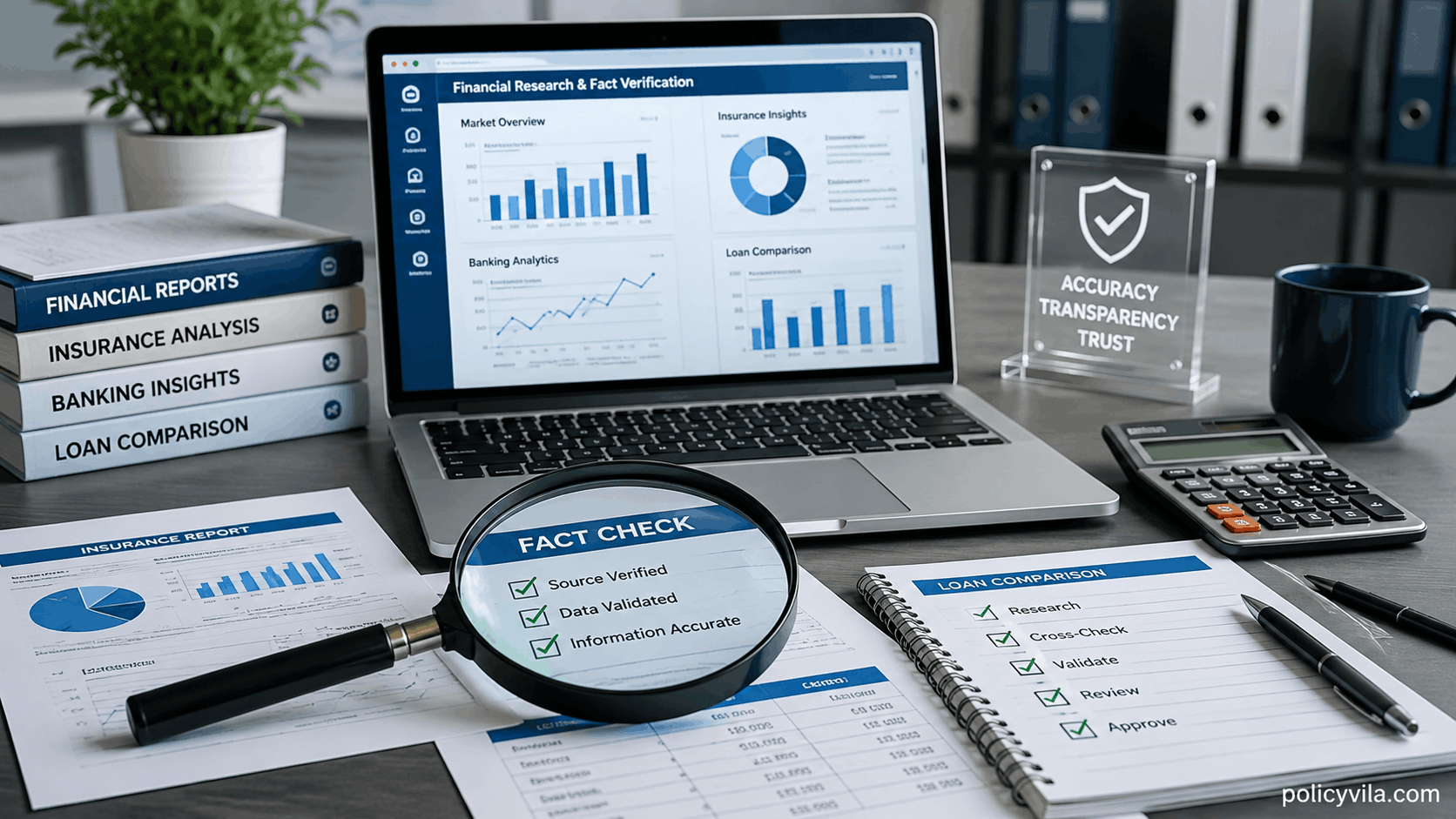
Why Fact-Checking Matters for Financial Content
Readers use financial education content to make real decisions — comparing loan offers, understanding what an insurance policy actually covers, figuring out how credit scores work, or learning basic investing concepts. Inaccurate or outdated information in any of these areas isn’t a minor inconvenience; it can lead someone toward a worse decision than they’d otherwise make.
| Topic Area | What’s at Stake if Information Is Wrong |
|---|---|
| Financial planning | Budgets or savings plans built on outdated assumptions |
| Insurance | Misunderstanding what a policy actually covers or excludes |
| Loans | Comparing lenders or rates using stale figures |
| Credit | Following advice that no longer matches current scoring models or reporting practices |
| Investing | Misunderstanding basic concepts that inform bigger financial choices later |
That’s the practical reason fact-checking isn’t treated as an optional extra step — it’s built into how content gets published in the first place.
How We Verify Information Before Publishing
Articles go through a structured process before they go live:
- Topic research — reviewing publicly available information, industry resources, and authoritative references related to the subject.
- Source checking — comparing claims against credible sources where possible, prioritizing organizations with established authority on the topic.
- Data validation — when we reference statistics, rates, or figures, we make a reasonable effort to confirm them against a reliable source rather than repeating a number we can’t trace back.
- Cross-referencing — significant claims are checked against more than one source where appropriate, rather than relying on a single reference.
- Editorial review — content is reviewed for factual consistency, clarity, and whether it actually holds up before publication.
This process reduces errors, but it doesn’t eliminate them entirely — see the limitations section below for what that means for readers.
The Kinds of Sources We Rely On
Where available, we prioritize:
- Government agencies and regulators
- Public financial institutions
- Insurance providers’ official documentation
- Publicly available industry reports and research
- Consumer protection resources
Source selection is based on reliability and relevance to the specific claim being made — not every source is treated as equally authoritative on every topic. Even so, readers should independently verify anything critical to a financial decision directly with the relevant institution, provider, or a qualified professional, since our content is educational rather than a substitute for official documentation.
Corrections
When a factual error is identified — whether through reader feedback, an internal review, or a source being updated — we review it, confirm what’s actually correct, and update the content. Corrections can come from several directions: a reader flags something, an editorial review catches an inconsistency, or a source we relied on changes. We aim to address verified errors as promptly as reasonably possible rather than letting them sit.
If you spot something that looks outdated or incorrect, telling us specifically what and where you found it is the fastest way to get it fixed — see the contact details below.
Ongoing Content Review
Financial information doesn’t stay static — regulations change, interest rates move, insurance products get updated, and lending markets shift. We periodically revisit existing articles and update them when something has changed enough to matter. This isn’t a fixed schedule applied uniformly across every article; it’s a practice of catching content that’s become outdated and fixing it when we identify it.
Use of Technology-Assisted Tools
Research, drafting, and editing may involve technology-assisted tools at various points. Regardless of what tools are used in the process, all published content goes through human editorial review before it appears on the site — responsibility for accuracy stays with our editorial process, not with any tool used along the way.
Limitations Worth Understanding
Fact-checking reduces errors, but it can’t guarantee that every article stays accurate indefinitely. Financial products, rates, regulations, and institutional offerings change — sometimes quickly — and a claim that was accurate at publication can become outdated without us catching it immediately. For anything with real financial stakes, verify current details directly with the relevant institution, provider, or a licensed professional rather than relying solely on what’s published here.
Our Approach to Trust
We’re not a licensed financial, insurance, or investment authority, and we don’t claim specialized professional credentials. What we’re accountable for is the process described on this page: checking claims against credible sources, reviewing content before publication, and correcting errors when they’re found. That’s the basis on which we’re asking readers to trust this site — a consistent process, not an unearned claim of expertise.
Reporting an Issue
We welcome reports of factual inaccuracies, outdated information, broken links, or anything that needs clarification. Specific feedback — which article, which claim, what you believe is correct — helps us verify and fix issues faster than general comments.
Contact Us
To report an inaccuracy or ask a question about this policy, email policyvila12@gmail.com. We aim to respond within a reasonable timeframe.