
cheapest cars to insure for new drivers: A first car can look affordable on a dealership window or used-car listing and still become expensive once the monthly bills begin.
Imagine a new driver comparing two used vehicles. One costs $9,000. The other costs $11,500. At first glance, the $9,000 car appears to be the obvious financial choice.
Then the insurance quotes arrive.
The less expensive vehicle may not produce the lower insurance quote. And even if it does, an older vehicle could introduce higher maintenance or repair uncertainty.
That is why choosing a first car should involve more than comparing purchase prices.
The cheapest car to insure for a new driver is not necessarily the cheapest car to own.
Insurance pricing depends on much more than the vehicle itself. According to the National Association of Insurance Commissioners (NAIC), insurers can consider factors including location, age, driving experience, driving record, claims history, vehicle type, vehicle use, mileage, selected coverages and deductibles.
This means there is no single vehicle that will be the cheapest to insure for every new driver in every U.S. ZIP code.
Instead, the smarter approach is to identify vehicles worth quoting, compare identical coverage, and evaluate the entire financial footprint of the car. cheapest cars to insure for new drivers
Quick Answer: Which Cars May Be Worth Comparing?
New drivers looking for potentially affordable insurance should start by investigating practical, mainstream vehicles rather than assuming a particular model is universally cheapest.
Examples worth getting quotes on can include vehicles such as:
- Honda Civic
- Toyota Corolla
- Hyundai Elantra
- Nissan Sentra
- Mazda3
- Kia K4
- Toyota Prius
- Honda Accord
- Toyota Camry
- Honda HR-V
- Hyundai Kona
- Mazda CX-30
- Mazda CX-5
- Subaru Forester
- Subaru Crosstrek
These vehicles are not presented as guaranteed cheapest-to-insure choices. They are examples of mainstream vehicles that can be useful candidates for comparison.
Safety is another useful screening factor. For example, the Insurance Institute for Highway Safety’s 2026 awards include models such as the Honda Civic, Hyundai Elantra, Kia K4, Mazda3, Nissan Sentra, Toyota Prius, Honda HR-V, Hyundai Kona, Mazda CX-30, Mazda CX-5 and Subaru Forester among its current Top Safety Pick or Top Safety Pick+ winners.
A strong safety rating does not guarantee a lower insurance premium. It is simply another useful variable to consider alongside insurance quotes, purchase price and ownership costs.
The First-Car Cost Stack
The first mistake many new drivers make is treating insurance as a separate expense from the car.
It isn’t.
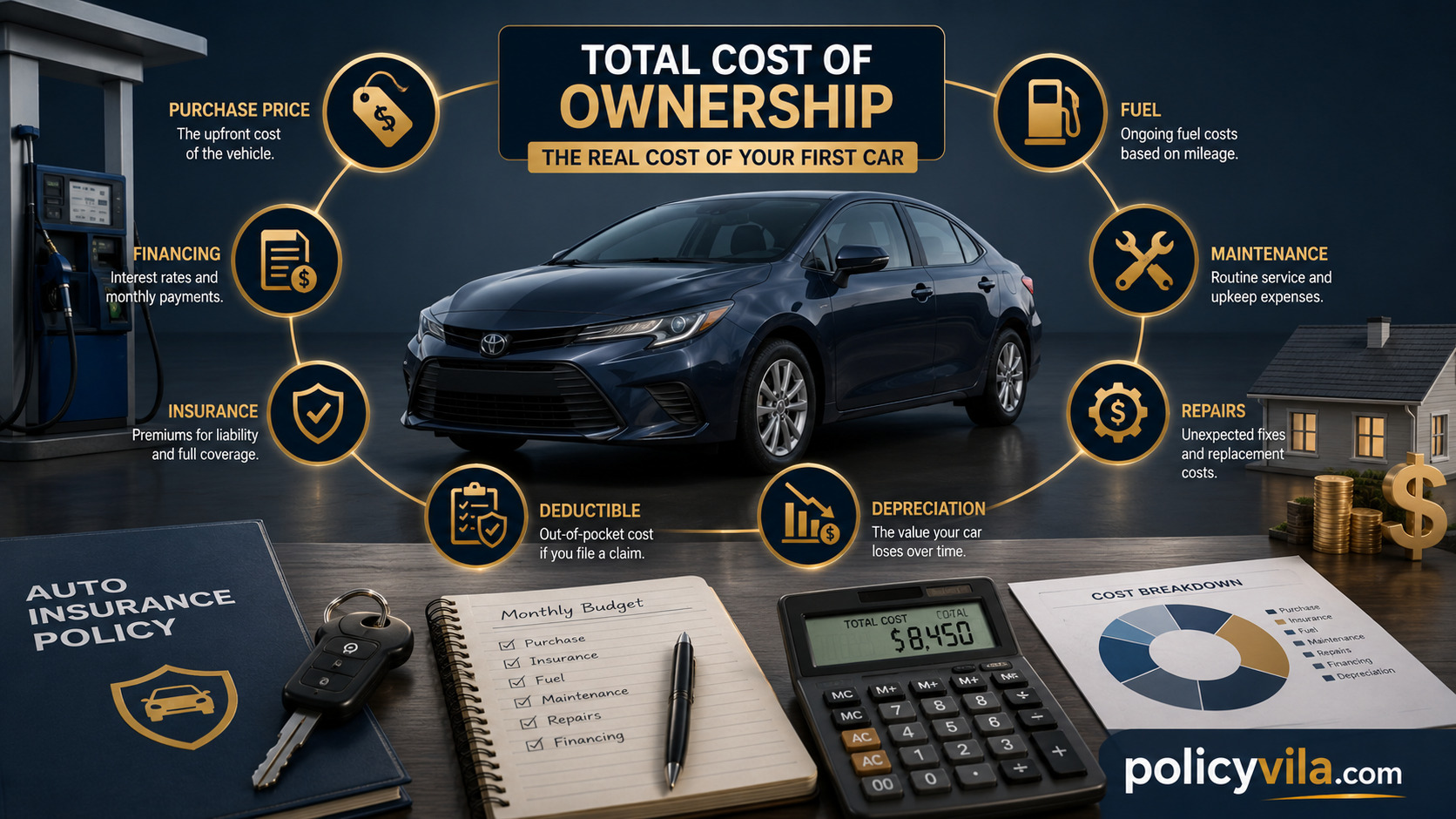
The financial impact of a vehicle is better understood as a stack:
Purchase → Financing → Insurance → Deductible Exposure → Fuel → Maintenance → Repairs → Depreciation
| Cost Layer | Question to Ask |
|---|---|
| Purchase | Can I afford the vehicle? |
| Financing | What will the payment actually cost? |
| Insurance | What will the required coverage cost? |
| Deductible | Could I afford a claim tomorrow? |
| Fuel | How much will driving cost each month? |
| Maintenance | What routine expenses should I expect? |
| Repairs | What happens if something unexpectedly fails? |
| Depreciation | How much value could the vehicle lose? |
This is why a car with a slightly higher purchase price can sometimes make more financial sense than a cheaper vehicle.
The correct comparison is not simply: cheapest cars to insure for new drivers
Car A = $10,000
versus
Car B = $13,000
It is:
Which vehicle creates the more manageable total financial burden?

The Insurance-to-Car Ratio
One useful budgeting concept for comparing vehicles is an Insurance-to-Car Ratio.
For this article, define it as:
Annual Insurance Cost ÷ Vehicle Purchase Price
This is an editorial budgeting metric—not an official insurance-industry formula and not a predictor of future premiums.
Consider a hypothetical example.
Vehicle A
- Purchase price: $10,000
- Illustrative annual insurance: $2,000
- Insurance-to-car ratio: 20%
Vehicle B
- Purchase price: $15,000
- Illustrative annual insurance: $1,500
- Insurance-to-car ratio: 10%
The $15,000 vehicle costs more to purchase, but the hypothetical insurance burden is lower relative to its purchase price.
That doesn’t make Vehicle B automatically better.
It simply demonstrates why looking at one number can produce the wrong conclusion.
The actual insurance quote should always come from the insurer using the driver’s information, exact vehicle and selected coverage.
The New Driver Risk Stack
Insurance decisions involve two broad groups of variables.
Driver Risk
These can include:
- Age
- Driving experience
- Driving history
- Claims history
- Location
- Previous insurance history
- Mileage and vehicle use
Vehicle Risk
Vehicle-related considerations can include:
- Vehicle type
- Vehicle value
- Repair costs
- Theft exposure
- Performance characteristics
- Safety characteristics
- Vehicle use
- Claims associated with the vehicle
NAIC specifically lists both personal and vehicle-related factors among the considerations that can affect auto insurance pricing.
The important lesson is simple:
The same vehicle can produce very different insurance outcomes for different drivers.
A Vehicle Risk Matrix for First-Car Shoppers
| Vehicle Characteristic | Potential Insurance Consideration | Financial Question |
|---|---|---|
| High vehicle value | Greater exposure in a total loss or covered damage | Can I afford the overall coverage? |
| High performance | May represent a different risk profile | Is it appropriate for my budget and experience? |
| Expensive repairs | Potentially higher claim costs | Are parts and repairs affordable? |
| Theft exposure | Can affect comprehensive risk | What does the actual quote show? |
| Strong safety equipment | May improve the vehicle’s safety profile | Does my insurer offer any applicable discount? |
| Widely available parts | May make repairs more practical | Are replacement parts easy to source? |
| High mileage | Can increase maintenance uncertainty | What repairs might be approaching? |
None of these factors should be treated as a guaranteed premium predictor.
They are screening questions. cheapest cars to insure for new drivers
Cars Worth Quoting Before You Buy
Instead of declaring one vehicle the winner, new drivers can divide potential vehicles into practical comparison groups.
Tier A: Mainstream First-Car Candidates
Vehicles such as the:
- Toyota Corolla
- Honda Civic
- Hyundai Elantra
- Nissan Sentra
- Mazda3
are reasonable examples to investigate because they occupy mainstream compact-car segments.
The advantage of starting with this category is that the buyer can compare practical transportation against higher-performance alternatives.
The actual insurance quote remains the deciding evidence.
Tier B: Midsize Cars Worth Comparing
Examples include:
- Toyota Camry
- Honda Accord
- Hyundai Sonata
These vehicles may appeal to drivers who want additional interior space without immediately moving into a larger SUV.
Safety can also be part of the comparison. IIHS lists the 2026 Toyota Camry and Hyundai Sonata as Top Safety Pick+ winners and the 2026 Honda Accord as a Top Safety Pick.
Again, safety recognition should not be confused with an insurance-price guarantee.
Tier C: Small SUVs and Crossovers
New drivers who need additional cargo space might investigate:
- Honda HR-V
- Hyundai Kona
- Mazda CX-30
- Mazda CX-5
- Subaru Forester
IIHS’s 2026 safety awards include several of these models among its Top Safety Pick+ selections.
However, moving from a sedan to an SUV can change purchase price, repair exposure, fuel costs and insurance pricing.
The vehicle should therefore be quoted rather than assumed to be cheaper.
Tier D: Vehicles That Deserve Extra Insurance Research
Some vehicles may look attractive because of styling or performance but deserve a more careful financial review.
Examples include:
- Sports cars
- High-output vehicles
- Performance trims
- Modified vehicles
- Luxury vehicles
- High-value vehicles
NAIC notes that make and model can matter to insurance pricing and specifically notes that luxury and sports cars average higher claim frequency in its consumer auto-insurance information.
That does not mean every sports or luxury vehicle is expensive to insure.
It means a new driver should get the quote before buying. cheapest cars to insure for new drivers
Same Driver, Different Car
Consider a fictional 20-year-old new driver living in the same ZIP code.
The driver requests identical coverage for four vehicles:
- Mainstream compact sedan
- Compact SUV
- Performance-oriented vehicle
- Luxury vehicle
The driver, location, coverage and deductible stay constant.
Only the vehicle changes.
The resulting quotes could be different because insurers evaluate vehicle characteristics and expected claim costs.
The lesson is more important than the numbers:
Never assume the insurance cost of one vehicle based on the insurance cost of another vehicle.
Get the actual quotes.
Same Car, Different Driver
Now reverse the experiment.
Three drivers consider the same vehicle.
Driver A
18 years old with very limited driving experience.
Driver B
25 years old and newly licensed.
Driver C
30 years old and newly licensed.
Even though the vehicle is identical, the insurance situation can differ because age and driving experience can influence rating.
NAIC lists age and driving experience among common auto-insurance rating factors.
This is why an article claiming that one car is “the cheapest car to insure for new drivers” should always be treated cautiously.
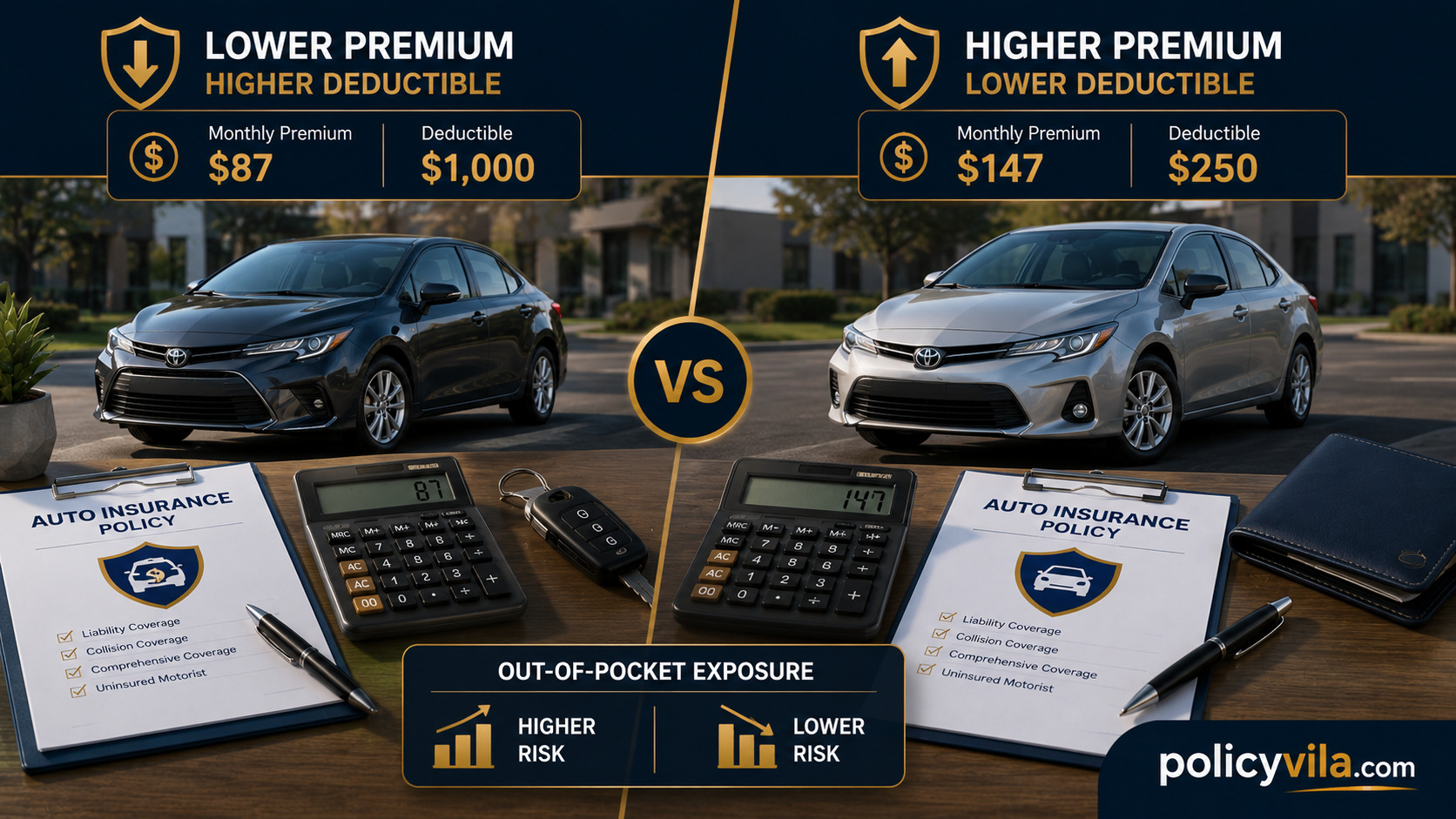
Premium vs. Deductible: The Hidden Second Price
A lower premium isn’t automatically a better financial deal.
Suppose two hypothetical policies provide otherwise comparable coverage.
Policy A
- Lower deductible
- Higher premium
Policy B
- Higher deductible
- Lower premium
The second policy could reduce regular expenses but increase the amount the driver must pay out of pocket after a covered claim.
NAIC explains that accepting more risk, including choosing a higher deductible, can reduce premiums.
This creates an important question.
The Claim Liquidity Test
Ask:
If a covered claim happened tomorrow, could I comfortably pay the deductible without using money needed for rent, tuition, food or other essential expenses?
If the answer is no, the lower premium may come with a level of financial exposure the driver cannot comfortably absorb.
Emergency Savings Changes the Decision
Consider three fictional drivers.
Driver With $300 Saved
A large deductible could create an immediate cash-flow problem after a covered claim.
Driver With $2,000 Saved
The driver has more flexibility, although the deductible still needs to fit the overall budget.
Driver With $8,000 Saved
The driver may have substantially more capacity to handle an unexpected expense.
These examples do not establish a correct deductible for any person.
They demonstrate why insurance decisions should be considered alongside emergency savings.
The Cheap-Car Trap
A low purchase price can be attractive to a new driver.
But a cheap vehicle can potentially become expensive because of:
- Frequent repairs
- Poor fuel economy
- Tires
- Brakes
- Aging components
- Insurance
- Financing costs
- Unexpected mechanical problems
A $7,000 vehicle that requires repeated repairs can become less attractive than a $10,000 vehicle with better maintenance history.
This is why:
Cheap to buy ≠ cheap to own.
The New Driver Performance Trap
Performance vehicles can be appealing.
They may offer:
- Faster acceleration
- More powerful engines
- Sportier handling
- Premium styling
But the financial equation can change.
A new driver should investigate:
- Insurance quote
- Vehicle value
- Repair costs
- Tire costs
- Fuel consumption
- Maintenance
- Financing
- Safety
- Emergency-fund requirements
The question isn’t whether performance cars are “bad.”
The question is whether the entire financial footprint makes sense.
What About Modified Cars?
Modifications can complicate the insurance conversation.
Examples include:
- Engine modifications
- Performance tuning
- Suspension changes
- Aftermarket wheels
- Exhaust systems
- Cosmetic modifications
Drivers should understand their policy requirements and disclose modifications when required.
Never assume an aftermarket modification is automatically covered.
Why ZIP Code Can Change the Answer
A vehicle can have different insurance pricing in different locations.
NAIC identifies factors such as location, traffic density, vehicle theft rates, weather, accident rates and repair costs among the factors contributing to differences in auto-insurance expenditures and premiums.
That means a national article cannot accurately promise:
“This is the cheapest car to insure everywhere.”
Two drivers can own the same vehicle and receive different quotes.
Location is one reason.
Driver characteristics are another.
Coverage choices are another. cheapest cars to insure for new drivers
Coverage Matters as Much as the Vehicle Comparison
When comparing cars, understand what you are actually comparing.
Liability Coverage
Helps cover covered damages or injuries you are legally responsible for, subject to policy limits and applicable law.
Collision Coverage
Generally addresses covered damage to your vehicle resulting from a collision, subject to the policy deductible.
Comprehensive Coverage
Generally addresses certain covered non-collision losses, such as specified theft, weather or other covered events.
Uninsured/Underinsured Motorist Coverage
Can provide protection in situations involving drivers who lack adequate insurance, depending on state law and policy terms.
Medical-Related Coverage
Depending on the state and policy, medical-related coverages can address certain injury expenses.
State requirements differ, so drivers should review their state’s rules and actual policy documents.
Why Financing Can Change the First-Car Decision
A financed vehicle may create different insurance requirements than an older vehicle owned outright.
A lender may require comprehensive and collision coverage to protect its financial interest in the vehicle.
That means the driver cannot necessarily compare:
cheap liability-only insurance
with
full coverage on a financed vehicle
and call one vehicle cheaper to insure.
The comparison needs to use equivalent coverage.
The Quote-Before-Purchase Experiment
Imagine three hypothetical vehicles.
| Cost Category | Vehicle A | Vehicle B | Vehicle C |
|---|---|---|---|
| Purchase Price | $9,000 | $12,000 | $15,000 |
| Illustrative Annual Insurance | $2,100 | $1,700 | $1,500 |
| Illustrative Fuel Cost | $1,800 | $1,500 | $1,300 |
| Maintenance Reserve | $1,000 | $800 | $700 |
| Deductible | $1,000 | $1,000 | $500 |
All figures above are hypothetical and are not insurance quotes.
Vehicle C costs the most to purchase but has the lowest illustrative annual insurance and fuel assumptions.
Vehicle A costs the least upfront but carries higher hypothetical recurring costs.
The exercise doesn’t prove that Vehicle C is better.
It demonstrates why purchase price alone isn’t enough.
The 36-Month Ownership Model
For a deeper comparison, estimate the first three years.
Consider:
Purchase/financing + insurance + fuel + maintenance + repairs + depreciation
Do not assume repairs will follow a predictable schedule.
Instead, create a reasonable reserve and test different scenarios.
Scenario 1 — Normal Ownership
Routine maintenance only.
Scenario 2 — Moderate Repair Year
One significant unexpected repair.
Scenario 3 — Major Loss
A covered accident creates deductible exposure and potentially changes the vehicle’s value.
The purpose is not to predict the future.
It is to see whether the budget can withstand uncertainty. cheapest cars to insure for new drivers
The First-Car Decision Scorecard
PolicyVila’s editorial framework can use a 100-point model:
| Category | Weight |
|---|---|
| Insurance affordability | 25 |
| Purchase affordability | 20 |
| Reliability & maintenance | 15 |
| Safety | 15 |
| Fuel economy | 10 |
| Repair exposure | 10 |
| Resale/depreciation | 5 |
| Total | 100 |
This is an educational decision framework, not an official automotive or insurance rating.
A vehicle that scores well on insurance but poorly on reliability may not be the strongest overall choice.
Likewise, a vehicle with excellent safety characteristics but an unaffordable purchase price may not fit a student’s budget.
The goal is balance.
A Better Definition of the “Best” First Car
The best first car can differ depending on the buyer.
Student With Limited Savings
May place greater importance on predictable monthly costs and manageable repair exposure.
Young Worker With Stable Income
May have greater flexibility in purchase price but still need to control insurance and maintenance.
Long-Distance Commuter
May place more importance on fuel consumption, reliability and mileage.
Parent Helping a Teen Driver
May prioritize safety, insurance costs and predictable ownership expenses.
Independent Used-Car Buyer
May need to pay especially close attention to vehicle history, inspection and repair reserves.
There is no universal winner.
There is only a better financial fit for a particular situation. cheapest cars to insure for new drivers
The 24-Hour First-Car Insurance Test
Before purchasing a vehicle, use this process.
Step 1: Identify the Exact Vehicle
Use the exact year, make, model, trim and VIN when available.
Step 2: Request an Insurance Quote
Get the actual quote before committing to the purchase.
Step 3: Keep Coverage Identical
Use the same liability limits and comparable coverage when comparing vehicles.
Step 4: Compare Deductibles
Check both premium and out-of-pocket exposure.
Step 5: Review Vehicle History
Look for accident, ownership and maintenance information.
Step 6: Check Safety Information
Use credible safety-testing sources.
IIHS provides current vehicle ratings and explains that its evaluations cover crashworthiness and crash avoidance/mitigation.
Step 7: Estimate Fuel
Consider expected annual mileage.
Step 8: Estimate Maintenance
Budget for routine service and wear items.
Step 9: Calculate the Monthly Ownership Burden
Don’t look only at the loan payment.
Step 10: Sleep on the Decision
If the numbers only work under perfect circumstances, the vehicle may not be financially comfortable.
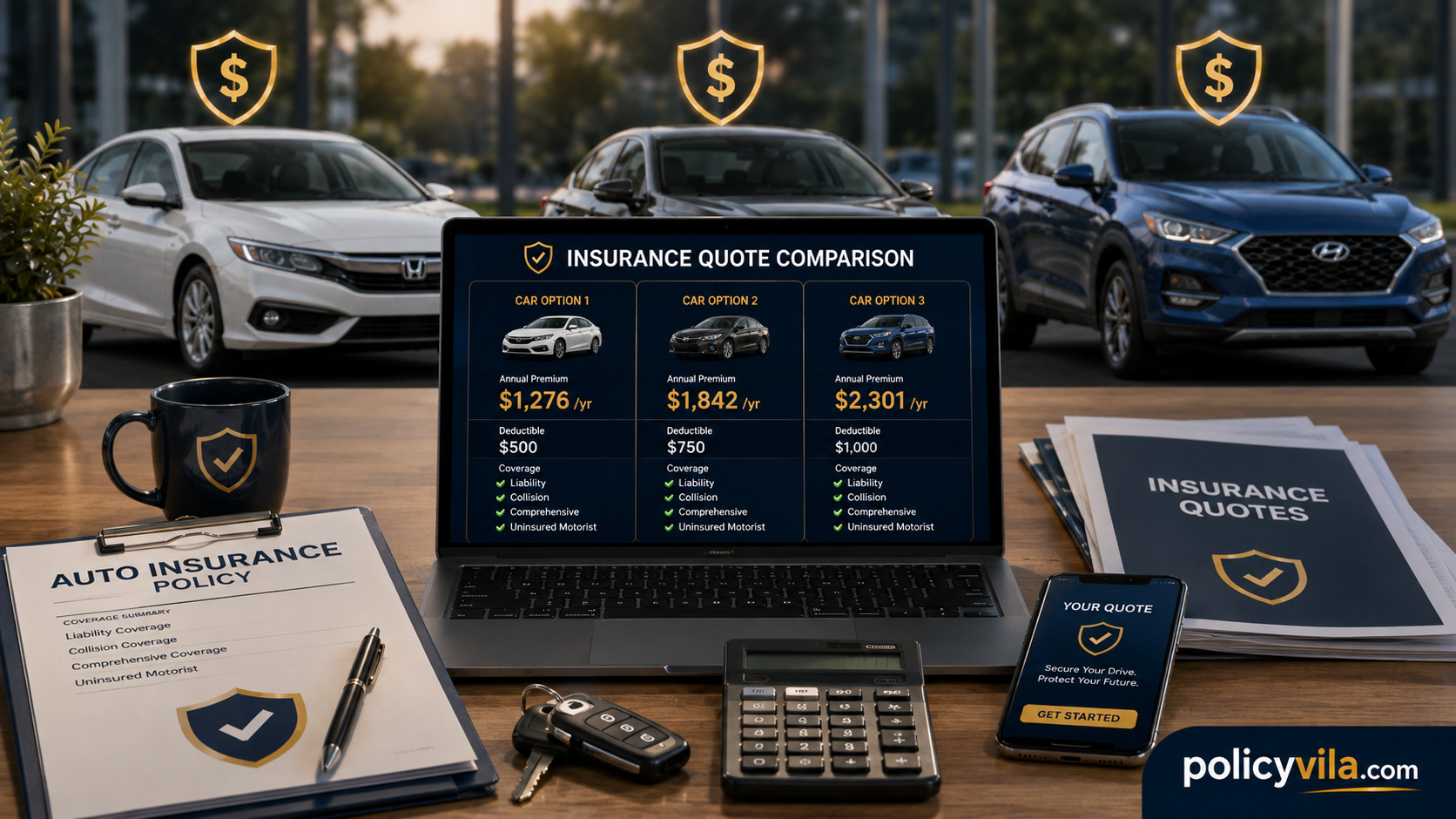
The Quote Comparison Rule
Never compare insurance quotes that provide substantially different protection.
For example:
$100/month liability-only
versus
$170/month full coverage
doesn’t tell you which vehicle is cheaper to insure.
For a meaningful comparison, keep the following consistent:
- Driver information
- Liability limits
- Comprehensive coverage
- Collision coverage
- Deductibles
- Vehicle usage
- Mileage assumptions
Then compare the actual premiums.
Case Study: Jordan’s First Car
Jordan is 19 years old and has:
- $12,000 available for a vehicle
- $2,000 in emergency savings
- Limited driving history
Jordan considers three vehicles:
Vehicle A
Lower purchase price but older.
Vehicle B
Moderate price with mainstream features.
Vehicle C
Higher price with stronger technology and newer equipment.
Instead of immediately selecting Vehicle B because it appears to be the “middle option,” Jordan could score each vehicle using:
- Insurance
- Purchase cost
- Safety
- Reliability
- Fuel
- Repair exposure
- Emergency-fund impact
The correct answer depends on the actual quotes and condition of each vehicle. cheapest cars to insure for new drivers
Five Things Cheap-Car Lists Usually Get Wrong
1. Cheapest Purchase Price Doesn’t Mean Cheapest Ownership
Insurance, fuel, repairs and depreciation matter.
2. Rankings Aren’t Universal
Location and driver characteristics can change insurance pricing.
3. Driver Profile Matters
A vehicle doesn’t exist independently from the person driving it.
4. Coverage Can Distort Comparisons
Different deductibles and coverage limits can make two quotes incomparable.
5. Deductible Risk Gets Ignored
A lower premium can come with greater out-of-pocket exposure.
Myths vs. Reality
| Myth | Reality |
|---|---|
| The smallest car always has the cheapest insurance. | Vehicle characteristics and driver factors both matter. |
| Older cars automatically cost less to insure. | Vehicle age alone doesn’t determine pricing. |
| A cheap purchase price means cheap ownership. | Repairs, fuel and insurance can change the equation. |
| One national ranking works for everyone. | Location and individual rating factors vary. |
| A higher deductible is always better. | It reduces premium in some circumstances but increases claim exposure. |
| Safety awards guarantee lower insurance. | Safety is only one consideration in pricing. |
| Sports cars are always unaffordable to insure. | Actual rates vary by vehicle, driver, location and insurer. |
| Liability-only is always the smartest choice. | Lower premiums can mean greater financial exposure. |
| SUVs automatically cost more to insure. | Vehicle-specific and driver-specific factors matter. |
| Shopping for insurance after buying is fine. | Getting quotes before purchase can prevent surprises. |
Frequently Asked Questions
What are the cheapest cars to insure for new drivers?
There is no universally cheapest vehicle. Practical mainstream cars such as the Toyota Corolla, Honda Civic, Hyundai Elantra, Nissan Sentra and Mazda3 can be reasonable vehicles to quote, but the actual premium depends on the driver, location, coverage and insurer.
Is a used car cheaper to insure than a new car?
Not necessarily. Vehicle value, claims experience, repair costs, coverage and other factors can influence the premium. A used vehicle can also have greater maintenance uncertainty.
Are sedans cheaper to insure than SUVs?
Not automatically. Insurance pricing is vehicle-specific, so a particular sedan may be cheaper or more expensive to insure than a particular SUV.
Should a new driver choose a $500 or $1,000 deductible?
Neither is universally correct. The decision should consider the premium difference and whether the driver could comfortably pay the deductible after a covered claim.
Does a car’s safety rating affect insurance?
Safety characteristics can be relevant to risk, but a strong safety rating does not guarantee a lower premium. Insurers use their own rating systems.
Does ZIP code affect car insurance?
Yes. NAIC identifies geographic territory and location among factors that can influence auto-insurance pricing.
Can two new drivers get different prices for the same car?
Yes. Age, driving experience, location, driving record, claims history and other rating factors can differ.
Should I get insurance quotes before buying a car?
Yes. Obtaining quotes before purchase can reveal whether a vehicle fits the intended budget.
Are older cars always cheaper to insure?
No. Age is only one factor. The actual vehicle, coverage, location and driver characteristics all matter.
Are sports cars bad choices for new drivers?
Not necessarily, but they deserve careful financial analysis because performance, vehicle value and claim characteristics may affect the insurance and ownership equation.
Do modifications affect insurance?
They can. Drivers should understand their insurer’s requirements and disclose modifications when required.
Is liability-only insurance cheaper?
It can reduce premiums compared with broader coverage, but it also provides less protection for the driver’s own vehicle in situations not covered by liability insurance.
Does a financed car need full coverage?
Lenders commonly require certain physical-damage coverage on financed vehicles, but requirements vary by lender and contract. Check the financing agreement.
Does a lower insurance premium always mean a better deal?
No. A lower premium may involve higher deductibles, narrower coverage or greater financial exposure.
What should new drivers compare besides insurance?
Compare purchase price, financing, fuel, maintenance, repairs, depreciation, deductible exposure and safety.
Final Takeaway
The search for the cheapest cars to insure for new drivers can easily turn into a hunt for one supposedly perfect model.
That is the wrong objective.
Insurance pricing is influenced by a combination of driver characteristics, location, vehicle characteristics, coverage and deductibles. NAIC’s consumer guidance specifically identifies factors such as driving record, geographic territory, age, prior insurance coverage, vehicle use and make/model as relevant considerations.
A smarter first-car decision starts before the purchase.
Get the insurance quote.
Compare equivalent coverage.
Check the deductible.
Review safety information.
Estimate fuel and maintenance.
Consider repair risk.
Then look at the total monthly and annual ownership burden.
The cheapest cars to insure for new drivers is only one piece of the first-car decision.
The stronger financial comparison is:
Purchase price + insurance + deductible exposure + fuel + maintenance + repairs + financing + depreciation.
The right first vehicle isn’t necessarily the one with the lowest advertised insurance estimate.