
renters insurance for college students: Moving into a college apartment can feel like a fresh start. New furniture, a laptop for classes, a phone, textbooks, clothes, headphones, perhaps a bicycle or gaming console—all gradually turn an empty room into a personal space.
But there is a financial question many students never ask until something goes wrong:
If those belongings were stolen, damaged or destroyed, who would actually pay to replace them?
A landlord’s insurance policy generally serves a different purpose from a renter’s personal property protection. A parent’s insurance policy may or may not extend to a student depending on the circumstances and policy terms. And roommates create another layer of uncertainty.
That is where renters insurance for college students becomes worth examining.
The goal isn’t to tell every student to buy a policy. It’s to understand the potential coverage gap between what you own, what protection may already exist and what expenses you could personally face after an unexpected event.
The Room Is Worth More Than It Looks
A college student may not think of a bedroom as a valuable collection of assets. Individually, many items seem ordinary.
Put everything together, however, and the replacement cost can become significant.
Consider this purely hypothetical inventory:
| Category | Example Items | Illustrative Value |
|---|---|---|
| Technology | Laptop, tablet, phone | $2,400 |
| Education | Textbooks, supplies | $600 |
| Clothing | Shoes, jackets, everyday clothing | $1,000 |
| Furniture | Desk, chair, bed accessories | $700 |
| Recreation | Gaming equipment, headphones | $600 |
| Transportation | Bicycle and accessories | $500 |
| Personal items | Miscellaneous belongings | $400 |
| Illustrative total | $6,200 |
The student in this example doesn’t necessarily feel like they own $6,200 worth of property.
That’s the point.
Small purchases accumulate.
A laptop bought for school, a phone purchased over the summer, several pairs of shoes, a bicycle and months of everyday purchases can create a much larger financial exposure than expected.
Before thinking about insurance, students can start by asking a simpler question:
Could I afford to replace most of my belongings if I suddenly had to?
If the answer is no, understanding existing protection becomes more important.
Three Doors Lead to Three Different Insurance Questions
College housing isn’t one uniform situation.
The insurance questions surrounding a university dorm can be different from those surrounding an apartment rented several miles from campus.
Door 1 — Campus Dorm
A student living in university housing may have different contractual and housing arrangements from a traditional tenant.
The student should investigate:
- Whether any existing protection applies to personal belongings
- Whether the university has specific housing rules
- Whether a parent’s existing policy may apply
- Whether particular belongings have special limitations
- Whether the student’s situation changes during school breaks
The important point is not to assume that “living at college” automatically determines the answer.
Door 2 — Off-Campus Apartment
An off-campus apartment introduces a traditional landlord-tenant relationship.
The lease may contain requirements concerning insurance or liability.
The student should examine:
- Personal property responsibilities
- Liability provisions
- Insurance requirements
- Deductibles
- Coverage limits
- Damage responsibilities
- Proof-of-insurance requirements
Door 3 — Shared Rental
A shared apartment creates another complication.
Four people can live under the same roof while having completely different financial interests.
One student may own a $2,000 laptop. Another may own a bicycle and basic furniture. A third may have expensive photography equipment.
Living together doesn’t automatically mean their belongings have identical protection.
The Coverage Gap Equation
A useful way to think about student insurance exposure is through a simple educational framework:
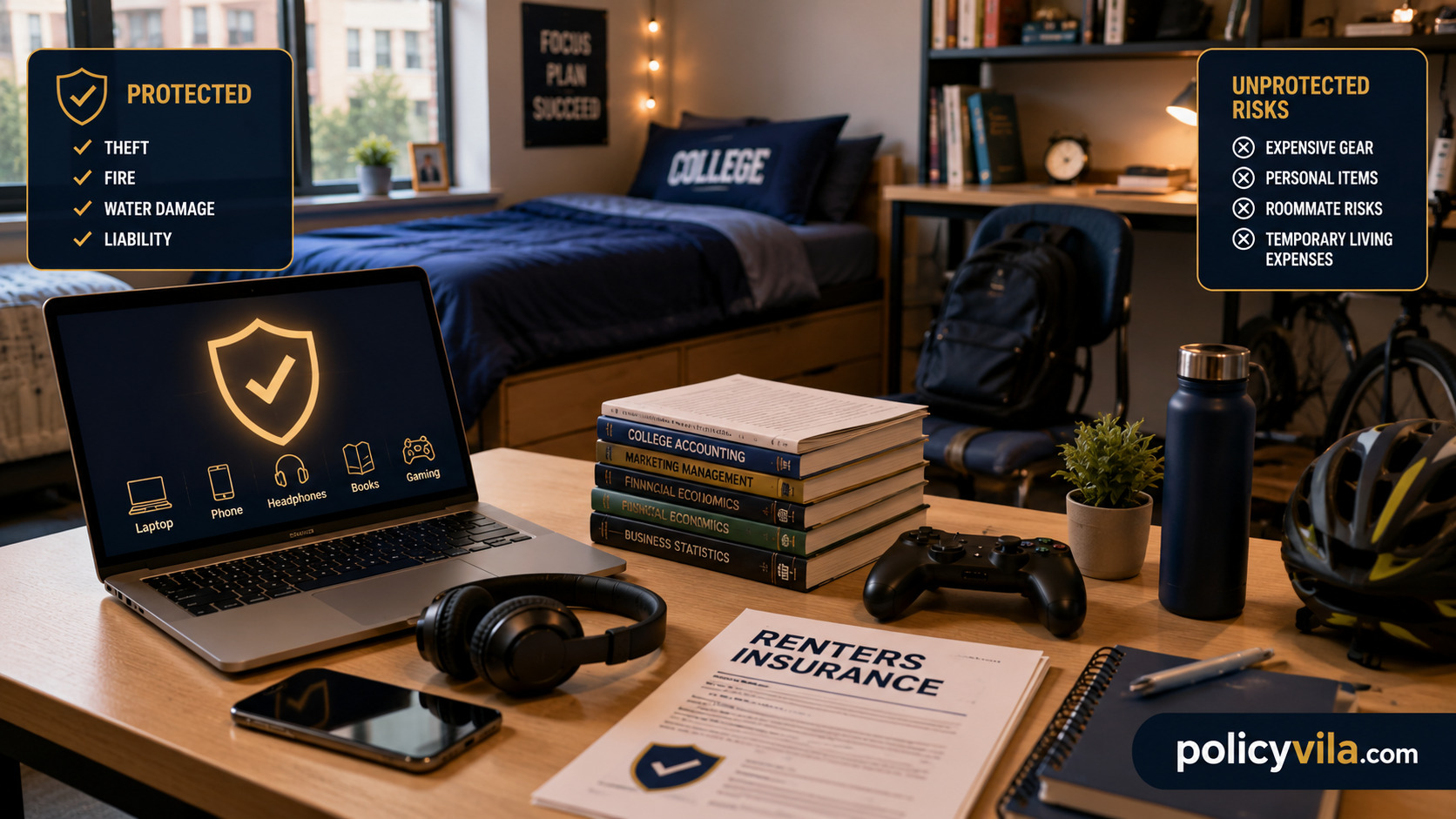
Potential Financial Exposure = Replacement Value + Potential Liability + Possible Temporary Expenses − Existing Applicable Protection
This isn’t an insurance pricing formula or a method for calculating an actual claim.
It’s simply a way to organize the conversation.
For example, a student could have:
- $4,000 of personal belongings
- A potential liability exposure
- Temporary living expenses after a serious covered event
- Some existing applicable protection
The remaining financial exposure depends on the actual policy, limits, exclusions, deductibles and circumstances.
This approach is more useful than asking only:
“How much does renters insurance cost?”
The better starting question is:
“How much financial exposure would remain without it?”
Your Landlord’s Policy Is Not Your Property Inventory
One of the most common assumptions among first-time renters is that the landlord’s insurance protects everything inside the apartment.
That isn’t how insurance responsibilities should be understood.
A landlord has an economic interest in the building and its property. A tenant has an economic interest in personal belongings brought into that building.
Consider a hypothetical apartment fire.
The event damages:
- Walls
- Flooring
- Cabinets
- Building fixtures
- A student’s laptop
- Clothing
- Textbooks
- Furniture
The landlord’s insurance arrangements and the student’s personal property situation are not automatically the same thing.
The exact financial outcome depends on the relevant contracts and policies.
That’s why students should separate two questions:
Who owns the building?
and
Who owns the belongings inside it?
That distinction can prevent a major misunderstanding.
Warning: Never assume that a landlord’s insurance policy automatically replaces a tenant’s personal belongings.
The Parent Policy Question Has More Conditions Than Most Families Realize
Parents often ask whether a college student’s belongings remain covered under a homeowners or renters policy at the family home.
There isn’t one universal answer.
Relevant factors can include:
- The student’s living arrangement
- The policy language
- Whether the student is living on campus
- Whether the student is renting independently
- Age and student status where relevant
- Distance from the family home where relevant
- Property limits
- Policy exclusions
- The student’s financial circumstances
Even when a family policy may provide some protection, it shouldn’t automatically be treated as unlimited protection.
A parent who has never reviewed the policy since the child left for college may not know the applicable limits or conditions.
The safest approach is to examine the actual policy rather than rely on assumptions.
The Parent Policy Reality Check
Before assuming an existing family policy solves the problem, consider these questions:
| Question | Why It Matters |
|---|---|
| Does the policy address the student’s current residence? | Housing arrangements can affect eligibility and coverage |
| Are the student’s belongings included? | Personal property protection may have conditions |
| Are there special limits? | Certain categories may receive different treatment |
| Does the housing type matter? | Dorms and independent rentals can differ |
| Are electronics subject to conditions? | Expensive items may require closer review |
| Are exclusions relevant? | Not every loss is necessarily covered |
| Has the student recently moved? | A change of residence can change the insurance question |
The goal isn’t to create unnecessary complexity.
It’s to replace assumptions with verified information.
The $1,800 Laptop Problem
For many students, a laptop is one of the most valuable belongings they own.
Imagine a hypothetical student with an $1,800 laptop.
A covered event causes a loss.
A simplified illustrative calculation might look like this:
| Item | Hypothetical Amount |
|---|---|
| Eligible loss | $1,800 |
| Illustrative deductible | $500 |
| Illustrative amount after deductible | $1,300 |
That $1,300 is not a guaranteed insurance payment.
The actual outcome could depend on whether the loss is covered, the valuation method, applicable limits, exclusions, documentation and other policy conditions.
The example simply demonstrates why a deductible matters.
A student shouldn’t look only at the monthly premium.
They should understand the potential out-of-pocket amount as well.
Replacement Cost Can Change the Conversation
A $1,500 laptop isn’t necessarily worth $1,500 forever.
Electronic equipment can depreciate quickly.
Insurance policies can use different valuation approaches, including concepts such as replacement cost or actual cash value, depending on the policy.
The distinction can matter.
Imagine a laptop that originally cost $1,500 but is several years old.
Under an illustrative depreciation-based approach, its value could be lower than the cost of purchasing a brand-new replacement.
Under a replacement-cost approach, the calculation may work differently, subject to the policy’s requirements and conditions.
Students should therefore look beyond the phrase “personal property coverage.”
They should also understand how property is valued. renters insurance for college students
Theft Gets Attention, Liability Gets Ignored
When students think about renters insurance, theft is usually the first risk that comes to mind.
Liability can be much less obvious.
Consider three hypothetical situations.
A visitor falls inside the apartment
A guest slips and suffers an injury.
A student accidentally damages someone else’s property
An accident creates a financial dispute.
A gathering results in accidental property damage
The tenant may face financial responsibilities depending on the circumstances.
These examples don’t establish legal liability or guarantee insurance coverage.
They illustrate why personal property and liability are separate concepts.
A student should understand both when reviewing an insurance policy.

The Student Risk Dashboard
| Risk | Example | Potential Financial Exposure | Question to Investigate |
|---|---|---|---|
| Theft | Laptop disappears | Property replacement | Is the loss covered? |
| Fire | Apartment belongings damaged | Major replacement costs | What property protection applies? |
| Water damage | Belongings are damaged | Repair/replacement | What causes of loss are covered? |
| Liability | Guest is injured | Potential legal/financial costs | What liability protection exists? |
| Electronics | Expensive laptop damaged | Significant out-of-pocket expense | Are limits or conditions applicable? |
| Temporary displacement | Apartment becomes unusable | Additional living expenses | Does applicable coverage address this? |
| Roommate issue | Shared property is damaged | Ownership dispute | Who owns and protects the item? |
This dashboard isn’t a prediction of what an insurer will pay.
It’s a checklist for identifying questions that deserve attention. renters insurance for college students
Roommates Create a Separate Financial Puzzle
Imagine three students sharing an apartment.
Alex owns a $1,800 laptop and $1,000 camera.
Jordan owns $2,500 of furniture and electronics.
Maya owns approximately $1,200 of personal belongings.
Their total household property is roughly $7,500.
But each student owns different property.
| Student | Major Belongings | Illustrative Value | Question |
|---|---|---|---|
| Alex | Laptop + camera | $2,800 | Whose coverage applies? |
| Jordan | Furniture + electronics | $2,500 | Are limits sufficient? |
| Maya | Personal belongings | $1,200 | Is existing protection applicable? |
A roommate’s insurance should not automatically be assumed to protect another roommate’s belongings.
The ownership of property and the terms of the relevant policy matter.
The Deductible Is Where the Math Becomes Personal
A deductible represents an amount the policyholder may be responsible for before applicable insurance payment begins, subject to the policy terms.
Consider the same hypothetical $1,500 covered loss:
| Illustrative Deductible | Hypothetical Amount Remaining After Deductible |
|---|---|
| $250 | $1,250 |
| $500 | $1,000 |
| $1,000 | $500 |
These figures are purely mathematical examples.
They don’t represent actual claim payments.
The lesson is straightforward:
A lower deductible can reduce the hypothetical amount paid out of pocket after a covered loss, while a higher deductible can increase that exposure.
Students should consider the deductible alongside the premium, coverage limits and their emergency savings.
The Emergency-Savings Test
Here’s a more useful question than simply comparing insurance prices:
If a student suddenly needed $1,000–$2,000 to replace essential belongings, could they pay it without missing rent, tuition or other necessities?
Consider three hypothetical students.
Student A — Minimal Savings
The student has little emergency cash.
A large unexpected expense could disrupt rent or other essential expenses.
Student B — Moderate Savings
The student has some emergency funds but a large loss would still create pressure.
Student C — Strong Savings
The student has a larger emergency reserve and could potentially absorb an unexpected expense more easily.
None of these situations automatically determines whether insurance is appropriate.
They simply demonstrate an important personal-finance principle:
The same financial loss can affect two households very differently.
The Lease Has Its Own Language
Insurance documents aren’t the only documents students should read.
The lease may address: renters insurance for college students
- Insurance requirements
- Liability
- Property damage
- Proof of insurance
- Tenant responsibilities
- Restrictions concerning certain activities
A lease requirement and an insurance decision are separate questions.
For example, a landlord may require a tenant to maintain certain coverage.
That doesn’t mean the student should stop reviewing what that coverage actually protects.
Likewise, the absence of an insurance requirement doesn’t necessarily mean the student’s financial exposure is insignificant.
The Technology Inventory Students Should Actually Keep
A student doesn’t need a complicated financial system to document important belongings.
A basic inventory can be enough.
| Item | Purchase Date | Estimated Value | Serial Number | Receipt |
|---|---|---|---|---|
| Laptop | Record date | $1,800 | Record number | Save if available |
| Smartphone | Record date | $800 | Record number | Save if available |
| Camera | Record date | $1,000 | Record number | Save if available |
| Bicycle | Record date | $500 | Record number | Save if available |
| Gaming console | Record date | $500 | Record number | Save if available |
Photographs, receipts and serial numbers can help demonstrate ownership when documentation becomes relevant.
Students should store important records somewhere other than only on the physical device that could be lost or damaged.
The 15-Minute Coverage Audit
A student can perform a basic review without spending an entire afternoon on it.
Minutes 1–5: List expensive belongings
Start with technology, furniture, bicycles and other high-value items.
Minutes 6–8: Estimate replacement value
Use realistic current replacement costs rather than guessing.
Minutes 9–11: Review existing protection
Check family insurance documents and any applicable housing arrangements.
Minutes 12–13: Read the lease
Look specifically for insurance and liability requirements.
Minute 14: Review limits and deductible
Identify the numbers that could affect out-of-pocket exposure.
Minute 15: Write down unanswered questions
Don’t guess.
Create a short list to verify with the appropriate insurance or housing professional.
Summer, Graduation and Moving Can Reset the Insurance Question
A student’s insurance situation can change several times within a few years.
Consider:
Freshman year: Dorm
Sophomore year: Shared apartment
Junior year: Different off-campus rental
Senior year: New city
After graduation: First full-time apartment
Each move can create a new insurance question.
Returning to a parent’s home during summer or temporarily relocating can also change the circumstances.
Students should review coverage whenever their living arrangement materially changes instead of assuming an old arrangement continues unchanged. renters insurance for college students
The College Housing Decision Matrix
Use these five factors as a simple educational framework:
| Factor | Lower Exposure | Moderate Exposure | Higher Exposure |
|---|---|---|---|
| Housing | Dorm or structured housing | Shared rental | Independent rental |
| Property | Few belongings | Moderate belongings | Expensive electronics/equipment |
| Existing Protection | Clearly applicable | Some uncertainty | Little known protection |
| Savings | Strong emergency reserve | Moderate reserve | Limited reserve |
| Liability | Limited concerns | Some exposure | Greater potential exposure |
This matrix isn’t an insurance recommendation.
It’s a way to identify where a student may have more questions to investigate.
When the Financial Exposure May Be Smaller
Not every student has the same risk profile.
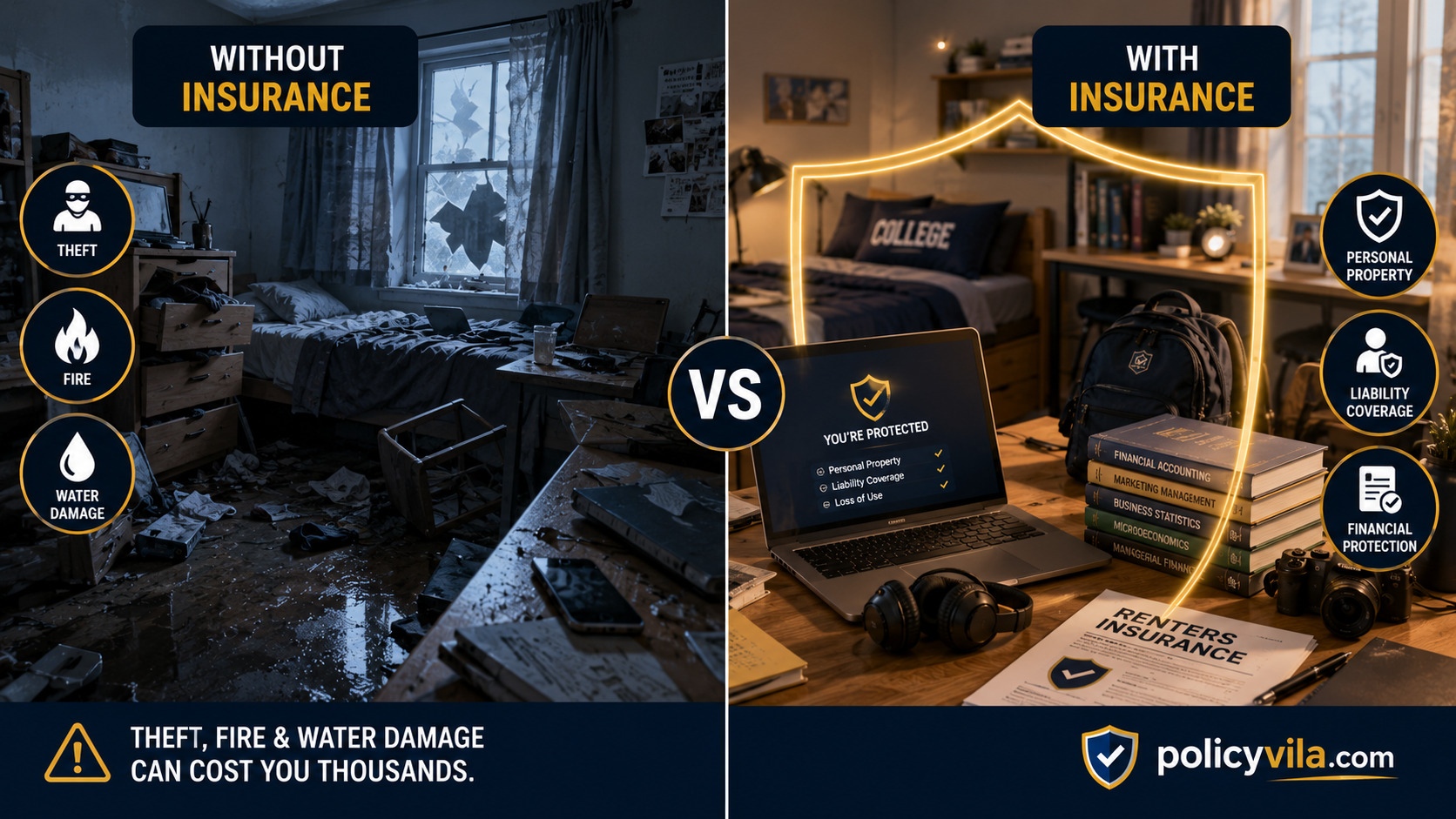
A student might have relatively few belongings, live in a particular housing arrangement and already have applicable protection through an existing policy.
Another student may own only a laptop and basic clothing.
In such cases, the financial exposure could be smaller than that of a student with expensive electronics, furniture and specialized equipment.
The important distinction is between:
“I don’t think I need insurance.”
and
“I have reviewed my exposure and understand what protection already exists.”
The second statement is much more informed.
When the Exposure Can Become Much Larger
The financial consequences can be more significant when a student has:
- Expensive electronics
- Photography equipment
- Specialized academic equipment
- High-value personal belongings
- Off-campus housing
- Multiple roommates
- Limited emergency savings
- Potential liability concerns
A student with $5,000 of belongings and $200 in emergency savings faces a very different financial situation from someone with $1,000 of belongings and $10,000 in savings.
Again, neither situation automatically determines an insurance decision.
It simply changes the financial context.
The $5,000 Student Property Scenario
Consider a hypothetical graduate student whose belongings total approximately $5,000.
| Category | Illustrative Value |
|---|---|
| Technology | $2,000 |
| Education equipment | $800 |
| Clothing | $700 |
| Furniture | $600 |
| Transportation | $400 |
| Personal items | $500 |
| Total | $5,000 |
Now imagine a serious covered event damages a large portion of those belongings.
The financial outcome would depend on numerous variables, including:
- Whether the event is covered
- Applicable deductible
- Coverage limits
- Exclusions
- Valuation method
- Documentation
- Policy conditions
The important lesson isn’t that the student would receive $5,000. renters insurance for college students
The lesson is that $5,000 of property creates a meaningful amount of potential financial exposure if there is no applicable protection or savings available to absorb the loss.
Ten Assumptions Worth Challenging
1. “The landlord covers my belongings.”
The landlord’s insurance and the tenant’s personal belongings are different financial interests.
2. “My parents’ insurance covers everything.”
Existing family coverage may apply in some circumstances, but the actual policy and student’s situation matter.
3. “My roommate has insurance, so I’m protected.”
A roommate’s coverage should not automatically be treated as protection for someone else’s belongings.
4. “Every theft is covered.”
Coverage depends on the policy, cause of loss and applicable exclusions.
5. “Every damaged item gets full replacement value.”
Valuation methods and policy conditions can affect the outcome.
6. “A higher deductible is always better.”
A higher deductible can mean greater out-of-pocket exposure after a covered loss.
7. “My inexpensive belongings don’t need documentation.”
A collection of inexpensive items can become expensive when replacement is required all at once.
8. “My coverage follows me everywhere.”
Moving or changing residences can affect the insurance situation.
9. “My lease automatically provides insurance.”
A lease can impose requirements, but it isn’t necessarily a substitute for reviewing insurance protection.
10. “Insurance is only about stolen property.”
Personal property is only one part of the broader financial picture. Liability and other expenses can matter too.
Before Signing the Lease
Use this checklist before moving into a college rental:
☐ Read the lease’s insurance language
☐ Identify who owns major belongings
☐ Estimate the replacement value of personal property
☐ Check existing family insurance
☐ Review applicable housing arrangements
☐ Examine deductible information
☐ Review personal-property limits
☐ Understand relevant exclusions
☐ Photograph valuable belongings
☐ Keep receipts where practical
☐ Discuss financial responsibilities with roommates
☐ Recheck coverage after moving
This doesn’t tell a student which insurance choice to make.
It helps ensure the decision isn’t based on assumptions.
Three College Housing Scenarios
Case Study A: The First-Year Dorm Student
A first-year student owns a laptop, phone, clothes, textbooks and basic personal items.
The student lives in university housing and assumes their parents’ insurance handles everything.
The useful questions are: renters insurance for college students
- Does the existing policy apply?
- Are there limits?
- Does the student’s housing arrangement matter?
- Are expensive electronics treated differently?
The key issue is not automatically buying another policy.
It’s determining what protection already exists.
Case Study B: The Off-Campus Apartment
A student rents an apartment with two roommates.
They own approximately $4,000 of furniture, electronics and personal belongings.
Their lease includes an insurance requirement.
Now the student has several separate questions:
- What does the lease require?
- What personal property protection exists?
- What liability provisions apply?
- What deductible would matter after a covered loss?
- How much emergency savings is available?
The apartment changes the financial context compared with a dorm.
Case Study C: The Graduate Student With Specialized Equipment
A graduate student owns a laptop, camera, specialized equipment and other belongings worth approximately $6,000.
The student rents independently.
In this situation, documentation becomes especially important.
The student should understand:
- Property limits
- Valuation
- Deductibles
- Exclusions
- Documentation
- Existing coverage
The higher value of the belongings doesn’t automatically dictate a specific insurance decision.
It does make the coverage question harder to ignore.
read also: Personal Finance Blog | Insurance, Loans & Money Tips
Featured Question: Do College Students Need Renters Insurance?
There is no universal answer. The relevant factors include where the student lives, the value of their belongings, whether an existing family policy applies, potential liability exposure, deductibles, coverage limits and policy exclusions. Students should review their lease and existing insurance documents rather than assume that a landlord’s policy or a parent’s insurance automatically provides complete protection. renters insurance for college students

Frequently Asked Questions
Does renters insurance for college students apply to off-campus apartments?
It can, depending on the policy and the student’s circumstances. Off-campus renters should review the lease, personal-property needs, liability considerations, deductible, limits and exclusions before assuming they have protection.
Are college students living in dorms automatically covered?
Not necessarily in every situation. A student’s existing family policy, university housing arrangements and the applicable insurance terms can all matter. Students should verify their specific circumstances.
Can a parent’s homeowners policy cover a college student?
It may provide some coverage in certain circumstances, but there is no universal rule. Student status, residence, policy language, limits and other conditions can affect the answer.
Does renters insurance cover a college student’s laptop?
A laptop may fall under personal-property coverage if the applicable policy covers the specific loss. Limits, deductibles, exclusions and valuation rules can affect the outcome.
Does renters insurance cover theft from a college apartment?
Theft may be covered under some policies, but students should examine the specific covered causes of loss, exclusions, limits and deductible rather than assume every theft is covered.
Can roommates share renters insurance?
Roommate arrangements can be complicated and depend on the policy and relationship between the occupants. Students should not automatically assume one roommate’s coverage protects everyone else’s belongings.
Does the deductible apply to every renters insurance claim?
The applicable deductible can depend on the type of claim and policy terms. Students should review the actual policy rather than assume one deductible applies identically to every situation.
Can a landlord require renters insurance?
A lease may include insurance requirements. Students should read the lease carefully and understand exactly what is required, including any proof-of-insurance or liability provisions.
Should students keep receipts for expensive belongings?
Keeping receipts, photographs and serial numbers can be useful documentation of ownership. Students should consider maintaining records for expensive electronics, bicycles and specialized equipment.
Does renters insurance change after graduation?
A student’s housing and financial circumstances often change after graduation. Moving into a new apartment or another residence can create a new insurance situation that should be reviewed rather than assumed to remain unchanged.
Does renters insurance cover a roommate’s belongings?
A student should not assume that their policy automatically protects another person’s property. Ownership, household relationships and policy terms can affect the answer.
Is renters insurance only useful for students with expensive belongings?
Not necessarily. Personal property is only one consideration. Liability and other potential financial exposures can also matter, while the relevance of coverage depends on each student’s circumstances.
The Bigger Financial Picture
For college students, insurance is rarely the most exciting part of moving into a new apartment.
Furniture is exciting.
Decorating is exciting.
A new laptop is exciting.
Signing the lease feels like a milestone.
But financial responsibility often begins the moment the student moves through the door.
The important question isn’t simply whether a student has renters insurance.
It’s whether the student understands the gap between:
what they own,
what protection may already exist,
and
what they could personally afford if something went wrong. renters insurance for college students
A student living in a dorm may face a different situation from a graduate student renting an apartment independently. Someone with $1,000 of belongings has a different financial exposure from someone with $6,000 of electronics and equipment. A student with substantial emergency savings may experience an unexpected loss differently from someone living paycheck to paycheck.
There is no single answer that fits every college renter.
The smarter starting point is information.