

If you are researching burial insurance cost in 2026, there is one important fact to understand first: there is no single price that applies to every applicant.
A burial insurance premium can vary substantially based on your age, health history, tobacco use, sex, state, coverage amount, policy type, underwriting method, insurer, and payment schedule. In general, insurance pricing is risk-based, meaning greater risk and more coverage can result in a higher premium.
That is why an online example showing a low monthly premium should not be treated as the price you will personally receive.
Quick answer: burial insurance is typically a form of permanent life insurance designed to provide a relatively modest death benefit that beneficiaries can use for final expenses. The best way to determine your actual cost is to compare quotes for the same coverage amount and comparable policy features.
This guide explains how burial insurance rates are determined, how age and coverage affect premiums, when guaranteed-issue coverage may make sense, and when saving money yourself could be a reasonable alternative.
What Is Burial Insurance?
Burial insurance is commonly used to describe a smaller permanent life insurance policy intended to help pay final expenses.
The policy generally has:
- A death benefit paid after the insured dies, subject to the policy terms
- A premium paid by the policy owner
- A beneficiary who receives the death benefit
- A policy owner who controls the policy while it is in force
- Permanent coverage that is designed to remain in force as long as applicable premiums and policy requirements are satisfied
The money does not necessarily have to be spent only on a casket or burial. Depending on the policy, beneficiaries can generally use life insurance proceeds for funeral expenses, cremation, medical bills, household obligations, debts, or other legitimate expenses.
The IRS generally says life insurance proceeds paid because of the insured person’s death are not taxable income to the beneficiary, although exceptions and tax treatment of interest can apply.
Burial Insurance vs. Final Expense Insurance
The terms burial insurance and final expense insurance are often used interchangeably in consumer marketing, but insurers do not necessarily use identical definitions.
Both generally refer to relatively small life insurance policies intended to help with expenses associated with death.
| Feature | Burial Insurance | Final Expense Insurance |
|---|---|---|
| Primary purpose | Help with burial and final expenses | Help with final expenses broadly |
| Policy type | Often permanent life insurance | Often permanent life insurance |
| Death benefit | Usually modest | Usually modest |
| Beneficiary | Receives policy proceeds | Receives policy proceeds |
| Possible uses | Funeral, burial and other expenses | Funeral, debts and other final expenses |
| Underwriting | Depends on policy | Depends on policy |
Always read the actual policy rather than relying solely on the marketing label.
Burial Insurance vs. Term Life Insurance
Term life insurance provides coverage for a specified period. NAIC explains that term policies may be issued for periods such as 1, 5, 10 or 20 years, or to a specified age, while permanent policies are designed differently.
| Feature | Burial/Final Expense Coverage | Term Life Insurance |
| Typical purpose | Final expenses | Temporary financial protection |
| Duration | Generally permanent | Fixed term |
| Death benefit | Usually smaller | Can be much larger |
| Underwriting | Varies | Often more extensive |
| Typical buyer | Person planning final expenses | Person protecting income, debts or dependents |
| Cash value | May be available with some permanent policies | Generally no cash value |
The right choice depends on the financial need. A person primarily concerned about funeral expenses may not need a large term policy, while someone supporting children or carrying a mortgage may need substantially more coverage than a typical burial policy provides.
Burial Insurance vs. Whole Life Insurance
There is considerable overlap because many burial or final-expense policies are forms of whole life insurance.
The important distinction is purpose and policy design, not simply the name used in advertising.
A traditional whole life policy can provide a larger death benefit and cash-value component, while a final-expense policy is generally designed around a smaller benefit and a specific final-expense planning need.
What Is the Average Burial Insurance Cost in 2026?
There is no reliable single “average burial insurance cost” that can accurately represent every U.S. applicant.
A quote depends on the individual risk profile and the policy being purchased. NAIC describes insurance pricing as risk-based and notes that factors such as age and the amount of coverage can affect cost.
Illustrative Cost Framework — Not a Personalized Quote
Instead of publishing a made-up national average, use this framework when evaluating quotes:
| Applicant profile | Coverage | What can influence the quote |
| Younger adult | $5,000–$10,000 | Age, health, tobacco status and insurer |
| Adult in their 50s | $10,000–$20,000 | Underwriting and benefit amount |
| Adult in their 60s | $10,000–$25,000 | Age, health and policy type |
| Adult in their 70s | $10,000–$25,000 | Eligibility, underwriting and waiting provisions |
| Applicant 80+ | Varies by insurer | Availability, age limits and policy design |
These are coverage-planning ranges, not premium quotes. They are included to demonstrate how shoppers can compare policies without treating an unsupported monthly price as an industry average.
A legitimate quote should be based on your actual application information and the insurer’s current underwriting rules.
Burial Insurance Cost Per Month
Most consumers think about burial insurance in terms of a monthly payment.
That is useful for budgeting, but it can also be misleading.
Consider two policies:
- Policy A has a lower monthly premium but less coverage.
- Policy B costs more each month but provides a larger guaranteed benefit.
- Policy C has a similar premium to Policy A but different waiting-period provisions.
Looking only at the monthly number does not tell you which policy provides the better value.
The better comparison is:
Premium + death benefit + policy guarantees + waiting period + eligibility requirements + long-term affordability
NAIC recommends comparing similar policies and making sure you understand whether premiums or benefits can change.
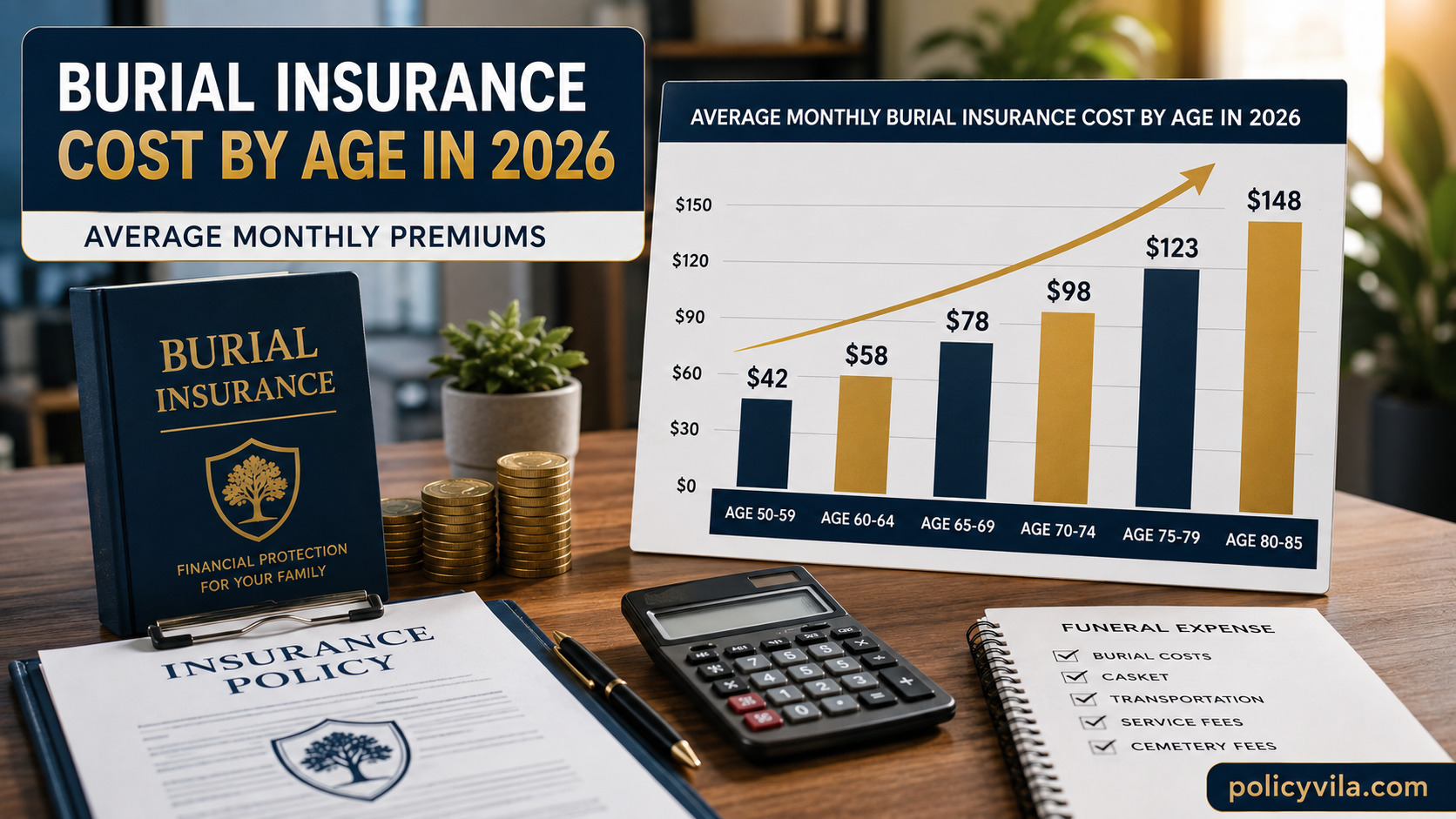
Burial Insurance Cost by Age
Age is one of the most important variables in life insurance pricing because mortality risk generally increases as people get older.
However, age alone cannot determine your premium.
Burial Insurance Cost in Your 40s
Someone in their 40s may have access to a wider range of life insurance products than someone much older.
For a buyer considering burial coverage, the key question is whether a small final-expense policy is actually the most efficient option.
A younger applicant may want to compare:
- Small permanent coverage
- Traditional whole life
- Term life insurance
- Existing employer coverage
- Personal savings
Buying more coverage than necessary simply because a policy is available can create an unnecessary long-term expense.
Burial Insurance Cost in Your 50s
In your 50s, the difference between policies can become more noticeable because age and health begin to play a larger role in underwriting.
Compare insurers carefully rather than assuming every company will price the same applicant identically.
Also consider whether you need only funeral protection or broader financial protection for a spouse, children, mortgage or other debts.
Burial Insurance Cost in Your 60s
Applicants in their 60s frequently focus more closely on final-expense planning.
At this stage, compare:
- Coverage amount
- Premium structure
- Health questions
- Prescription-related underwriting
- Waiting-period provisions
- Guaranteed versus non-guaranteed features
- Whether the premium fits your retirement budget
The cheapest policy is not necessarily the most appropriate policy.
Burial Insurance Cost in Your 70s
Availability and eligibility can become more important as age increases.
Some policies may have maximum issue ages, coverage limits or different underwriting rules.
If you are shopping in your 70s, request quotes from multiple insurers and disclose your health information accurately. Do not assume that one company’s decision represents the entire market.
Burial Insurance Cost in Your 80s
Applicants in their 80s may encounter fewer available products or more restrictive eligibility rules, depending on the insurer and policy.
Guaranteed-issue products can be relevant for some applicants, but the trade-offs must be examined carefully.
Look specifically at:
- Maximum coverage
- Premium
- Waiting-period provisions
- Graded or modified benefits
- Eligibility
- Whether the premium is guaranteed
Does Gender Affect Burial Insurance Cost?
Sex can be used as a rating factor for some life insurance products, depending on applicable law and the insurer’s pricing structure.
It should not be assumed that two applicants of the same age and health will receive identical quotes.
The practical lesson is simple: compare the actual quote rather than relying on a generalized online rate chart.
Does Health Affect Burial Insurance Cost?
Yes, health can have a major effect on the type of policy available and its pricing.
Depending on the underwriting process, insurers may consider information such as:
- Diabetes
- Heart disease
- Cancer history
- High blood pressure
- Tobacco use
- Prescription medications
- Previous medical procedures
- Other health history
Different insurers can evaluate the same condition differently.
That is one reason shopping around can be particularly important for applicants with health conditions.
Do not hide or change medical information to try to obtain a lower premium. An inaccurate application can create serious problems later.
How Coverage Amount Changes Burial Insurance Cost
The basic relationship is straightforward:
More death benefit generally means a higher premium.
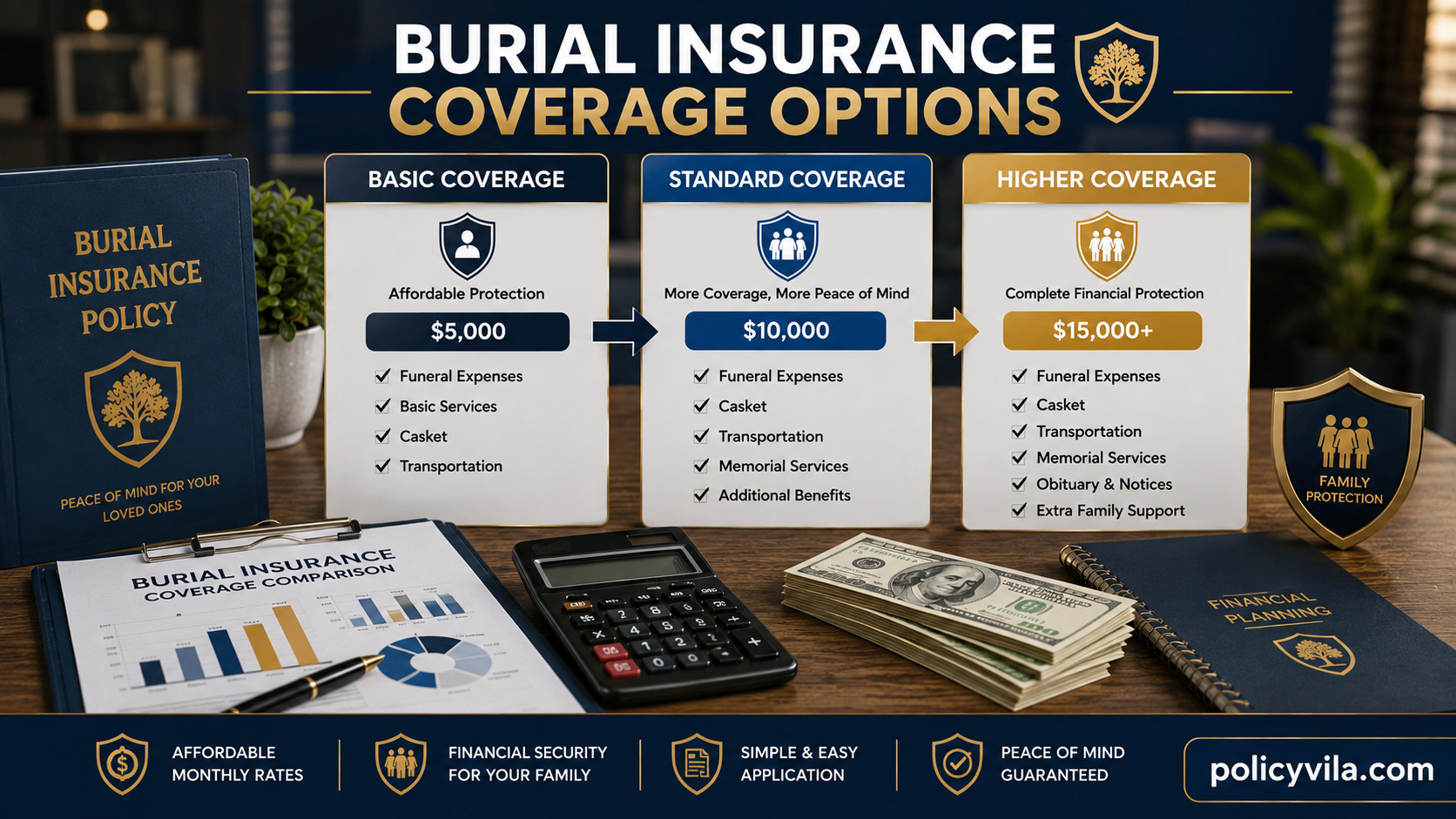
Common coverage levels include:
- $5,000
- $10,000
- $15,000
- $20,000
- $25,000
- Higher amounts where available
But buying the largest available policy is not automatically a smart decision.
A useful planning formula is:
Estimated coverage need = expected final expenses + outstanding final bills + desired family cushion − dedicated savings and other available funds
This is a planning framework, not an insurance quote or financial guarantee.
$10,000 Burial Insurance Cost
A $10,000 death benefit can be considered when the primary objective is to provide a modest pool of money for final expenses.
Potential expenses could include:
- Funeral-home services
- Burial-related costs
- Cemetery expenses
- Transportation
- Memorial expenses
- Outstanding final bills
The actual amount required depends heavily on location and the arrangements selected.
The FTC says funeral providers covered by the Funeral Rule must provide itemized pricing information and allow consumers to compare and select many funeral goods and services individually.

$20,000 Burial Insurance Cost
A $20,000 benefit may be considered when a buyer wants more room for:
- A more extensive funeral
- Cemetery-related expenses
- Burial or cremation arrangements
- Transportation
- Medical or household bills
- A financial cushion for beneficiaries
Again, the appropriate amount depends on the family’s actual financial situation.
10 Factors That Can Affect Burial Insurance Cost
| Factor | Why insurers care | Possible pricing effect | What shoppers should do |
| Age | Mortality risk generally changes with age | Older applicants may pay more | Compare policies available at your age |
| Health | Underwriting assesses risk | Can affect eligibility and premium | Answer health questions accurately |
| Tobacco use | Often treated as a separate risk category | May increase premiums | Disclose tobacco use honestly |
| Sex | May be used in rating | Can affect quoted premium | Compare actual quotes |
| Coverage amount | Larger benefit creates greater insurer exposure | More coverage generally costs more | Buy only what you need |
| Policy type | Different products have different risks | Guaranteed-issue and underwritten products can differ | Compare features, not labels |
| State | Insurance regulation and product availability vary | Quotes can differ by location | Verify state availability |
| Insurer | Companies use different pricing and underwriting | Same applicant can receive different quotes | Get multiple quotes |
| Underwriting method | More health information can affect risk classification | Can change eligibility and price | Ask what underwriting is required |
| Payment frequency | Payment method affects how premiums are collected | Total annual cost may differ | Compare total annual outlay |
These factors do not necessarily affect every policy in exactly the same way.
Guaranteed Issue vs. Simplified Issue Burial Insurance
One of the biggest decisions for applicants with health concerns is whether to consider guaranteed-issue or simplified-issue coverage.
| Feature | Guaranteed Issue | Simplified Issue |
| Medical exam | Generally not required | Usually no full medical exam, depending on product |
| Health questions | Limited or absent depending on policy | Health questions commonly used |
| Underwriting | Little or no medical underwriting | Underwriting based on application information |
| Eligibility | Often easier for qualifying applicants | More dependent on health history |
| Premium | May be higher | May be lower for applicants who qualify favorably |
| Waiting period | May apply | May or may not apply |
| Coverage limits | Can be more limited | May allow different amounts |
| Best fit | Applicants with serious qualification concerns | Applicants willing to answer health questions |
NAIC materials distinguish guaranteed-issue products from policies where issuance depends on health information.
Do not assume guaranteed issue is automatically better because it is easier to qualify for. Nor should you assume simplified issue is always cheaper. Compare the actual policy.
How to Find Affordable Burial Insurance
“Affordable” should mean a policy you can maintain while receiving useful coverage, not simply the lowest advertised premium.
Use these strategies:
- Compare several insurers.
- Request the same coverage amount from each.
- Give each insurer the same applicant information.
- Ask whether premiums are guaranteed.
- Review waiting-period provisions.
- Read exclusions and benefit limitations.
- Compare underwriting requirements.
- Check insurer licensing and financial information.
- Review the policy before purchasing.
NAIC specifically recommends comparison shopping, checking that an insurer is authorized to operate in your state, and understanding policy guarantees before buying.
How Much Burial Insurance Do You Actually Need?
Start with the expense rather than the insurance product.
Ask:
- What type of funeral do I expect?
- Will there be burial or cremation?
- Is a cemetery plot already owned?
- Is there an existing funeral plan?
- Are there unpaid debts?
- Are there medical or household bills that could remain?
- How much money is already set aside?
- Should beneficiaries receive an additional cushion?
Then subtract money that is genuinely available for those purposes.
For example:
Estimated final expenses: $16,000
Existing dedicated savings: $6,000
Other funds available: $2,000
Potential coverage need: approximately $8,000
That does not mean an $8,000 policy is automatically correct. It is simply a starting point for obtaining quotes.
NAIC similarly recommends considering final expenses, debts, family needs and affordability when determining life insurance needs.
Four Realistic Burial Insurance Buyer Scenarios
Scenario 1: Healthy 55-Year-Old Non-Smoker
This buyer may have several policy options.
The priority should be comparing:
- Permanent versus term coverage
- Guaranteed premium
- Death benefit
- Cash-value features
- Long-term affordability
Because the buyer is relatively young compared with many final-expense shoppers, it may also be worth asking whether a broader life insurance policy would better match the family’s needs.
Scenario 2: 67-Year-Old With Existing Health Conditions
This buyer should focus heavily on underwriting.
Rather than applying only to one insurer, compare companies that evaluate the applicant’s health profile differently.
Important questions include:
- Which health conditions affect eligibility?
- Is a medical exam required?
- Is the policy fully underwritten?
- Is there a waiting period?
- Is the full death benefit immediately available?
The buyer should never omit health information just to obtain a lower quote.
Scenario 3: 74-Year-Old Seeking a Small Final-Expense Policy
This applicant may not need a large death benefit.
The goal could be to cover a known gap between expected final expenses and existing savings.
A smaller policy may fit the budget better than unnecessary additional coverage.
Scenario 4: Applicant Age 80+ Comparing Guaranteed-Issue Options
The main question may be availability rather than simply price.
Compare:
- Maximum issue age
- Coverage limit
- Premium
- Waiting period
- Graded or modified benefits
- Exclusions
- Financial strength and licensing
A policy that accepts the applicant but provides limited early benefits should not be compared with a fully immediate-benefit policy as if the two were identical.
When Burial Insurance May Make Sense
Burial insurance can make sense when someone:
- Has limited savings
- Wants a predictable source of final-expense funding
- Does not want family members to handle the entire expense
- Wants a permanent death benefit
- May have difficulty qualifying for larger life insurance
- Wants to separate funeral planning money from everyday savings
The goal is not to buy insurance simply because funeral costs exist. The goal is to solve a specific financial problem.
When You May Not Need Burial Insurance
You may not need a separate burial policy if you already have enough resources to cover the expected expenses.
Possible sources include:
- Existing life insurance
- Dedicated savings
- Bank or investment assets
- Employer benefits
- Other financial arrangements
For example, someone with $20,000 specifically reserved for final expenses may not need another $20,000 policy.
Existing life insurance should also be reviewed before purchasing additional coverage. NAIC advises consumers not to cancel an existing policy before carefully evaluating replacement coverage.
Burial Insurance vs. Saving for Funeral Expenses
There is no universally superior choice.
| Consideration | Burial Insurance | Self-Funding With Savings |
| Monthly cash flow | Requires ongoing premium | Requires saving discipline |
| Immediate protection | Can provide a death benefit subject to policy terms | Depends on accumulated savings |
| Long-term cost | Premiums continue according to policy | Depends on savings and investment returns |
| Access to money | Policy terms control access to cash value, if any | Savings are generally accessible |
| Investment opportunity | Depends on policy | Savings can potentially be invested |
| Risk of early death | Insurance can transfer some financial risk | Savings may be insufficient early on |
| Inflation | Coverage amount may not automatically increase | Savings target can be adjusted |
| Family burden | Can provide dedicated death benefit | Depends on amount saved |
The decision should be based on your budget, financial goals, existing assets and the amount of risk you want to transfer.
How to Compare Burial Insurance Quotes
Step 1: Choose an Approximate Coverage Amount
Start with your estimated expense gap rather than an arbitrary policy size.
Step 2: Gather Your Applicant Information
Prepare:
- Age
- State
- Tobacco status
- Health history
- Prescription information
- Existing insurance
- Desired coverage
Step 3: Request Multiple Quotes
Compare several insurers whenever practical.
Step 4: Compare Identical Coverage
A $10,000 policy should be compared with another $10,000 policy—not with a $20,000 policy that happens to have a similar premium.
Step 5: Review the Waiting Period
A low premium can look attractive until you discover that the policy does not provide the same immediate benefit under all circumstances.
Step 6: Check Premium Guarantees
Ask whether the premium is level and guaranteed or can change.
Step 7: Read the Policy
The policy contract—not the advertisement—is the final authority on coverage.
Burial Insurance Quote Comparison Worksheet
Use this worksheet before requesting quotes:
| Information | Your Details |
| Age | __________ |
| State | __________ |
| Tobacco use | __________ |
| Desired coverage | $__________ |
| Existing life insurance | $__________ |
| Dedicated funeral savings | $__________ |
| Estimated funeral/burial expenses | $__________ |
| Outstanding final bills | $__________ |
| Desired family cushion | $__________ |
| Monthly budget | $__________ |
Then request quotes using the same information.
This makes comparisons much more meaningful.
Common Mistakes When Comparing Burial Insurance
1. Comparing Different Coverage Amounts
Problem: One quote is for $10,000 and another is for $20,000.
Fix: Compare the same death benefit first.
2. Looking Only at Monthly Premiums
Problem: The lowest monthly number appears to be the winner.
Fix: Review coverage, guarantees, waiting periods and long-term cost.
3. Ignoring Waiting Periods
Problem: The buyer assumes the full benefit is immediately available.
Fix: Read the policy’s benefit provisions carefully.
4. Not Checking Exclusions
Problem: The buyer never reviews limitations.
Fix: Ask the insurer to explain exclusions and restricted benefits.
5. Giving Inaccurate Health Information
Problem: The application does not accurately reflect medical history.
Fix: Provide complete and truthful information.
6. Buying Too Much Coverage
Problem: Premiums consume money that could be used for other priorities.
Fix: Calculate the actual expense gap.
7. Buying Too Little Coverage
Problem: The policy does not cover the expected financial need.
Fix: Obtain funeral pricing and estimate other final bills before selecting the benefit.
8. Choosing an Insurer Without Checking Its Information
Problem: The buyer focuses entirely on price.
Fix: Verify licensing and research the insurer’s financial information.
9. Ignoring Inflation
Problem: Today’s estimated funeral expenses may not remain the same for decades.
Fix: Review the plan periodically.
10. Replacing Existing Coverage Too Quickly
Problem: An existing policy is cancelled before the new policy is fully understood or issued.
Fix: Review both policies carefully before making a replacement decision.
2026 Burial Insurance Buyer’s Checklist
Determine the expected final-expense gap
Estimate the desired death benefit
Gather age, health and tobacco information
Compare multiple insurers
Compare identical coverage amounts
Check underwriting requirements
Review waiting-period provisions
Review exclusions and limitations
Confirm whether premiums are guaranteed
Check insurer licensing and financial information
Read the policy before purchasing
Reassess your coverage periodically

How to choose affordable burial insurance in 2026 using insurance quotes, coverage comparisons, and financial planning

Frequently Asked Questions About Burial Insurance Cost
How much does burial insurance cost per month?
There is no single monthly price that applies to everyone. Premiums depend on age, health, tobacco use, coverage amount, state, policy type, underwriting and insurer pricing. A $10,000 policy for one applicant can have a very different premium from a $10,000 policy for another applicant. The safest way to determine your cost is to request personalized quotes using identical coverage and applicant information.
What is the average burial insurance cost for seniors?
There is no dependable single national average for all seniors because the market includes different policy types, benefit amounts and underwriting classes. Seniors should compare actual quotes rather than relying on a generic online average. Age is an important pricing factor, but health, tobacco use, coverage amount, state and insurer can also materially change the premium.
Does burial insurance get more expensive as you age?
Generally, age is an important risk factor in life insurance pricing, so waiting to purchase coverage can affect the premium or available products. However, the exact effect depends on the insurer and policy. A person should not assume that an age-based rate chart represents a guaranteed future price.
How much does a $10,000 burial insurance policy cost?
The cost depends on the applicant and policy. A $10,000 benefit for a healthy applicant may be priced differently from the same benefit for an older applicant with significant health conditions. Compare the premium, policy type, waiting period and guarantees—not just the advertised monthly payment.
How much does a $20,000 burial insurance policy cost?
A $20,000 policy generally represents more death-benefit coverage than a $10,000 policy, so the premium will commonly be higher. However, the exact amount depends on age, health, tobacco use, state, insurer and underwriting. Request quotes for exactly $20,000 from multiple insurers to make a useful comparison.
Is burial insurance cheaper than life insurance?
That depends on what type of life insurance you compare it with. Burial insurance is usually designed around a smaller death benefit, while term life insurance can provide substantially more coverage for a defined period. Permanent life insurance can have different pricing and features. Compare policies based on the financial need they are intended to solve.
Can someone with health problems get burial insurance?
Possibly. Some policies use health underwriting, while guaranteed-issue products may have limited or no medical underwriting. Eligibility and benefit provisions vary. Applicants with health conditions should compare multiple insurers rather than assuming a single insurer’s decision represents the entire market.
Does smoking increase burial insurance premiums?
Tobacco use can be a rating factor for life insurance and may result in a different premium classification. The exact effect varies by insurer and policy. Always answer tobacco-related application questions accurately because the policy contract and underwriting classification can affect coverage and pricing.
Is burial insurance worth the cost?
It can be worthwhile when the policy solves a real financial problem, such as providing funds for final expenses when savings are limited. It may be less attractive when someone already has sufficient dedicated savings or existing life insurance. Compare the total cost and coverage against your actual financial need.
What is the cheapest type of burial insurance?
There is no universally cheapest policy for every applicant. A policy with a lower advertised premium may provide less coverage or have different underwriting and benefit provisions. For a healthy applicant, a medically underwritten policy may be priced differently from guaranteed issue. Compare comparable policies rather than searching for a single “cheapest” product.
Can burial insurance premiums increase?
It depends on the policy. Some policies are designed with guaranteed level premiums, while other products can have different premium structures. Before buying, ask specifically whether the premium is guaranteed, whether the death benefit is guaranteed and under what circumstances either can change.
Does burial insurance have a waiting period?
Some policies do and some do not. Waiting-period provisions are particularly important with certain guaranteed-issue or graded-benefit products. Do not assume that every burial insurance policy pays the full advertised death benefit immediately. Read the contract and ask the insurer to explain the provision.
Can burial insurance pay for cremation?
Life insurance proceeds can generally be used by beneficiaries for legitimate expenses, including cremation, subject to the policy and applicable law. Burial insurance is not necessarily restricted to traditional burial expenses. The beneficiary typically controls how the proceeds are used unless specific contractual arrangements apply.
How much burial insurance should I buy?
Start with your expected final expenses, outstanding final bills and desired financial cushion. Then subtract dedicated savings and other funds that are genuinely available. The resulting gap can provide a starting point for determining the death benefit to consider. Review the estimate periodically because costs and financial circumstances can change.
Should I buy burial insurance if I already have life insurance?
Not necessarily. First determine whether your existing life insurance already provides enough coverage for funeral expenses and other financial obligations. If there is already a sufficient death benefit, buying another policy may be unnecessary. Review your current policy before purchasing additional coverage.
Final Thoughts on Burial Insurance Cost in 2026
The most useful way to think about burial insurance cost is not as a single monthly number.
The real question is:
How much coverage do you need, what policy features do you receive, and how much will that protection cost over time?
Age, health, tobacco use, coverage amount, state, policy design and insurer underwriting can all affect your premium. Two people who appear similar on the surface can receive different quotes.
Before buying, estimate the actual financial gap first. Then compare multiple policies using the same coverage amount and applicant information. Pay attention to waiting periods, exclusions, premium guarantees and long-term affordability—not just the first monthly price you see.