
public liability insurance for self employed: A self-employed photographer damages a client’s property. A contractor accidentally causes a visitor to fall. A consultant is accused of making a harmful statement about another business. In each case, the business owner may face a claim personally or through the business.
That is why public liability insurance for self-employed professionals deserves a closer look. In the U.S., the coverage people often mean by “public liability insurance” is generally called commercial general liability (CGL) or general liability insurance. It can help protect a business against certain claims involving bodily injury, property damage, personal injury, and related legal defense costs. The National Association of Insurance Commissioners (NAIC) identifies these as core areas of general liability coverage.
There is no single 2026 price that every self-employed person should expect to pay. Premiums can depend on the type of work, revenue, location, claims history, coverage limits, business operations, and insurer underwriting. The important question is therefore not simply “What is the cheapest policy?” but “What liability exposure do I have, and does the policy actually address it?”
For a U.S. freelancer, contractor, consultant, tradesperson, or other solo business owner, that distinction can make a significant difference.
Public Liability Insurance vs. U.S. General Liability: What Are You Actually Looking For?
One source of confusion is terminology.
“Public liability insurance” is widely used in some international insurance markets. In the United States, a self-employed person searching for similar protection will commonly encounter general liability insurance or commercial general liability insurance.
The names are not necessarily interchangeable in every policy context, so read the actual coverage rather than relying on the label.
The SBA describes general liability insurance as coverage that can protect a business against financial losses associated with bodily injury, property damage, medical expenses, libel, slander, lawsuits, and certain related legal obligations.
The practical idea is straightforward:
If your business causes a covered injury or damages someone else’s property, liability insurance may help pay covered costs according to the policy terms and limits.
That does not mean every lawsuit or mistake is covered.
What risk is being transferred?
You are transferring some financial risk of covered third-party liability claims to an insurer.
Who is protected?
Generally, the named business and other parties specifically included by the policy can receive protection, subject to the contract.
What triggers coverage?
A covered event or claim must fall within the policy’s insuring agreement and satisfy its conditions.
What can remain outside the policy?
Professional errors, employee injuries, vehicle-related liability, intentional acts, and many other exposures may require separate coverage or may be excluded.
That last point is where many self-employed buyers make their first mistake. public liability insurance for self employed
The Three Questions a Solo Business Owner Should Answer Before Buying
Before comparing premiums, identify three things:
1. What can go wrong because of my work?
A painter, web designer, electrician, dog groomer, consultant, and photographer do not face the same liability exposures.
2. Who could make a claim against me?
Think about customers, visitors, landlords, suppliers, members of the public, and other third parties.
3. What would happen financially if the claim were large?
Even a one-person business can face legal expenses and a liability judgment that is much larger than the owner’s monthly insurance budget.
The SBA recommends thinking about business risks that you would not be able to comfortably pay for yourself when deciding what insurance makes sense.
What General Liability Insurance Can Actually Cover
General liability is primarily designed around third-party liability exposures.
Depending on the policy, coverage can include claims involving:
- Bodily injury
- Damage to someone else’s property
- Certain personal injury claims
- Libel or slander
- Advertising-related claims
- Medical expenses associated with covered injuries
- Legal defense costs for covered claims
NAIC describes commercial general liability as addressing categories such as bodily injury, property damage, personal injury including slander and libel, and false or misleading advertising.
Imagine a self-employed flooring installer working in a customer’s home. A tool accidentally damages an expensive surface. Whether the resulting claim is covered depends on the policy language and circumstances, but this is the kind of third-party property-damage exposure general liability is designed to address.
Now consider a different situation.
A freelance financial consultant gives advice that a client claims caused a financial loss. That may be a professional liability issue rather than a standard general liability claim.
That distinction matters.
What General Liability Usually Does Not Solve
A general liability policy should not be treated as an all-purpose business insurance policy.
NAIC specifically notes that standard CGL coverage generally does not provide protection for several exposures, including professional errors and omissions, employee work-related injuries, and vehicle-related business liability.
Depending on the business, you may need separate coverage for:
| Risk | Coverage that may be relevant |
|---|---|
| Customer slips and is injured | General liability |
| You damage a customer’s property | General liability |
| Professional advice causes financial loss | Professional liability / E&O |
| Business vehicle causes an accident | Commercial auto |
| Employee is injured at work | Workers’ compensation |
| Business equipment is damaged | Commercial property |
| Cyber incident or data exposure | Cyber liability |
| Larger liability exposure above primary limits | Commercial umbrella |
The exact policy combination depends on the business.
Why the Cheapest Liability Policy May Be the Wrong Policy
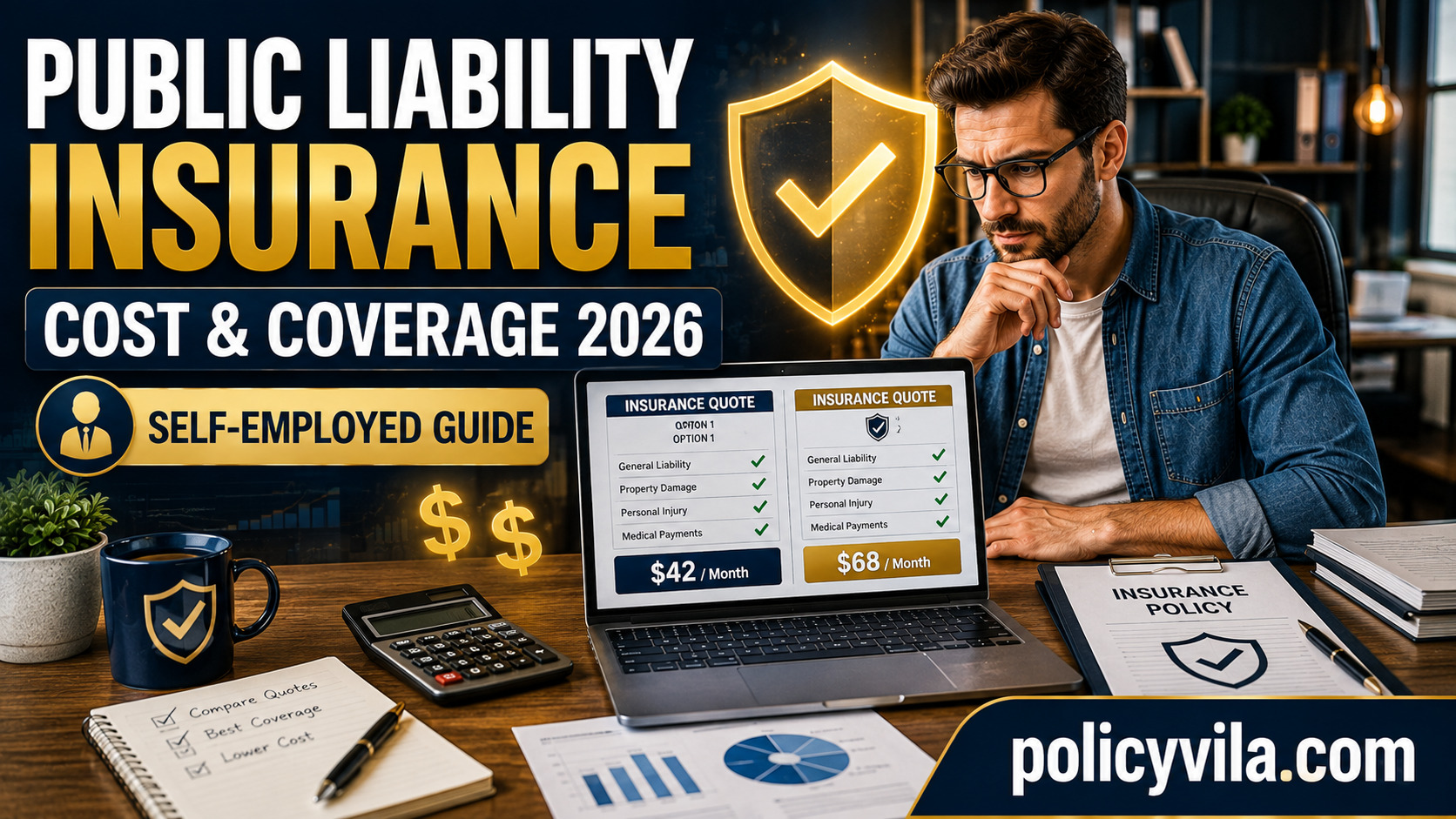
Suppose two self-employed business owners receive different quotes.
One policy costs less.
That does not automatically make it the better deal.
The cheaper policy could have:
- Lower liability limits
- Different deductibles
- More exclusions
- Less suitable coverage for the business activity
- Fewer endorsements
- Different claims conditions
- No coverage for a risk the buyer assumed was included
The right comparison is therefore:
Premium + coverage + limits + exclusions + conditions + business fit
rather than:
Premium alone
This is particularly important when a client, landlord, general contractor, or licensing body requires proof of insurance.
How Much Does Public Liability Insurance Cost for Self-Employed Workers?
There is no reliable universal 2026 price that applies to every self-employed person.
NAIC explains that business liability premiums can depend on factors including the type of products or services, sales or payroll estimates, claims experience, state laws, business operations, and the perceived risk associated with the business.
For that reason, an online “average” should be treated carefully.
A solo graphic designer working from home may have a very different liability profile from a self-employed roofer entering construction sites.
A useful way to think about pricing is: public liability insurance for self employed
Lower-risk operation + smaller exposure → potentially lower premium
Higher-risk operation + greater exposure → potentially higher premium
That is a framework, not a quote.
Illustrative example — not an insurance quote
Imagine two hypothetical self-employed businesses:
Business A: A freelance copywriter working remotely with little physical interaction with customers.
Business B: A self-employed contractor regularly working on customer properties.
Even if both businesses have similar annual revenue, their liability profiles can be very different. The contractor may face substantially different underwriting considerations because the physical work creates different opportunities for bodily injury or property damage.
Actual pricing must come from an insurer or licensed insurance professional based on the applicant’s information.
The Hidden Pricing Variables Most Buyers Overlook
Revenue is important, but it is not the whole story.
1. Type of work
The physical and financial consequences of a mistake vary dramatically by profession.
A construction-related business may have different liability exposure from a virtual consultant.
2. Annual revenue
Insurers may use business sales or revenue information when evaluating liability risk. NAIC notes that liability premiums are commonly linked to sales and payroll estimates and that premium adjustments may occur when actual figures differ from estimates.
3. Location
State laws, local requirements, business environment, and insurer availability can influence the insurance market.
4. Claims history
Previous claims can affect how an insurer evaluates risk.
5. Coverage limits
Higher limits generally mean the insurer is taking on more potential exposure, which can affect premium.
6. Business operations
Two businesses with the same job title may have completely different operations.
A photographer who works exclusively in a studio is not necessarily exposed to the same risks as one who regularly works at large public events.
7. Employees and subcontractors
Even a business that started as a one-person operation can develop additional exposures when workers or subcontractors become involved.
8. Contract requirements
A client may require specific limits or additional insured status. That can influence what policy structure you actually need.

The Coverage-Limit Question: $500,000, $1 Million or More?
Self-employed buyers often focus heavily on the premium without first determining the required limit.
That is backwards.
First ask: public liability insurance for self employed
What liability limit does my risk profile or contract require?
Then compare the cost of appropriate policies.
For example, a client contract may specify a particular liability limit. A landlord may require proof of insurance. A general contractor may require certain insurance terms before allowing a subcontractor onto a project.
Do not assume that because a policy certificate says “general liability” it automatically satisfies every contract.
Ask the insurer or agent to confirm the relevant requirements.
For businesses with unusually large exposures, commercial umbrella insurance can provide additional liability protection above underlying policies. NAIC notes that umbrella business liability coverage can provide additional protection beyond standard liability insurance.
The Self-Employed Coverage Gap Test
Before buying a policy, run this simple test.
Step 1: List your physical risks
Could someone be injured because of your work?
Step 2: List your property risks
Could you damage property belonging to a customer or another third party?
Step 3: List your professional risks
Could a customer claim that your advice, design, service, or professional work caused financial harm?
Step 4: List your transportation risks
Do you drive for business purposes or use vehicles as part of your work?
Step 5: List your employee risks
Do you have employees or other workers whose activities create additional exposures?
Step 6: Match each risk to insurance
Do not assume one policy handles all six categories.
This simple exercise can expose a major coverage gap before you buy.
General Liability vs. Professional Liability for Self-Employed Workers
This is one of the most important distinctions for freelancers and service providers.
| Situation | General Liability | Professional Liability |
|---|---|---|
| Client slips at your business location | Often relevant | Usually not the primary coverage |
| You damage client property | Often relevant | Usually not the primary coverage |
| You are accused of professional negligence | Usually not the main solution | Often relevant |
| Client claims your advice caused financial loss | Usually not the main solution | Often relevant |
| Libel/slander allegation | May be relevant depending on policy | Depends on circumstances |
| Business vehicle accident | Usually separate | Usually separate |
The SBA similarly distinguishes general liability from professional liability, describing professional liability as coverage for financial losses associated with malpractice, errors, and negligence in professional services.
A self-employed consultant, architect, engineer, accountant, designer, or technology professional should therefore investigate professional liability rather than assuming general liability alone is enough.
Four Self-Employed Buyers, Four Different Insurance Decisions
The Freelance Designer
A graphic designer works mostly online and rarely meets customers in person.
The primary liability exposure may differ from that of a tradesperson. The designer should ask whether general liability is needed for physical third-party risks and whether professional liability is more important for allegations connected to professional services.
Priority: Understand the difference between general liability and professional liability.
The Independent Contractor
A self-employed contractor works at customer properties and uses tools and equipment.
The potential for third-party bodily injury and property damage can be more significant.
Priority: Confirm appropriate general liability limits and investigate commercial auto, equipment, workers’ compensation, or other relevant coverage where applicable.
The Home-Based Consultant
A consultant operates from a home office and occasionally meets clients.
Homeowners or renters insurance should not automatically be assumed to cover business-related liability. NAIC warns that individual policies can have significant limitations for business property and business-related liability.
Priority: Determine whether dedicated business coverage is necessary and whether professional liability should be added.
The Self-Employed Photographer
A photographer works at weddings, corporate events, and private venues.
The business may have exposure involving customer property, venues, guests, equipment, and contractual requirements.
Priority: Examine general liability, property/equipment coverage, and venue-specific insurance requirements.
These examples are hypothetical. Actual insurance needs depend on the business’s operations and policy terms. public liability insurance for self employed
When a Self-Employed Person May Not Need Standard General Liability
Insurance should not be purchased simply because an SEO article says every business needs the same policy.
You may already have relevant protection through:
- Existing business coverage
- A professional liability policy
- A business owners policy
- A contract arrangement
- Another appropriate commercial policy
However, having an LLC does not automatically eliminate the need for insurance.
The SBA explains that an LLC or corporation can provide some protection for personal property, but that protection has limits, and business insurance can fill gaps.
The right question is not:
“Am I an LLC?”
It is:
“What financial risks remain if my business is sued or causes covered harm?”
BOP or Standalone General Liability?
Some self-employed businesses may encounter a business owners policy (BOP) rather than purchasing individual policies separately.
NAIC describes a BOP as a package that typically combines business property, business interruption/continuation, and liability coverage, although not every business qualifies and important exclusions can remain.
A BOP may be worth investigating when a business needs more than liability protection.
A standalone general liability policy may make more sense when the primary requirement is liability protection and the business’s other exposures are limited or insured separately.
Compare the actual coverage rather than assuming one format is automatically cheaper.
Can Self-Employed People Deduct Liability Insurance?
There can be a tax advantage to legitimate business insurance expenses, but this is an area where readers should avoid oversimplification.
The IRS states that liability insurance premiums are generally among business insurance costs that can be deductible when they qualify as ordinary and necessary business expenses.
The IRS also instructs Schedule C filers to deduct premiums paid for business insurance on the appropriate line.
That does not mean every insurance payment is automatically deductible.
Business structure, policy type, timing, personal use, and other tax circumstances can matter.
Treat the deduction as a possible tax consideration—not a reason to buy unnecessary coverage. public liability insurance for self employed

How to Compare Self-Employed Liability Insurance Quotes
When three insurers send quotes, put them side by side.
| What to compare | Quote A | Quote B | Quote C |
|---|---|---|---|
| Annual premium | |||
| Liability limit | |||
| Deductible | |||
| Business description | |||
| Exclusions | |||
| Additional insured options | |||
| Policy period | |||
| Endorsements | |||
| Professional liability included? | |||
| Commercial auto included? |
Do not compare a $1 million policy against another policy with different limits and assume the lower premium represents a better deal.
Nine Questions to Ask Before Buying
- What exact business activities are covered?
- What are the per-occurrence and aggregate limits?
- Is my work location covered?
- Are customer property claims addressed?
- Are there important exclusions for my profession?
- Do I need professional liability separately?
- Does the policy satisfy my client contracts?
- Can clients or landlords be added as additional insureds when appropriate?
- What circumstances could cause a claim to be denied?
The last question can be particularly useful because it moves the conversation away from marketing language and toward the actual contract.
A Simple “Cheap vs. Appropriate” Decision Framework
Choose the lowest-cost option only when: public liability insurance for self employed
- It provides the coverage you actually need.
- The limits meet your requirements.
- Exclusions do not create a major gap.
- Contractual requirements are satisfied.
- The insurer and policy are appropriate for your business.
Look beyond the cheapest policy when:
- You work at customer locations.
- You have significant physical liability exposure.
- Your clients require higher limits.
- You own substantial business assets.
- You have employees or subcontractors.
- Your professional work creates separate errors-and-omissions exposure.
The goal is not to buy the biggest policy available.
The goal is to buy appropriate protection for the risk you cannot comfortably absorb yourself.
Common Mistakes Self-Employed Buyers Make
Mistake 1: Searching only for the lowest premium
Fix: Compare limits, exclusions, deductibles, and coverage.
Mistake 2: Assuming an LLC replaces insurance
Fix: Treat legal-entity protection and insurance as separate forms of risk management.
Mistake 3: Assuming general liability covers professional mistakes
Fix: Ask specifically about professional liability or E&O.
Mistake 4: Ignoring contract language
Fix: Review the insurance requirements before purchasing.
Mistake 5: Forgetting business vehicles
Fix: Ask whether commercial auto coverage is needed.
Mistake 6: Assuming home insurance covers the business
Fix: Ask your insurer what business-related exclusions apply.
Mistake 7: Buying a policy and never reviewing it
Fix: Reassess after major changes in revenue, services, employees, locations, equipment, or contracts.
NAIC recommends reviewing business insurance periodically because changes in operations, employees, products, buildings, and other circumstances can affect coverage and costs.
The 2026 Self-Employed Liability Insurance Checklist
Before purchasing, save this checklist: public liability insurance for self employed
☐ Identify your main liability exposures
☐ Determine whether clients require insurance
☐ Identify the required liability limits
☐ Compare multiple insurers
☐ Compare identical limits
☐ Review exclusions
☐ Check deductibles
☐ Determine whether professional liability is needed
☐ Check business auto exposure
☐ Review home-business limitations
☐ Ask about additional insured requirements
☐ Confirm the policy matches your actual business activities
☐ Read the policy documents
☐ Reassess coverage when your business changes
read also: Life Insurance for Seniors Over 60: The Financial Questions Worth Asking First
Frequently Asked Questions
Is public liability insurance the same as general liability insurance in the U.S.?
Not necessarily in every legal or policy context, but U.S. consumers looking for “public liability” protection will often encounter general liability or commercial general liability insurance. The safest approach is to compare the actual coverage rather than relying solely on terminology.
How much does liability insurance cost for a self-employed person?
There is no universal price. Premiums can depend on the type of work, revenue, location, claims history, operations, limits, and insurer underwriting. A remote consultant and a construction contractor can receive very different quotes even if both are self-employed.
Do freelancers need general liability insurance?
Not every freelancer has the same insurance needs. A freelancer who rarely interacts physically with customers may have a different liability profile from someone working at customer locations or events. Professional liability may also be relevant for advice or professional services.
Does an LLC mean I do not need liability insurance?
No. An LLC can provide certain legal protections, but the SBA notes that business structures have limits and insurance can help fill financial-risk gaps.
Does general liability cover professional mistakes?
Generally, professional errors and omissions are a separate exposure. NAIC identifies professional liability as coverage for certain wrongful professional practices, errors, and omissions.
Can a self-employed person deduct liability insurance premiums?
Business liability insurance premiums may generally qualify as deductible business expenses when they meet IRS requirements for ordinary and necessary business expenses. Individual tax circumstances vary.
Does homeowners insurance cover a home-based business?
Not necessarily. Personal policies can contain limitations or exclusions for business-related property and liability. NAIC recommends investigating dedicated business coverage when those gaps exist.
Do clients have the right to require liability insurance?
A private client or contracting party may include insurance requirements in a business contract. The exact requirements depend on the agreement and applicable law. Review the contract before purchasing a policy.
What liability limit should a self-employed person choose?
There is no single appropriate limit. Start with contractual requirements, the potential severity of claims, the nature of the business, available assets, and the cost of additional limits. A licensed insurance professional can help evaluate the appropriate structure.
Is a BOP better than standalone general liability?
Not automatically. A BOP can combine liability with property and business-interruption coverage, but not every business qualifies and it may not address every exposure. Compare the complete coverage package and price.
Does general liability cover business vehicle accidents?
Generally, business vehicle liability requires commercial auto coverage rather than relying on standard general liability. NAIC specifically identifies vehicle-related business liability as an area requiring separate consideration.
What happens if my business grows after I buy a policy?
Your insurance needs can change as revenue, employees, services, locations, equipment, and contracts change. Notify the insurer when significant changes occur and review coverage periodically.
Can I buy liability insurance without employees?
Yes. Being self-employed does not itself prevent you from purchasing business liability coverage. Many commercial policies are designed for small or owner-operated businesses.
Is general liability enough for a consultant?
It may not be. A consultant should consider whether professional liability or errors-and-omissions exposure is more important than physical third-party liability. The appropriate combination depends on the actual services provided.
Should I buy insurance if I have enough savings to pay a claim?
That is a risk-management decision. Savings can help absorb certain losses, but a serious liability claim may involve legal defense costs and damages that exceed available cash. Consider the size and severity of risks you could realistically self-fund.
Conclusion: Choose Protection That Fits Your Actual Business Risk
For self-employed workers, choosing public liability insurance for self employed is not simply about finding the lowest monthly premium. The right policy depends on what you do, where you work, who you serve, and what could financially happen if a third party is injured or their property is damaged.
Start by identifying your biggest liability risks, then compare policies using the same coverage limits and business information. Pay close attention to exclusions, deductibles, policy limits, contractual requirements, and whether you need additional protection such as professional liability, commercial auto, or property coverage.
If your business already has insurance, review it whenever your services, revenue, employees, equipment, or contracts change. And before purchasing, verify the policy details with the insurer or a licensed insurance professional.
The goal is not to buy the most expensive policy—or simply the cheapest one. It is to find appropriate coverage that protects your business without paying for protection you do not need.