
Quick Answer: What Is Umbrella Insurance?
Umbrella insurance is a personal liability policy that sits on top of your existing auto, homeowners, or renters insurance and pays covered claims after those underlying policies reach their limits. Many personal umbrella policies start at $1 million in coverage and are sold in additional million-dollar increments, though minimums can vary by insurer. To qualify, insurers generally require you to carry certain minimum liability limits on your underlying policies first. Depending on the policy, umbrella coverage may also help with legal defense costs and a small number of liability situations that base policies often don’t address at all — though exactly what’s included and excluded always comes down to the specific policy wording.
What This Guide Covers
- How Umbrella Insurance Actually Works
- A Hypothetical Example
- What Umbrella Insurance Typically Covers
- What It Usually Doesn’t Cover
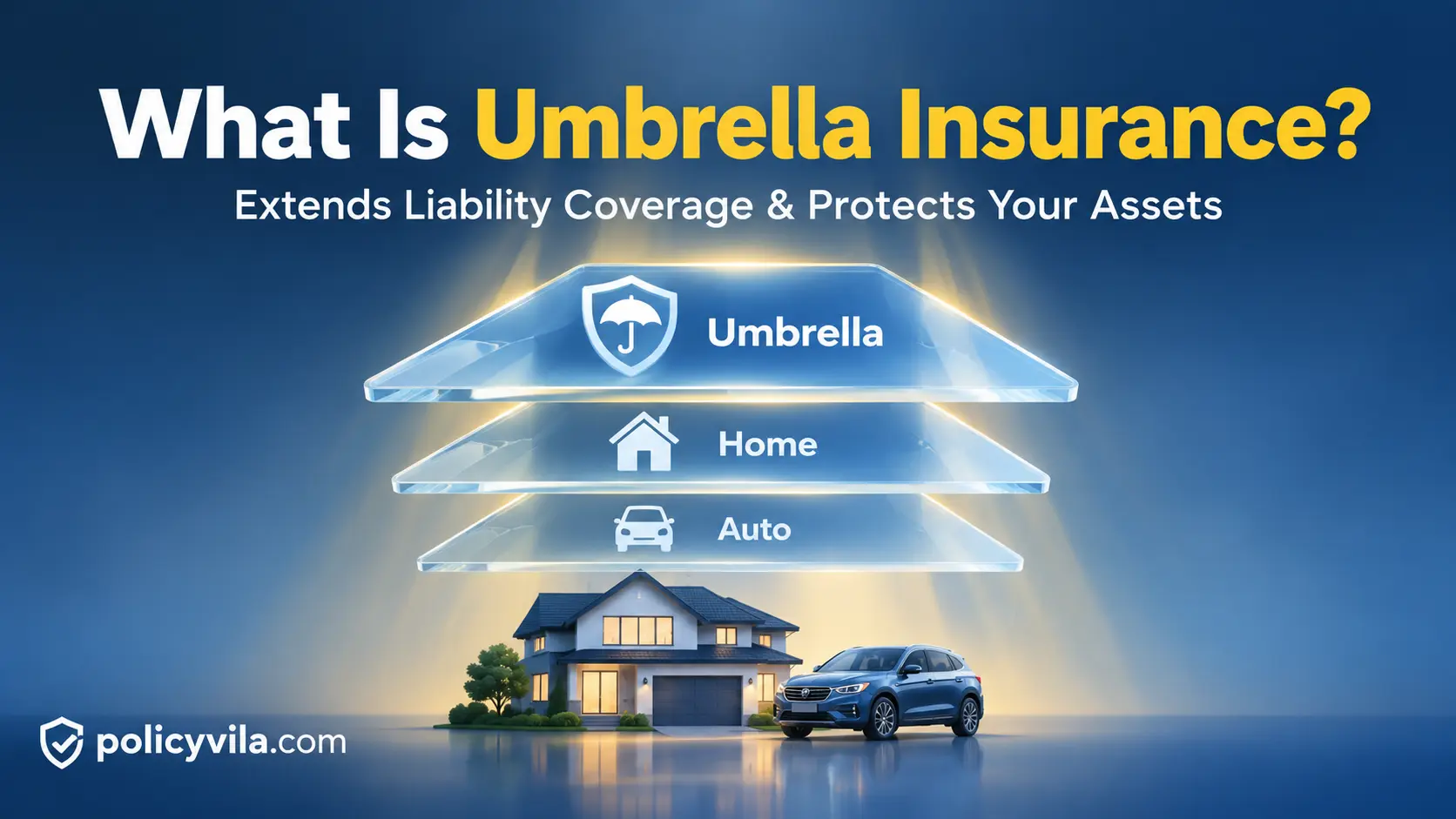
- How It Stacks on Your Existing Policies
- Who Tends to Consider It
- How Much Coverage to Consider
- What It Costs
- Underlying Policy Requirements
- Umbrella vs. Excess Liability Insurance
- Benefits and Real Limitations
- Common Mistakes
- Questions to Ask Before You Buy
- Frequently Asked Questions
How Umbrella Insurance Actually Works
The core idea is that umbrella insurance doesn’t replace anything you already have. It layers on top of it.
Your auto policy pays first, up to its limit. Your homeowners policy pays first, up to its limit. Only when a covered claim exceeds what an underlying policy pays does the umbrella policy begin contributing — up to its own, typically much higher limit.
The Insurance Information Institute describes this structure directly: a personal umbrella policy generally activates only after the underlying policy limits have been used up, subject to that policy’s own terms and conditions. That last phrase is worth remembering, because it means the umbrella isn’t a blanket guarantee — it responds according to what its specific policy language says.
Why the underlying policy has to pay first
This layered structure is also why insurers care about the strength of your base coverage. An umbrella policy is priced with the assumption that a meaningful amount of risk is already being absorbed underneath it. If your auto liability limit were very low, the umbrella would likely need to respond more often and for larger amounts — which is part of why insurers set minimum underlying limits as a condition of coverage.
This also points to a mistake worth avoiding: letting an underlying policy lapse, or lowering its limits below what the umbrella insurer requires, can leave a gap the umbrella won’t necessarily fill. Depending on the policy, you could end up responsible for that layer yourself.
What about a deductible?
Umbrella policies typically don’t work with a conventional deductible the way auto or home policies do. Some instead include a self-insured retention — an amount you’d be responsible for on a claim the umbrella covers but that isn’t addressed by any underlying policy at all. Not every umbrella policy includes one, and where they exist, amounts vary by insurer, so it’s a specific question worth asking.
A Hypothetical Example
To make the layering concrete, here’s a simplified, entirely hypothetical scenario. The figures are illustrative only — not a quote, not a statistic, and not a prediction of how any actual claim would be resolved, since real outcomes depend on policy language, state law, and the specific facts involved.
| Item | Illustrative Amount |
|---|---|
| Total covered liability claim | $800,000 |
| Underlying auto policy’s bodily injury liability limit | $300,000 |
| Auto insurer pays, up to its limit | $300,000 |
| Remaining balance | $500,000 |
| Without an umbrella policy, this remaining amount could become the policyholder’s responsibility, subject to the specific circumstances and applicable law | $500,000 |
| With a hypothetical $1 million umbrella policy, the umbrella could contribute up to | $500,000 |
The umbrella didn’t replace the auto policy in this example — it picked up where the auto policy’s limit ended. That’s the basic mechanic, though how any specific claim is actually handled depends entirely on the real policy language and facts involved.
[Relevant image: diagram showing an umbrella policy layered above auto and homeowners liability limits]
What Umbrella Insurance Typically Covers
Coverage details vary by policy and insurer, but these categories commonly appear:
- Bodily injury liability — injuries to other people that you’re found legally responsible for, whether from a car accident, an incident involving a pet, or someone injured on your property.
- Property damage liability — damage you cause to property belonging to someone else.
- Certain personal injury claims — some umbrella policies extend to claims like libel, slander, or false arrest, categories that standard auto and homeowners policies frequently don’t address at all. This is one of the ways umbrella coverage can be broader, not just larger.
- Legal defense costs — on many umbrella policies, defense costs for a covered claim are paid in addition to the liability limit rather than reducing it, though this isn’t universal. Check the supplementary payments section of your specific policy to see how it’s handled.
- Coverage that may extend beyond your home state — many policies apply to covered incidents in other states or, in some cases, other countries, though the specifics depend on the policy.
The defense-cost detail is easy to overlook but genuinely useful to understand: even a lawsuit that’s ultimately dismissed or decided in your favor can generate significant legal expense, and for many policyholders that’s a more realistic scenario than a catastrophic judgment.
What It Usually Doesn’t Cover
Umbrella insurance is a liability product. It isn’t general-purpose protection for your own losses, and that distinction trips people up often.
- Damage to your own property or your own injuries. If your home is damaged or you’re hurt in an accident, that falls under your homeowners, auto, or health coverage — not the umbrella.
- Intentional or criminal acts. These are generally excluded, though the exact wording and scope of this exclusion can differ between insurers.
- Business-related liability. A personal umbrella policy typically doesn’t extend to liability arising from a business you operate; that usually calls for separate commercial coverage. This is a common blind spot for people running a side business.
- Professional liability. Claims related to errors in professional work usually require separate professional liability or errors-and-omissions coverage.
- Certain contractual obligations you’ve voluntarily taken on outside your policy.
- Specific higher-risk exposures — depending on the insurer, certain aircraft, watercraft, or recreational vehicles may be excluded or may need to be separately scheduled on the policy. Some insurers also apply different underwriting considerations to particular animals or activities; these vary by insurer and by state, so this is worth confirming directly rather than assuming.
Exclusions differ meaningfully from one insurer to the next. The only reliable way to know what applies to you is reading your own policy’s exclusions section or asking your agent directly.
How It Stacks on Your Existing Policies
| Underlying Policy | What It Generally Handles | What the Umbrella May Add |
|---|---|---|
| Auto insurance | Bodily injury and property damage liability up to your policy limit | May continue paying covered claims above that limit |
| Homeowners insurance | Personal liability for injuries on your property or caused by you | May extend the liability limit well beyond the base policy |
| Renters insurance | Personal liability protection, even without owning property | Renters may often be able to purchase umbrella coverage on top of it |
| Landlord or rental property policy | Liability tied to a property you rent out | May extend above it if the property is disclosed and included on the umbrella policy |
| Watercraft or recreational vehicle policy | Liability tied to that specific vehicle | May extend above it, depending on the type of vehicle and the insurer’s terms |
The word “disclosed” in that landlord row matters. If you own rental property, additional vehicles, or a boat and don’t report them to your umbrella insurer, those exposures may not actually be covered.
Who Tends to Consider It
Umbrella insurance isn’t something every household needs, and no one can tell you that you specifically do without knowing your finances. It tends to come up in conversation for people who have either meaningful assets to protect, elevated liability exposure, or both.
- Homeowners with significant equity or savings
- Households with a newly licensed or teenage driver
- People who own rental property
- Households with a swimming pool, trampoline, or certain pets that raise liability questions with their insurer
- People who host gatherings or events at their home regularly
- Higher earners, since a serious judgment can potentially affect future income as well as current assets, depending on state law
- Boat owners, ATV owners, and households with multiple vehicles
- Anyone whose current liability limits are noticeably lower than what they’d stand to lose in a serious claim
That last point is really the practical test: compare what you have against what you’d actually lose, and see how large the gap is.
How Much Coverage to Consider
There’s no single correct amount that applies to everyone, and any number offered without knowing your specific finances should be treated as a starting point for discussion, not an answer. Factors worth working through include:
- Your net worth — savings, investments, home equity, and other assets that could potentially be reached in a judgment
- Your income and future earning potential — depending on state law, future wages can sometimes factor into how a judgment is satisfied, which is why income is often considered alongside current assets
- Your existing liability limits — the gap between what you have and what you could lose is essentially what you’d be filling
- Your specific risk factors — teen drivers, a pool, rental properties, or frequent entertaining are commonly cited considerations
- Where you live — litigation patterns and typical settlement or judgment sizes can vary by state and region
One approach some people use is comparing their total coverage to their approximate net worth plus some cushion for future income, then adjusting from there. Treat that as one possible starting framework rather than a rule — the right number for your household is really a conversation for a licensed insurance professional who can look at your actual numbers.
What It Costs
Pricing for umbrella insurance varies considerably, and no single number applies broadly. Published industry sources have described $1 million umbrella policies as generally inexpensive relative to the coverage they provide, with additional million-dollar layers typically costing less per dollar of coverage than the first layer. Beyond that general pattern, specific premium figures circulate widely across insurance websites and vary enough between sources that citing one as a dependable average would be misleading — the only way to know what a policy would actually cost you is to request a quote based on your own situation.
What does reliably affect the premium:
- The coverage limit you select
- The number of vehicles and drivers in your household, including any teen drivers
- The number and type of properties you own
- Your location and its litigation environment
- Your claims history
- Whether your current underlying limits already meet the insurer’s requirements, or need to be raised
- Specific risk factors the insurer considers relevant, such as a pool, watercraft, or certain pets
- The individual insurer’s own underwriting approach
One cost that’s easy to overlook: if your current auto or homeowners limits fall short of what the umbrella insurer requires, raising them adds to your total spending, even though that increase is often described as relatively modest.
Underlying Policy Requirements
Before issuing an umbrella policy, insurers generally require certain minimum liability limits on your underlying auto and homeowners or renters policies. Figures commonly cited across the industry include auto liability limits somewhere around $250,000 per person / $500,000 per accident, and roughly $300,000 in personal liability on a homeowners or renters policy.
These specific numbers show up often in industry materials, but they are not a legal standard or a figure every insurer uses identically. Requirements vary by insurer and by state, and some carriers set thresholds higher or lower than these commonly cited figures. Confirm the actual requirement with the specific insurer you’re applying to, rather than assuming these numbers will match your policy.
You’ll also typically need to disclose everything relevant to your application: all household drivers, all vehicles, all owned properties, watercraft, and any other exposure you’d want the umbrella to address.
Umbrella vs. Excess Liability Insurance
These terms are often used interchangeably, and in some cases the products genuinely overlap. There’s still a distinction worth understanding.
| Umbrella Insurance | Excess Liability Insurance | |
|---|---|---|
| Core function | Raises liability limits above underlying policies | Raises liability limits above underlying policies |
| Scope of coverage | May cover certain claims that underlying policies don’t address at all, such as some personal injury claims | Typically follows the underlying policy’s own terms and covers what that policy covers |
| Breadth | Can potentially be both higher and broader | Generally provides additional height, not necessarily additional breadth |
| Typical use | Broader personal liability protection across several exposures | Adding limit to a specific policy or exposure |
Neither product is universally better — which one fits depends on what you’re trying to solve. Because the actual policy language is what controls, ask directly whether a given policy simply follows the underlying form or provides its own, separately worded coverage grant.
Benefits and Real Limitations
| Potential Benefits | Real Limitations |
|---|---|
| Meaningfully higher liability limits, often for a relatively modest premium | Requires maintaining specific minimum underlying coverage, which can add to overall cost |
| May cover legal defense costs, sometimes outside the policy limit | Doesn’t cover your own property, your own injuries, business activities, or professional work |
| May cover certain claims your base policies exclude entirely | Exclusions vary by insurer and require actually reading the policy to understand |
| Additional coverage layers are often priced more efficiently than the first | Undisclosed vehicles, properties, or drivers may not be covered |
| Can help address exposure tied to future income, not only current assets | Isn’t a substitute for specialized coverage like professional liability insurance |
Common Mistakes
Assuming it covers everything
It’s liability coverage. Losses to your own property or person generally fall outside it.
Letting underlying coverage slip
Dropping auto liability below the required minimum, or letting a policy lapse, could leave that layer uncovered even with an active umbrella policy in place.
Not disclosing everything
A rental property, a boat, a newly licensed driver in the household — undisclosed exposures may not be covered, and finding that out after a claim is the worst possible time.
Expecting it to cover a side business
Personal umbrella policies generally exclude business liability. If you’re running any kind of business — consulting, rentals, an online shop — ask specifically how it’s treated under your policy.
Picking a limit without actually measuring exposure
Defaulting to the entry-level amount without checking it against your net worth and income can undercut some of the point of buying the coverage in the first place.
Skipping the exclusions section
It’s the least interesting part of any policy document and often the part that matters most.
read also: Vacant Home Insurance Between Tenants: Coverage Options, Risks & What Landlords Should Know
Questions to Ask Before You Buy
- What minimum liability limits do I need on my auto and homeowners or renters policies to qualify?
- Does this policy include a self-insured retention, and if so, how much?
- Are legal defense costs paid inside or outside the policy’s liability limit?
- Which of my vehicles, properties, and drivers need to be specifically listed?
- How does the policy treat any business or rental activity I’m involved in?
- Does the policy address personal injury claims like libel or slander?
- Does coverage apply outside my home state, or outside the country?
- What happens if one of my underlying policies lapses or its limits are lowered?
- What are the specific exclusions in this particular policy?
- What would each additional million dollars of coverage cost for my household?
Frequently Asked Questions
Can renters buy umbrella insurance?
Often, yes. Renters typically need a renters policy that meets the insurer’s minimum personal liability requirement, but owning a home usually isn’t a prerequisite. Confirm eligibility with individual insurers, since it can vary.
Does umbrella insurance cover auto accidents?
It may extend above your auto liability limits for a covered claim, once the underlying auto policy is exhausted. It doesn’t replace auto insurance and generally doesn’t cover damage to your own vehicle.
Does it cover lawsuits?
For covered liability claims, many policies address both a judgment or settlement and the legal defense costs involved, sometimes with defense costs paid separately from the limit. The specifics depend on the individual policy.
Does it cover rental property liability?
It may, provided the property is disclosed and included on the umbrella policy and you carry the required underlying landlord coverage. An undisclosed rental property is a common source of unexpected gaps.
Can one umbrella policy cover multiple cars and homes?
Often, yes, as long as each is disclosed and each underlying policy meets the insurer’s requirements. Confirm the specifics with your insurer.
What is a self-insured retention?
It’s an amount you may be responsible for on a claim the umbrella covers but that isn’t addressed by any underlying policy. Not every umbrella policy includes one, and where they exist, amounts vary by insurer.
Does umbrella insurance cover my own injuries or property?
Generally, no. It’s built around liability to others. Your own losses are typically handled by your health, auto, or homeowners coverage instead.
Do I need to buy it from the same company as my auto and home insurance?
Not always, though many insurers prefer or require this, and bundling can make it easier to confirm your underlying limits meet requirements. Some carriers do offer standalone umbrella policies — ask directly.
Will a claim on my umbrella policy affect my rates?
It can. Claims history is generally one of the factors insurers consider at renewal, and a claim reaching the umbrella layer may influence future pricing or availability, depending on the insurer.
Is $1 million enough coverage?
It depends entirely on your individual assets, income, and risk factors. It may be more than sufficient for some households and insufficient for others with greater net worth or higher exposure. This is worth discussing directly with a licensed insurance professional familiar with your finances.
Does it cover a teenage driver in the household?
Generally, if they’re properly disclosed as a household driver on your underlying auto policy. Families with a newly licensed driver are among those who commonly look into umbrella coverage, though whether it’s the right fit depends on individual circumstances.
What happens if my homeowners policy lapses?
You could lose the layer of protection the umbrella was built on top of, potentially leaving that portion of a claim uncovered. Maintaining continuous underlying coverage is generally treated as a condition of the umbrella policy.
Does it cover me if I’m sued over something I posted online?
Some policies extend to certain personal injury claims like libel or slander, which could be relevant in this kind of situation, though coverage varies considerably between insurers and intentional conduct is typically excluded. Ask your insurer directly how this is handled.
Is umbrella insurance tax deductible?
This depends on your specific circumstances — for example, whether the coverage relates to a rental property or business activity versus purely personal use — and on current tax rules. This is a question best directed to a qualified tax professional rather than answered generally here.
Final Thoughts
Umbrella insurance is built around a fairly narrow problem: a liability claim that costs more than the policies you already have are designed to pay. For many households, adding this layer of coverage is described in the industry as relatively affordable compared to the protection it can provide, though actual costs and terms depend entirely on your specific situation and insurer.
A reasonable starting point is simpler than shopping for a policy outright: pull out your current auto and homeowners declarations pages, find your liability limits, and compare them honestly to what you’d stand to lose in a serious claim — your savings, your home equity, potentially future income. If there’s a meaningful gap between those numbers, that’s the specific question umbrella insurance is designed to address, and it’s worth a conversation with a licensed insurance professional who can evaluate your actual circumstances.