The Quick Answer
Many homeowners and renters policies include personal property coverage that can apply to belongings even when those belongings are away from the home or rented residence — including at a workplace. That said, coverage is never automatic. It depends on the policy language, the cause of loss, applicable limits and exclusions, and whether the item counts as personal property or business property.
Two things commonly narrow the answer:
- Off-premises limits. Some policies apply a reduced limit to personal property located away from the residence, rather than the full contents limit.
- Business property treatment. Items used primarily for business — including work you do for an employer, in some policy forms — may be treated differently from purely personal belongings, and may be subject to tighter restrictions or excluded outright.
Add a deductible on top, and a modest loss may fall below the point where filing a claim makes financial sense. The rest of this article walks through how to figure out where your particular item lands.
What This Article Covers
- The quick answer
- What counts as “belongings kept at a workplace”
- Does homeowners insurance cover personal belongings at work?
- Does renters insurance cover belongings at work?
- What happens if the item is used for work?
- What if your employer owns the item?
- What if the item is stolen from your workplace?
- What if the item is damaged at work?
- Personal items vs. business equipment
- What about expensive items?
- Does your employer have to pay?
- What to keep on file before anything goes wrong
- What to check in your policy
- Working from home and elsewhere
- If you’re self-employed
- Homeowners vs. renters vs. business insurance
- Common mistakes
- How to check whether your item may be covered
- Worked examples
- FAQ
- Final takeaway
What Counts as “Belongings Kept at a Workplace”?
Insurers care about categories, not vibes. Before anything else, it helps to sort the item into the right bucket, because each bucket points toward a different policy.
- Personal property. Things you own and use for yourself — a phone, a jacket, a gym bag, reading glasses, a bike you ride to work.
- Personal property used for work. You own it, but you use it to do your job. A personal laptop you answer emails on. A car mechanic’s own socket set. This is where most disputes live.
- Employer-owned property. The company bought it and issued it to you — a work laptop, a badge scanner, a uniform, a company phone.
- Business-owned property. If you run your own business, equipment owned by that business is usually treated separately from your household goods, even when it lives in the same building you do.
Location and duration matter too. An item you carry in and out each day isn’t in the same position as a spare monitor and a pair of boots that have lived in your locker for two years. Some policy wording distinguishes property that is usually located at a residence you don’t occupy, or at another location, and treats it differently. That distinction can quietly change your limit.
Does Homeowners Insurance Cover Personal Belongings at Work?
It can. Homeowners policies typically include personal property coverage that isn’t strictly limited to the four walls of the house — many forms extend some protection to your belongings anywhere in the world, subject to the policy’s terms.
Where people get surprised is the size of that extension. A common structure applies a percentage of your contents limit to property that’s away from the residence premises, rather than the full amount. Whether your policy does that, and at what percentage, is something only your declarations page and policy form can tell you.
The second constraint is the cause of loss. Most standard homeowners forms cover personal property on a named perils basis — meaning theft, fire, certain water damage, vandalism and similar listed causes may be covered, while anything not on the list generally isn’t. Dropping your own phone on a concrete stairwell is a classic example of a loss that often falls outside a standard form unless you’ve added broader coverage.
A third constraint applies specifically to work situations: many homeowners forms include a sharply reduced special limit for property used primarily for business purposes, and that limit is sometimes even lower when the property is away from the home. More on that below.
Does Renters Insurance Cover Belongings at Work?
Renters insurance works on similar principles. A renters policy is essentially the personal property and liability portion of a homeowners policy without the building coverage, so the same off-premises concepts usually apply — including the possibility that belongings at your workplace fall under a reduced away-from-home limit.
Renters policies also tend to be written on named perils forms, so theft from an office may be a listed cause while accidental breakage may not be. And because renters policies are often purchased with lower contents limits overall, a percentage-based off-premises limit can end up being fairly small in practice.
Having renters insurance means you may have a path to a claim. It doesn’t mean any item, in any circumstance, at any location, is protected.
What Happens If the Item Is Used for Work?
This is the single biggest factor people overlook. Personal lines policies — homeowners, renters, condo — are designed to insure your household life, not your working life. When an item crosses over into business use, the policy language often changes how it’s treated.
The wrinkle: “business” in a policy usually has a defined meaning, and that definition doesn’t always match everyday usage. In some forms, a trade, profession or occupation is included, which can pull employee activities into scope. In others, employment for someone else is treated more narrowly. Definitions vary by insurer and form, so the only reliable move is to read the definitions section of your own policy rather than assume.
A practical way to think about it:
- Purely personal use. A jacket, a water bottle, a novel. Usually the simplest case for personal property coverage to apply, subject to limits and perils.
- Mixed use. Your own laptop used for both Netflix and spreadsheets. Insurers may look at primary use. Incidental work on a personal device is a different picture from a device bought specifically for the job.
- Clear business use. Tools you’re required to supply for your trade, or equipment for a side business. Often subject to reduced special limits, an endorsement, or a separate policy.
Business use doesn’t automatically kill coverage. It usually changes the limit, the conditions, or the section of the policy that applies. Some insurers offer endorsements that increase business property limits or extend them off-premises; availability and cost vary.
What If Your Employer Owns the Item?
If the item belongs to your employer, it isn’t your personal property, and your homeowners or renters policy generally isn’t the place to look for repair or replacement. The employer’s commercial property insurance — or their own decision about whether to repair or replace — typically governs.
Where this gets uncomfortable is when an employer asks an employee to pay for damaged or lost company equipment. Whether an employer may do that, and to what extent, depends on state wage and deduction laws, any written agreement you signed, and the specific circumstances. Rules differ meaningfully from state to state. If you’re facing that situation and real money is involved, your state labor department or an employment attorney is the right resource — not a general insurance article.
Separately, if you accidentally damage someone else’s property, the liability portion of a homeowners or renters policy sometimes comes into the conversation. But liability coverage has its own exclusions — often including property in your care, custody or control, and often including business-related liability — so it’s not a general-purpose backstop.
What If the Item Is Stolen From Your Workplace?
Theft of personal property away from home is one of the more likely scenarios to fall within a standard policy’s named perils — but “likely to be a covered peril” isn’t the same as “your claim will be paid.” Several things still have to line up.
- Ownership and classification. Was it genuinely your personal property, or business property under the policy’s definitions?
- The off-premises limit. Your away-from-home limit may cap the payout well below the item’s value.
- Special sublimits. Categories like jewelry, watches, firearms and cash often carry their own theft sublimits regardless of where the theft occurred.
- Your deductible. A stolen $700 phone against a $1,000 deductible produces no payment at all.
- Proof. Insurers generally expect you to substantiate ownership and value.
- Mysterious disappearance. An item that simply vanished with no evidence of theft can be harder to establish than a documented break-in.
Practical steps after a workplace theft: report it to your employer in writing and keep a copy, file a police report if appropriate, gather receipts and serial numbers, and then call your insurer to discuss whether a claim makes sense given your deductible and limits. Asking a coverage question is not the same as filing a claim — you can ask first.
What If the Item Is Damaged at Work?
With damage, the cause of loss does most of the work. Under a named perils form, the question is simply whether what happened appears on the list.
- Fire or smoke. Commonly a listed peril on standard forms.
- Sudden water discharge. Often listed in some form, though gradual leaks, seepage and flood are frequently excluded or handled separately.
- Vandalism. Frequently listed, sometimes with conditions.
- Accidental breakage by you. Often not a listed peril on a standard named perils form. Broader “open perils” personal property coverage is available from some insurers as an upgrade, and it comes with its own exclusions.
- Mechanical or electrical breakdown, wear and tear. Generally excluded as maintenance issues rather than sudden accidental losses.
If a coworker damages your property, there may be a liability angle involving that person or, depending on the facts, the business. That’s a separate question from your own first-party property coverage, and it can involve law rather than just policy language.
Personal Items vs. Business Equipment: Where to Look
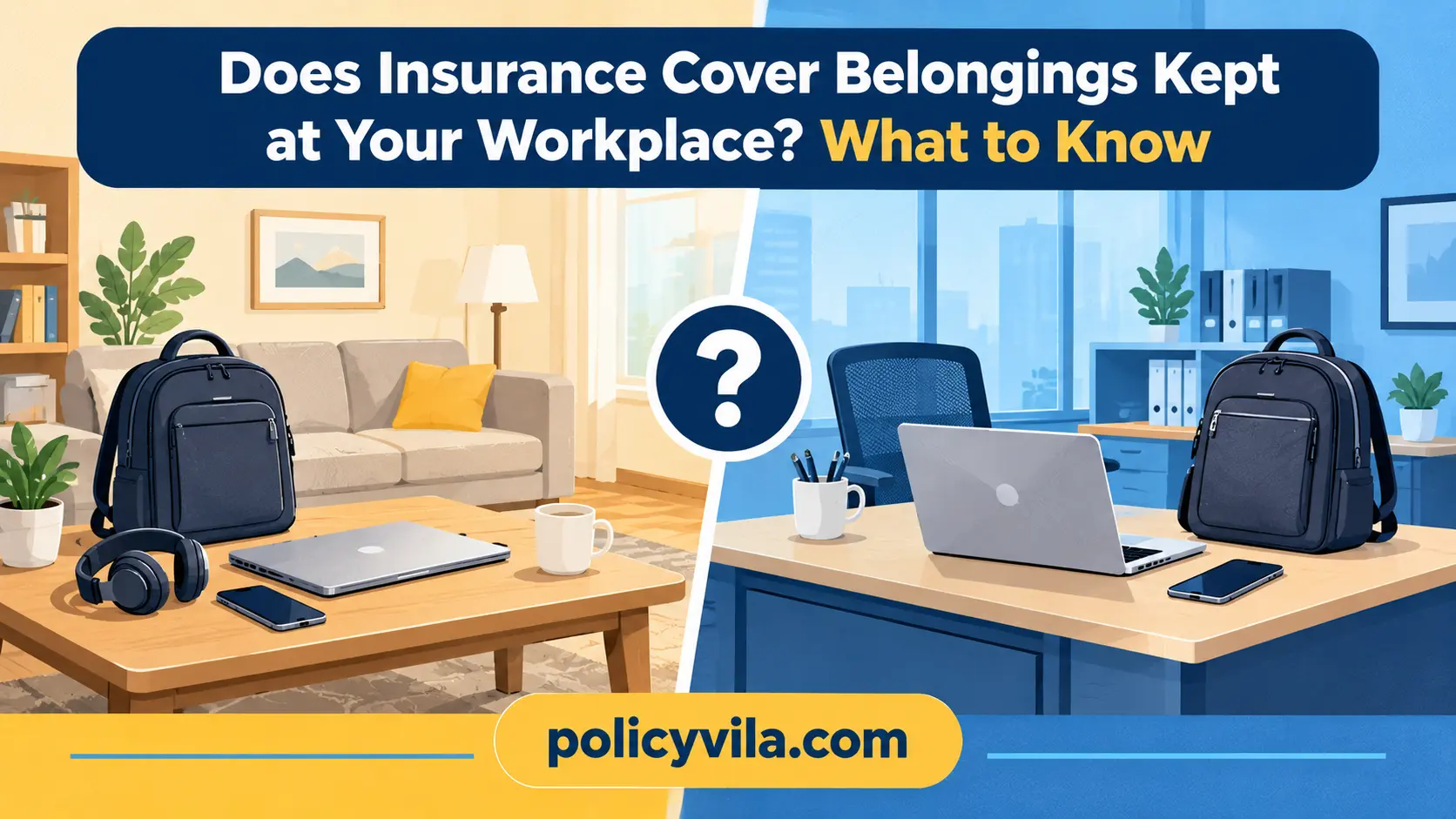
[Relevant image: a desk showing a personal phone and backpack beside company-issued equipment]
| Item / property type | Typical ownership | Insurance that may be relevant | Important consideration |
|---|---|---|---|
| Jacket, bag, water bottle, personal phone | You | Homeowners or renters personal property | Off-premises limit and deductible may matter more than whether it’s “covered” |
| Personal laptop also used for job tasks | You | Homeowners or renters, possibly under business property provisions | Primary use and the policy’s definition of business can change the applicable limit |
| Company-issued laptop or phone | Employer | Employer’s commercial property insurance | Not your personal property; reimbursement questions may involve state law and agreements |
| Tools you’re required to supply for your trade | You | Personal policy business property limit, an endorsement, or a commercial policy | Standard business property limits are often modest, especially off-premises |
| Equipment owned by your own business | Your business | Business owners policy or commercial property | Household policies commonly exclude or sharply limit business property |
| Bicycle parked at the workplace | You | Homeowners or renters personal property; sometimes a scheduled endorsement | Value, deductible and any bicycle-specific sublimit drive the outcome |
What About Expensive Items?
High-value belongings are where policy fine print bites hardest. Standard homeowners and renters forms commonly apply special sublimits to certain categories — jewelry and watches for theft, for instance — that are far below the overall contents limit. Those sublimits apply wherever the loss happens, workplace included.
If you routinely bring a professional camera, expensive jewelry, a high-end bike or specialized equipment to work, ask your insurer about scheduling those items. Scheduled personal property endorsements (sometimes called a personal articles floater) typically insure specific listed items, often on a broader basis and sometimes with a lower or no deductible. Availability, cost, appraisal requirements and terms vary by insurer and state.
Two things scheduling usually requires: proof of the item’s existence and value, and accurate description. Getting an appraisal or keeping the purchase invoice isn’t bureaucratic box-ticking — it’s what makes the endorsement work.
Does Your Employer Have to Pay If Your Belongings Are Stolen?
There’s no single national rule that requires an employer to reimburse employees for stolen or damaged personal belongings. Whether any obligation exists can depend on state law, the nature of the loss, the employer’s own policies, an employment contract or union agreement, and whether the employer did something that contributed to the loss.
It’s also worth separating two different things:
- Insurance coverage — whether a policy responds to the loss.
- Legal responsibility — whether someone can be held liable for it.
A business’s commercial property policy generally insures the business’s own property, not employees’ personal effects. Some employers voluntarily reimburse small losses as a matter of goodwill. Many employee handbooks say the opposite in plain terms: the company isn’t responsible for personal items brought on site. Reading your handbook takes ten minutes and tells you where you actually stand.
If a loss was substantial and you think the employer’s conduct played a role, that’s a legal question for a licensed attorney in your state, not something to resolve from a general guide.
What to Keep on File Before Anything Goes Wrong
Claims tend to go more smoothly for people who already have records. Building that file takes one evening.
- Receipts or order confirmations for anything valuable you take to work
- Photographs of each item, including any distinguishing marks
- Serial numbers and model numbers, stored somewhere that isn’t the device itself
- A simple written inventory with purchase dates and approximate values
- Appraisals for jewelry or specialty gear, kept current
- Copies of your declarations page and any endorsements
- After a loss: the workplace incident report, any police report number, and the names of anyone you notified
Keep the file somewhere you can reach it if your laptop or phone is the thing that’s missing — a cloud account you can access from another device, or a printed copy at home.
What to Check in Your Insurance Policy
You don’t need to read the whole form. Look for these specific things:
- Coverage C / personal property limit on your declarations page.
- Property away from the residence premises — is there a percentage or dollar cap, and what is it?
- Named perils list versus open perils, so you know which causes of loss apply.
- Special limits of liability — the list of categories with their own sublimits.
- Business property provisions — how much, and whether the limit drops when the property is off-premises.
- Definitions section — particularly how “business” and “residence premises” are defined.
- Exclusions that could apply to your situation.
- Your deductible, and whether any endorsement changes it.
- Duties after loss — notification deadlines, proof of loss requirements, whether a police report is expected.
- Replacement cost versus actual cash value on contents, which affects how much a five-year-old laptop is worth in a claim.
If any of that is unclear, your agent or the insurer’s service line can walk you through it. Asking a hypothetical coverage question doesn’t create a claim record.
What If You Work From Home and Also Use Another Workplace?
Hybrid arrangements create a moving target: the same laptop might be at your kitchen table Monday, in an office Tuesday, and in a coworking space Thursday. Each location can raise a different question under the same policy.
At home, the item is on the residence premises, so the off-premises limit generally isn’t the issue — but business property provisions still may be. At the employer’s office, both the off-premises limit and the business-use question can apply at once. In a coworking space or client site, the same off-premises analysis applies, and the space’s own insurance almost certainly doesn’t cover your personal belongings.
If you regularly move valuable equipment between locations, it’s worth telling your insurer how you actually use it. A policy priced on the assumption that your things stay home may not be the right fit.
What If You Are Self-Employed?
If you own the business, the property you use to run it is usually business property in insurance terms — even if you bought it with a personal credit card and store it in your garage. Personal lines policies commonly restrict business property to a small limit, and that limit is often smaller still when the property is away from the home.
Options to discuss with an agent typically include a business property endorsement on a homeowners or renters policy, a business owners policy (BOP), a standalone commercial property policy, or inland marine coverage for equipment that travels. Which fits depends on the value of your equipment, where it’s kept, and what else the business needs insured.
One common failure mode: assuming a homeowners policy will handle a few thousand dollars of business gear because it’s “just a side thing.” The distinction insurers draw is about use, not about how serious the business feels.
Homeowners vs. Renters vs. Business Insurance
| Policy type | Generally designed to address | Typical relevance to belongings at work |
|---|---|---|
| Homeowners | The dwelling, other structures, personal property and personal liability for an owner-occupied home | May extend some personal property coverage off-premises, often at a reduced limit and subject to business property restrictions |
| Renters | Personal property and personal liability for a tenant; no building coverage | Similar off-premises concepts to homeowners, often with smaller overall contents limits |
| Scheduled personal property endorsement | Specific high-value items listed individually | Can be useful for valuables that regularly travel, subject to the endorsement’s terms |
| Business owners policy / commercial property | Business property, business liability and often business income | The usual home for business-owned equipment; typically does not insure employees’ personal effects |
| Employer’s commercial policy | The employer’s own property and liability | Relevant to company-owned equipment, not generally to what you personally brought in |
Common Mistakes People Make With Belongings at Work
- Assuming “I have renters insurance” ends the inquiry. Having a policy and having a payable claim are different things.
- Not knowing the off-premises limit. Plenty of people learn about it for the first time during a claim.
- Blurring personal and business property. The laptop you bought for work may not be classified the way you’d assume.
- Skipping proof of ownership. No receipt, no photo, no serial number makes substantiating a loss harder.
- Forgetting the deductible. Many workplace losses are smaller than a typical deductible.
- Expecting the employer’s insurance to step in. It usually insures the business’s property, not yours.
- Filing reflexively. A small claim can affect future pricing or eligibility in some cases; it’s worth weighing.
- Reading the policy for the first time after a loss. By then, your options are set.
How to Check Whether Your Specific Item May Be Covered
- Identify the owner. You, your employer, or your business. This alone decides which policy is even in play.
- Identify where it was. On the residence premises, at an employer’s site, in a vehicle, in transit.
- Identify how it was being used. Personal, incidental work use, or primarily business.
- Identify the cause of loss. Theft, fire, water, breakage, disappearance with no evidence.
- Check the personal property section and the away-from-premises provision on your form.
- Check special limits and exclusions for that category of item and that cause.
- Compare the likely payout to your deductible. If the gap is small, a claim may not be worth filing.
- Call your insurer or agent with the specifics if anything is still ambiguous. Describe the facts plainly and ask how the policy would treat them.
Worked Examples
These are hypothetical illustrations, not predictions about any real claim. The point is to show which questions matter.
Personal laptop taken from an office desk
Owner: the employee. Location: employer’s premises. Use: mostly personal, some work email. Cause: theft. The questions to work through are whether theft is a listed peril, what the off-premises limit is, whether the policy’s business property provisions apply given the work email, and whether the laptop’s depreciated value exceeds the deductible.
Phone dropped and cracked in the warehouse
Cause of loss is accidental breakage. Under a named perils form, that’s frequently not a listed cause, so the analysis may end quickly unless broader coverage or a separate device plan is in place. Location barely matters here — the cause does.
Bicycle stolen from a workplace rack
The bike is personal property, so a personal policy may be the right place to look. Key issues: the off-premises limit, any bicycle sublimit, whether it was locked, evidence of theft, and whether the deductible leaves anything meaningful. For an expensive bike, scheduling it before the loss is the usual way to improve the position.
Camera left overnight in an office and destroyed in a fire
Fire is commonly a listed peril, which helps. But if the camera is used for paid photography work, it may be classified as business property with a much smaller limit. The same physical object can sit in two very different policy categories depending on use.
A mechanic’s own tools kept in a shop locker
Tools required for the trade are a textbook business property question. Personal policy business limits are often modest, especially away from home, so the practical answer frequently involves a tools endorsement or a commercial policy rather than the homeowners form.
A self-employed consultant’s equipment stored at a client site
Business-owned property, off the residence premises, used for business. That combination points toward commercial or inland marine coverage. Relying on a household policy here is where people find out the limit was a few thousand dollars at most — or nothing.
Frequently Asked Questions
Does renters insurance cover my belongings at work?
It may, through the policy’s personal property coverage, which often extends away from the rented residence. The amount available off-premises can be lower than your main contents limit, and the loss still has to be caused by something the policy covers.
Does homeowners insurance cover a laptop kept at work?
Possibly, though the answer hinges on how the laptop is used. A purely personal laptop is a cleaner case than one used primarily for your job, which may fall under the policy’s business property provisions and a smaller limit.
Does insurance cover a phone stolen from my workplace?
Theft is a listed peril on many standard forms, so a claim may be possible. In practice, the deductible often decides it — phone values frequently sit below common deductible amounts, which is one reason separate device protection exists.
Does renters insurance cover a bicycle kept at work?
Bicycles are generally personal property, so a renters policy may respond depending on the cause of loss. Check whether your policy applies a bicycle sublimit and what the off-premises limit is before assuming the full value is available.
What if my employer owns the equipment?
Then it isn’t your personal property, and your homeowners or renters policy generally isn’t the source of repair or replacement. The employer’s commercial coverage and internal policies govern, and any attempt to charge you may implicate state wage laws.
Does business insurance cover my personal belongings?
Commercial property policies are written to insure the business’s property. Employees’ personal effects are typically outside that scope, though some commercial forms include limited provisions — which is something only the specific policy can confirm.
What if I use my personal laptop for work?
Mixed use is common and genuinely ambiguous. Insurers may look at primary use, and some policy forms define business broadly enough to include employment activities. Worth a direct conversation with your agent rather than a guess.
Does insurance cover belongings left in an office overnight?
Leaving something overnight doesn’t by itself void coverage, but it can affect the facts of a theft claim — for example, whether there’s evidence of forced entry. The same off-premises limits and perils analysis applies either way.
Does a deductible apply to property lost at work?
Generally yes. Personal property claims are usually subject to the policy deductible regardless of where the loss occurred. Scheduled items under an endorsement sometimes have different deductible treatment.
What if my item is damaged by another employee?
Two separate paths exist: your own property coverage, and potential liability on the part of the person or business responsible. The second one is a legal question that depends on the circumstances and state law.
Does insurance cover personal belongings in a company vehicle?
Auto policies typically insure the vehicle rather than personal items inside it. Personal property taken from a vehicle is often handled under a homeowners or renters policy’s off-premises provisions, subject to the usual limits and deductible.
Should I photograph expensive belongings?
Yes — it’s low effort and it directly helps a claim. Photos, serial numbers and receipts are the practical evidence insurers ask for, and they’re much easier to collect before an item disappears.
Do I need separate coverage for business equipment?
Often, if the equipment has real value. Personal policy business property limits tend to be small, particularly off-premises. An endorsement or a commercial policy is the usual route, and an agent can size it to what you actually own.
What documents help most with a claim?
Proof of ownership and value carries the most weight: receipts, invoices, photographs, serial numbers, appraisals for valuables. For theft, add the workplace incident report and any police report.
How can I check whether my policy covers property away from home?
Look at the declarations page for your personal property limit, then find the away-from-premises provision in the policy form and the special limits section. If the wording is unclear, call the number on your declarations page and ask for a plain explanation.
read also: Life Insurance for Gig Workers: Complete Coverage Guide for 2026
Final Takeaway
Belongings you keep at work aren’t in an insurance dead zone — but they’re not automatically protected either. A homeowners or renters policy may reach them through personal property coverage, with the real outcome shaped by the off-premises limit, the cause of loss, any special sublimits, how the item is used, and your deductible.
The most useful thing you can do is unglamorous: pull up your declarations page, find the away-from-home provision and the business property limit, and see what they actually say. Photograph the valuable things you take to work and save the receipts somewhere you can reach from any device. If your gear is expensive or work-related, ask an agent whether scheduling it or adding business coverage makes sense.
Coverage details vary by insurer, policy form and state, so treat this as a map of the right questions rather than an answer for your specific situation. Your policy documents and your insurer are the authorities on what you have. For general consumer guidance, your state’s department of insurance and the National Association of Insurance Commissioners publish neutral material on how personal property coverage works.