
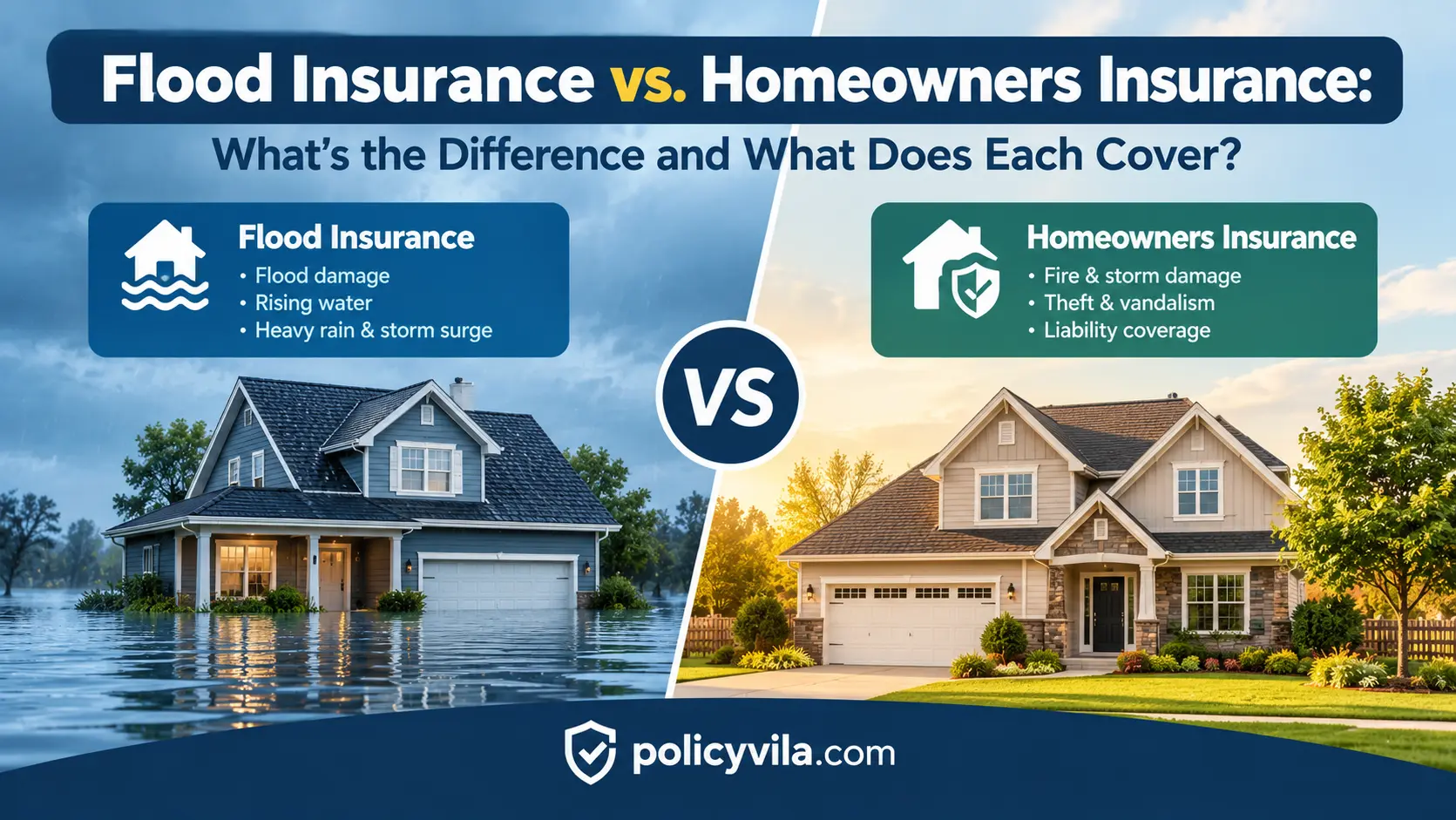
That distinction — not the water itself, but where it came from — is the single most important thing to understand about flood insurance and homeowners insurance. This guide walks through what each policy is actually built to do, where the line between them falls, and what questions are worth asking before you assume either one has you covered.
Does Homeowners Insurance Cover Flood Damage?
Generally, no. Standard homeowners insurance policies typically exclude flood damage as a covered cause of loss. According to the National Association of Insurance Commissioners, flood damage is excluded under standard homeowners policy forms, which means rising water from a storm surge, an overflowing river, or heavy rainfall entering from outside the home is typically not covered by a standard policy. Flood insurance is a separate product, available through the National Flood Insurance Program (NFIP) or private insurers, specifically designed to address that gap. Whether your particular policy has any flood-related provisions still depends on its exact wording, so this is worth confirming directly with your insurer.
What This Guide Covers
- What Actually Counts as a Flood
- Why the Source of the Water Is Everything
- What Homeowners Insurance Generally Covers
- What Flood Insurance Is Designed to Cover
- What Flood Insurance Typically Doesn’t Cover
- Homeowners Insurance vs. Flood Insurance, Side by Side
- Seven Hypothetical Water-Damage Scenarios
- What Flood Insurance Costs
- How Flood Insurance Deductibles Work
- The Waiting Period Before Coverage Starts
- Flood Zones and Why They Don’t Tell the Whole Story
- Is Flood Insurance Required?
- NFIP vs. Private Flood Insurance
- Basements and Below-Ground Areas
- Renters and Flood Risk
- Condo Owners
- Landlords and Rental Properties
- Common Misconceptions, Corrected
- A Neutral Decision Framework
- Questions to Ask an Insurer
- Common Mistakes
- Frequently Asked Questions
What Actually Counts as a Flood
In everyday conversation, “flood” describes almost any scenario involving unwanted water. In insurance terms, it’s narrower. A flood is generally understood as an excess of water on land that is normally dry, typically arising from causes such as heavy or prolonged rainfall, the overflow of a river or other body of water, storm surge along a coastline, rapid accumulation or runoff of surface water, or in some cases mudflow — with the specific definition ultimately set by the applicable policy or program.
A detail that surprises a lot of homeowners: many flood definitions require that the water affect a broader area, not just one isolated property — commonly framed as affecting two or more properties, or a minimum acreage of normally dry land. That’s part of why a single home flooding from a backyard drainage issue can raise a genuinely complicated coverage question, while a whole neighborhood flooding after a storm is more clearly treated as a flood.
This is a general explanation, not a universal legal definition. The specific policy or program you’re dealing with controls how “flood” is defined for your situation.
Why the Source of the Water Is Everything
Two homes can end up with the same soaked carpet and still be handled completely differently, because insurers generally focus on where the water came from and how it entered the property — not simply that water caused damage.
| Water Source | How It’s Commonly Approached |
|---|---|
| Burst or leaking interior pipe | Often addressed under homeowners insurance as sudden and accidental water damage, subject to policy terms |
| Roof leak during a storm | May be addressed under homeowners insurance if wind or another covered peril damaged the roof and rain then entered, subject to the policy’s specific wording and exclusions |
| Sewer or drain backup | Often excluded under a standard homeowners policy unless a specific sewer/drain backup endorsement has been added |
| Groundwater seeping in | Frequently excluded under both standard homeowners policies and, depending on the cause, may not fit a flood insurance policy’s definition either |
| River or lake overflow | Generally the kind of event flood insurance is designed to address, not homeowners insurance |
| Coastal storm surge | Generally treated as a flood event and addressed through flood insurance rather than standard homeowners wind or water coverage |
| Heavy surface water/runoff entering the home | Often treated as a flood event, particularly when it affects a broader area |
| Water entering through a door or window during a storm | Depends heavily on the cause — wind-driven rain and surface flooding can be treated very differently |
None of these categorizations are absolute. Actual claim treatment depends on the specific policy language, the documented cause of loss, and the circumstances of the event. When water damage happens, the practical first step is documenting exactly how and where the water entered, since that detail often determines which policy — if either — responds.
What Homeowners Insurance Generally Covers
A standard homeowners policy is typically built around several coverage components:
- Dwelling coverage — the physical structure of the home itself, against covered causes of loss such as fire or certain storm damage, subject to the policy’s terms.
- Other structures — detached structures like a garage, shed, or fence.
- Personal property — belongings inside the home, again subject to covered causes of loss and policy limits.
- Loss of use / additional living expenses — costs of temporary housing if a covered loss makes the home uninhabitable.
- Personal liability — protection if you’re found legally responsible for injury or property damage to someone else.
- Medical payments to others — limited medical costs for a guest injured on your property, regardless of fault.
These components respond to a defined list of covered causes of loss — commonly including things like fire, certain wind and hail events, and specific other named perils — which varies by the type of policy and the insurer. Flood is typically not among them. Whether any particular event is covered always comes down to the exact policy form and its exclusions.
What Flood Insurance Is Designed to Cover
Flood insurance — whether through the NFIP or a private insurer — is built specifically around flood-related losses, and it generally separates coverage into two distinct components.
Building property coverage
This addresses the physical structure. Under the NFIP’s Dwelling Form, building coverage may extend to elements such as the foundation, electrical and plumbing systems, HVAC equipment, water heaters, built-in appliances, flooring, walls, and built-in cabinetry — subject to the policy’s specific terms and whether the damage was directly caused by a qualifying flood event.
Contents (personal property) coverage
This is a separate, optional coverage that must generally be purchased on its own — it isn’t automatically bundled with building coverage. It’s intended to address personal belongings, such as furniture, clothing, and certain electronics, again subject to policy limits and specific terms.
Coverage limits
For most residential NFIP policies under the Dwelling Form, FEMA has published maximum limits of $250,000 for building coverage and $100,000 for contents coverage. Different NFIP policy forms apply to other property types — a General Property Form for larger residential and non-residential buildings, and a Residential Condominium Building Association Policy for condo associations — with their own applicable limits. Private flood insurers set their own limits, which can differ from NFIP’s caps in either direction. These figures can change, so confirm current limits directly through FEMA’s FloodSmart.gov or your insurer rather than assuming these numbers remain fixed indefinitely.
One detail worth knowing in advance: NFIP contents coverage has generally been paid out based on actual cash value — meaning depreciated value at the time of the loss — rather than full replacement cost. A well-used sofa is typically valued at what a used sofa is worth, not what a new one costs. Confirm how your specific policy values contents before assuming otherwise.
[Relevant image: comparison diagram showing flood insurance and homeowners insurance coverage layers]
What Flood Insurance Typically Doesn’t Cover
Flood insurance isn’t unlimited protection against every flood-related loss. Categories commonly treated as excluded or limited include:
- Property located outside the insured building — items in a detached structure not separately insured, for example.
- Landscaping — trees, shrubs, plants, and similar outdoor landscaping are generally not covered.
- Currency, precious metals, and certain valuable papers — these categories are commonly excluded or subject to strict limits under flood policies.
- Temporary living expenses — unlike many homeowners policies, standard flood insurance often does not include an equivalent to loss-of-use coverage; this varies by program and policy.
- Business personal property — coverage for business-related contents can be limited or require separate commercial flood coverage.
- Certain below-ground and basement contents — addressed in more detail below, since this is one of the more commonly misunderstood limitations.
- Damage from a cause that doesn’t meet the policy’s flood definition — even water damage that looks like flooding to a homeowner may fall outside the policy’s specific definition, depending on the circumstances.
Because these exclusions and limitations vary by policy and by whether coverage comes through the NFIP or a private insurer, treat this list as a starting point for questions rather than a complete or universal list.
Homeowners Insurance vs. Flood Insurance, Side by Side
| Feature | Homeowners Insurance | Flood Insurance |
|---|---|---|
| Main purpose | Broad protection for the home, belongings, and personal liability against a defined list of covered perils | Protection specifically for flood-related building and/or contents damage |
| Flood damage | Generally excluded | Specifically what the policy is designed to address |
| Fire | Commonly a covered peril, subject to policy terms | Not applicable — flood insurance addresses flood-related loss |
| Wind-related damage | Often covered, though wind and hurricane treatment varies by state and policy | Not applicable unless the damage is specifically flood-related |
| Personal liability | Commonly included | Not included |
| Building coverage | Dwelling coverage, subject to covered perils | Building property coverage, subject to flood-specific terms and limits |
| Personal belongings | Personal property coverage, subject to covered perils | Separate, optional contents coverage |
| Additional living expenses | Commonly included for covered losses | Often not included, or handled differently — check the specific policy |
| Deductibles | One policy deductible, or sometimes separate wind/hurricane deductibles depending on state | Separate deductibles for building and contents coverage |
| Separate policy required? | N/A | Yes — flood insurance is a distinct policy, whether through the NFIP or a private insurer |
| Typical use case | General homeownership risk | Properties with any degree of flood exposure, which can extend beyond obviously high-risk areas |
Seven Hypothetical Water-Damage Scenarios
These are illustrative examples only, not actual claims or guaranteed outcomes. Real claim decisions depend on the specific policy, documented cause of loss, and circumstances involved.

1. River water enters a home after heavy regional rainfall
This is the kind of event flood insurance is generally designed to address. A homeowners policy would typically not be expected to respond to this cause of loss.
2. A supply line under a bathroom sink bursts
This is commonly the kind of sudden, accidental interior water damage that a homeowners policy may address, subject to its specific terms and any relevant exclusions.
3. Wind damages the roof during a storm, and rain then enters through the damaged area
This scenario often raises two separate questions: whether the wind damage itself is covered, and whether the resulting water intrusion is treated as a consequence of that covered peril. The answer depends heavily on the specific policy wording.
4. Coastal storm surge reaches the home
Storm surge is generally treated as a flood event and is the kind of loss flood insurance is built around, rather than standard homeowners wind or water coverage.
5. A municipal sewer line backs up into the basement
Sewer and drain backup is frequently excluded from standard homeowners policies unless a specific endorsement has been added, and it may also be treated differently under a flood policy depending on the cause. This is a genuinely important gap to ask about directly.
6. Straight-line wind damages a roof with no associated flooding
Wind damage without a flood component is more commonly the kind of loss addressed under homeowners insurance, subject to the policy’s wind-related terms, which can vary meaningfully by state, especially in coastal regions.
7. Floodwater damages furniture inside a home with a flood insurance policy
Whether the furniture itself is covered depends on whether contents coverage was purchased separately from building coverage — a detail worth confirming before assuming both are automatically included.
What Flood Insurance Costs
There is no reliable single national average premium that applies to every property, and any figure presented as a universal flood insurance cost should be treated with caution. Premiums are influenced by a combination of factors, including:
- The property’s location and specific flood exposure
- Building characteristics, such as construction type and foundation
- Elevation of the structure relative to base flood elevation
- The coverage limits selected for building and contents
- The deductible chosen
- Property type — for example, a single-family home versus a condo unit
- Whether coverage is obtained through the NFIP or a private insurer, since pricing approaches differ
- Underwriting and rating factors specific to the individual property
The only way to know what flood insurance would actually cost for a specific property is to request a quote for that property. Public cost-index tools exist that track transaction-based averages by region, but these reflect broad market data rather than a personalized estimate for any individual home.
How Flood Insurance Deductibles Work
A deductible is the amount you’re responsible for before your policy pays toward a covered loss. Flood insurance deductibles work on the same basic principle as a homeowners deductible, with one structural difference worth understanding: because building coverage and contents coverage are separate components, many flood policies apply separate deductibles to each — meaning you could face one deductible for structural damage and a different one for damaged belongings, rather than a single combined amount.
Choosing a higher deductible can lower your premium but increases what you’d pay out of pocket if a claim occurs. Actual deductible amounts and options vary by policy and insurer, so check your declarations page or ask your agent directly rather than assuming a specific figure applies to you.
read also: Health Insurance Deductibles Explained: What Every Family Must Know in 2026
The Waiting Period Before Coverage Starts
Flood insurance often isn’t effective immediately after purchase. For NFIP policies, FEMA has generally described a standard 30-day waiting period before a new policy takes effect, with specific exceptions — commonly cited examples include certain situations tied to a mortgage closing or loan transaction, and coverage related to a recent flood map change, among others FEMA outlines. Private flood insurers may offer different waiting periods, sometimes shorter, depending on the carrier and circumstances.
The practical implication is straightforward: flood insurance isn’t something you can reliably buy the day before a storm arrives and expect to be covered for that specific event. If flood exposure is a real consideration for your property, it’s worth investigating coverage well before severe weather is forecast, not during an active warning.
Flood Zones and Why They Don’t Tell the Whole Story
It’s a common assumption that flood risk is essentially limited to homes near rivers, lakes, or the coast, or to properties formally mapped into a high-risk flood zone. That assumption doesn’t match the available data. Multiple sources citing FEMA figures indicate that a meaningful share of NFIP flood claims — commonly cited as more than 20% — come from properties located outside FEMA’s designated high-risk flood zones.
Flood maps are a useful reference point, but they reflect a modeled risk assessment as of a given date — they don’t account for every local factor that can change flood exposure over time, including nearby development, changes in drainage patterns, and shifting weather trends. A property being outside a high-risk zone reduces the odds of flooding; it doesn’t eliminate them, and it doesn’t necessarily reflect current on-the-ground conditions. Checking your property’s designation directly through FEMA’s Flood Map Service Center is a reasonable step, but it shouldn’t be treated as a final word on your actual flood risk.
Is Flood Insurance Required?
Whether flood insurance is required depends on which kind of “required” you mean, and these get confused often.
- Federal mandatory purchase requirement — federal law has generally required flood insurance for properties located in a FEMA-designated Special Flood Hazard Area that carry a mortgage from a federally regulated or federally backed lender. This requirement is tied to the property’s flood zone designation and the type of loan, not to whether the home has ever actually flooded.
- Individual lender requirements — a specific mortgage lender may have its own requirements beyond the federal minimum, particularly for certain loan types.
- Voluntary coverage — outside these situations, flood insurance is generally not legally mandated, though it remains available to purchase voluntarily, including for properties outside high-risk zones.
Not every homeowner is required to carry flood insurance, and the requirement that does exist depends on specific, checkable factors — your property’s flood zone status and your loan’s characteristics — rather than a blanket national rule. If you’re unsure whether it applies to you, your mortgage servicer or lender can confirm directly.
NFIP vs. Private Flood Insurance
U.S. property owners shopping for flood insurance will generally encounter two broad options.
The National Flood Insurance Program is a federal program administered by FEMA. NFIP policies are sold through participating insurers and agents, but the program itself sets the standardized policy forms and maximum coverage limits, and FEMA has indicated that NFIP rates don’t vary between the companies or agents selling them.
Private flood insurance is offered by individual insurance companies operating outside the federal program. Private insurers set their own coverage limits, pricing, underwriting criteria, and policy features, which can mean higher available limits, different deductible options, or coverage for things the standard NFIP form doesn’t address — though availability and terms vary considerably by insurer, location, and property.
Neither option is universally better. NFIP offers standardized, federally backed coverage widely accepted by mortgage lenders, but its coverage limits are capped. Private flood insurance can sometimes offer higher limits or additional features, but availability, pricing, and lender acceptance can vary by carrier and by property. Comparing an NFIP quote against available private options for your specific property is a reasonable way to evaluate which fits your situation.
A note on current program status: The NFIP’s statutory authority is subject to periodic congressional reauthorization, and its authorization has faced expiration deadlines in recent years, generally resulting in temporary lapses or extensions handled through federal legislative action. If you’re relying on the NFIP, it’s worth confirming the program’s current operating status directly through FEMA or FloodSmart.gov, since this can change based on federal funding and reauthorization decisions.
Basements and Below-Ground Areas
Basement coverage under flood insurance is one of the more commonly misunderstood areas, and it deserves a careful explanation rather than a blanket statement in either direction.
Under NFIP rules, certain building components in a basement or below-ground area may be covered — items like the foundation, certain plumbing and electrical systems, and central air conditioning equipment or furnaces have generally been treated as eligible for building coverage, subject to the policy’s specific terms. However, contents commonly kept in a basement — finished flooring, drywall below a certain point, furniture, and personal belongings — have often faced significant limitations or exclusions under standard flood policy rules.
It is not accurate to say basements are “never covered,” and it’s equally inaccurate to assume a finished basement is treated the same as an above-ground living space. The applicable policy or program’s specific basement provisions are what determine the outcome, and these are worth reviewing directly rather than assuming either extreme.
Renters and Flood Risk
Renters face a different version of this issue, since they generally don’t carry building coverage at all. A renters insurance policy is typically built around personal belongings and liability, not the structure itself — which remains the property owner’s responsibility.
Renters may be able to obtain flood insurance covering their personal contents, separate from any building coverage carried by the property owner or landlord. If flood exposure is a genuine concern at a rented property, contents-focused flood coverage — rather than relying on a landlord’s coverage, which generally doesn’t extend to a tenant’s belongings — is the relevant option to investigate.
Condo Owners
Condo ownership adds a layer of complexity, since responsibility for different parts of the property is often divided between an association-held master policy and the individual owner’s own coverage.
A condo association’s master policy may address the building structure and common areas, potentially including some flood coverage through a Residential Condominium Building Association Policy under the NFIP or a private equivalent — but the specifics depend entirely on the association’s governing documents and its own insurance decisions. Individual condo owners are generally still responsible for their own unit’s interior finishes, personal belongings, and any gaps not addressed by the master policy, which is where individual condo insurance and, potentially, individual flood contents coverage come in.
Reviewing the condo association’s governing documents and current insurance declarations — rather than assuming the master policy handles everything — is the only reliable way to know where your personal responsibility begins.
Landlords and Rental Properties
Owners of rental property face considerations beyond a standard homeowners policy, which is generally built around an owner-occupied residence rather than a rental arrangement. Relevant factors for landlords include:
- Property (building) coverage — typically addressed through a landlord or dwelling fire policy rather than a standard homeowners form.
- Liability coverage — protection if a tenant or visitor is injured on the property.
- Flood exposure — the same flood-versus-water-damage distinction applies to rental property, and a standard landlord policy generally doesn’t include flood coverage any more than a standard homeowners policy does.
- Tenant belongings — a landlord’s policy generally does not cover a tenant’s personal property; that responsibility typically falls to the tenant’s own renters insurance.
A standard homeowners policy should not be assumed to automatically extend to a rental-property situation. Landlords should confirm they’re carrying an appropriate landlord or rental-property policy, and evaluate flood exposure for that property separately, just as they would for a primary residence.

Common Misconceptions, Corrected
“My homeowners insurance covers all water damage.”
Not generally. Homeowners insurance typically addresses certain types of water damage, like a sudden interior pipe burst, while excluding flood-related water damage from outside sources. The source of the water matters more than the fact that water caused the damage.
“If I live outside a flood zone, I don’t need flood insurance.”
Flood zone maps reflect a modeled risk assessment, not a guarantee. A meaningful share of flood claims have come from properties outside designated high-risk zones, based on figures commonly cited from FEMA data.
“Flood insurance only matters near the ocean.”
Flooding can result from heavy rainfall, river overflow, and rapid surface water accumulation well away from coastal areas. Inland and riverine flooding is a real and well-documented category of flood risk.
“My mortgage automatically includes flood coverage.”
A mortgage doesn’t include insurance coverage by itself. If your loan and property meet the criteria for the federal mandatory purchase requirement, you’d be required to obtain a separate flood policy — it isn’t bundled into the loan automatically.
“Flood insurance covers every item in my basement.”
Basement coverage under flood insurance is limited and specific, generally addressing certain building components more than furnishings and personal belongings kept below ground. Check your policy’s specific basement provisions.
“Flood insurance and homeowners insurance are interchangeable.”
They address different, though sometimes adjacent, risks. Many properties may benefit from both, depending on their specific exposure, rather than treating one as a substitute for the other.
“One deductible always applies to everything.”
Flood policies frequently apply separate deductibles to building coverage and contents coverage, unlike the single deductible structure common on many homeowners policies.
A Neutral Decision Framework
This isn’t personalized insurance advice, and it isn’t a recommendation about what you specifically should buy. It’s a starting checklist for what’s worth reviewing.
Consider reviewing flood insurance if you have:
- A property located in or near a flood-prone area, based on current FEMA flood maps or local knowledge
- A mortgage lender with flood-related coverage requirements
- A home near a river, lake, coastline, drainage area, or otherwise low-lying location
- A basement or other below-ground living or storage space
- Significant personal property that would be costly to replace if damaged by flooding
- Concern about flood-related losses that your current homeowners policy may not address
Whether any of these apply to your specific situation — and what to do about it — is worth discussing directly with a licensed insurance professional who can review your actual policy and property.
Questions to Ask an Insurer
- Does my current homeowners policy exclude flood damage, and how is “flood” defined in that policy?
- What flood coverage options are available for my specific property?
- What building coverage limit would apply, and is it sufficient for my home’s rebuild cost?
- Is contents coverage available, and is it included or does it need to be purchased separately?
- What deductible would apply to building coverage, and what deductible would apply to contents?
- Is there a waiting period before this coverage becomes effective, and are there any exceptions that apply to me?
- How are items in my basement or below-ground area treated under this policy?
- What specific exclusions apply to this policy?
- Does this policy include any coverage for additional living expenses if I’m displaced?
- Is my property eligible for NFIP coverage, private flood coverage, or both?
- Does my mortgage lender specifically require flood insurance for this property?
- How would a sewer or drain backup be treated under this policy versus my homeowners policy?
- How would coastal storm surge specifically be treated?
- What documentation would I need to provide if I had to file a flood claim?
Common Mistakes
Assuming homeowners insurance covers flooding
Fix: Confirm directly with your insurer whether flood damage is excluded from your specific policy, rather than assuming either way.
Waiting until severe weather is approaching to look into coverage
Fix: Given typical waiting periods before flood coverage takes effect, investigate your options well ahead of storm season, not during an active forecast.
Looking only at the premium and ignoring the deductible structure
Fix: Review both the building and contents deductibles together with the premium to understand your real out-of-pocket exposure.
Not checking whether contents coverage is included
Fix: Confirm whether personal belongings are covered automatically or require a separate purchase — this is a frequent point of confusion.
Ignoring basement-specific limitations
Fix: Ask specifically how your policy treats below-ground building components versus below-ground contents.
Assuming flood-zone status tells the entire story
Fix: Treat your flood zone designation as one data point, not a complete risk assessment, given how many claims occur outside high-risk zones.
Misunderstanding what “flood” means under the policy
Fix: Ask your insurer for the specific definition used in your policy, rather than assuming your own everyday understanding of the word applies.
Assuming a lender requirement means the policy covers everything you need
Fix: A lender-required minimum coverage amount may not match your actual rebuild cost or the value of your belongings — review your real exposure separately.
Not reviewing exclusions
Fix: Read the exclusions section of both your homeowners and any flood policy directly, rather than relying on assumptions from either.
Failing to keep an inventory of valuable belongings
Fix: A documented, dated inventory — photos, receipts, serial numbers — makes any future claim, flood or otherwise, considerably easier to support.

Frequently Asked Questions
Is flood insurance separate from homeowners insurance?
Yes. Flood insurance is a distinct policy, obtained either through the NFIP or a private insurer, separate from a standard homeowners policy.
Does flood insurance cover rainwater?
It can, depending on how the rainwater enters the property and whether the event meets the policy’s flood definition — for example, surface water accumulation from heavy rain reaching the home is commonly treated as a flood event, while rain entering through a damaged roof may be evaluated differently.
Does homeowners insurance cover water coming through a damaged roof?
It may, if the roof damage itself resulted from a covered peril like wind, subject to the specific policy’s terms and any relevant exclusions. This is worth confirming directly rather than assuming.
Does flood insurance cover personal belongings?
Only if contents coverage has been purchased, since it’s typically a separate, optional component from building coverage under most flood policies.
Does flood insurance cover temporary housing?
Often not in the same way homeowners insurance does — many standard flood policies don’t include an equivalent to loss-of-use coverage, though this varies by program and policy. Confirm directly with your insurer.
Can renters get flood insurance?
Generally, yes, for their personal contents. Renters typically don’t need or purchase building coverage, since that responsibility usually belongs to the property owner.
Can condo owners get flood insurance?
Yes, though coverage responsibility may be split between the condo association’s master policy and the individual owner’s own coverage, depending on the association’s governing documents.
Is flood insurance required if I’m outside a high-risk flood zone?
Generally not by federal mandate, since the mandatory purchase requirement is typically tied to Special Flood Hazard Area designation and a federally backed mortgage. It remains available to purchase voluntarily regardless of zone.
How long does flood insurance take to become effective?
NFIP policies have generally carried a 30-day waiting period, with specific exceptions such as certain mortgage-related transactions or recent flood map changes. Private insurers may offer different timelines. Confirm the applicable waiting period with your specific insurer.
Does flood insurance cover sewer backup?
It depends on the cause of the backup and the specific policy — sewer and drain backup is a commonly excluded or separately endorsed coverage under both homeowners and flood policies, so this is worth asking about directly rather than assuming either way.
Does homeowners insurance cover storm surge?
Generally not. Storm surge is typically treated as a flood event and addressed through flood insurance rather than standard homeowners coverage.
Can I have homeowners and flood insurance at the same time?
Yes. Many property owners carry both, since the two policies are designed to address different categories of risk rather than duplicate each other.
What’s the difference between flood insurance and water backup coverage?
Water backup coverage is typically an endorsement added to a homeowners policy addressing specific situations like sewer or drain backup, while flood insurance is a separate policy addressing flood events as defined by the applicable program or insurer. They address different causes of water damage.
How much flood insurance do I need?
This depends on your property’s rebuild cost, the value of your personal belongings, your specific flood exposure, and any lender requirements. A licensed insurance professional can help evaluate this for your specific property rather than relying on a general rule.
Can flood insurance be purchased right before a storm is forecast?
Generally not effectively, given typical waiting periods before coverage takes effect — purchasing a policy immediately before an approaching storm usually won’t provide coverage for that specific event.
What happens if my mortgage lender requires flood insurance?
You’d generally need to obtain and maintain a qualifying flood policy meeting the lender’s requirements as a condition of the loan; failing to do so can result in the lender purchasing more expensive, lender-placed coverage on your behalf under many loan agreements.

Final Thoughts
Homeowners insurance and flood insurance are designed for different types of risk. Standard homeowners insurance generally does not replace dedicated flood coverage, and the correct interpretation for any specific situation depends on the exact policy language and the circumstances of the loss — not on a general rule that applies to every home the same way.
Before assuming either policy has a particular scenario covered, review your current declarations pages, read the exclusions sections closely, understand your property’s actual flood exposure beyond just its zone designation, and confirm whether your mortgage lender has specific requirements. That review, done ahead of time rather than after water is already on the floor, is what actually determines whether either policy does what you expect it to.