

A low monthly premium can hide a much higher cost the first time a family needs an ER visit, a diagnostic test, or a specialist referral. Understanding how deductibles actually work — and how they interact with copays, coinsurance, and your out-of-pocket maximum — makes it possible to compare plans by total realistic cost, not just the number on the monthly bill.
Quick Answer: What Is a Health Insurance Deductible?
A health insurance deductible is the amount you pay out of pocket for covered medical care before your insurance starts sharing the cost. A $2,000 deductible means you’re generally responsible for the first $2,000 of eligible expenses each plan year before coinsurance or reduced-cost coverage kicks in.
What a Deductible Actually Is
A deductible is the dollar amount you’re responsible for paying toward covered healthcare services before your insurance begins sharing the cost. It resets each plan year, typically annually.
A Simple Example
A family with a $3,000 deductible has these expenses during the year:
- Urgent care visit: $500
- Specialist visits and testing: $1,000
- Outpatient procedure: $2,000
That totals exactly $3,000. Until this point, the family pays the full negotiated cost for each service. Once the deductible is met, the insurer starts covering its share of additional costs for the rest of the plan year, according to the plan’s specific cost-sharing terms.
How a Deductible Works, Step by Step
- Care is received. A family member sees a doctor, undergoes testing, or receives treatment.
- The bill applies toward the deductible. If the service is deductible-eligible, you pay the plan’s negotiated rate for it.
- The deductible is met. Once total eligible expenses reach the deductible amount, cost-sharing begins.
- Insurance starts sharing costs. You typically pay coinsurance or a copay for additional covered care, with the insurer covering the rest.
- The out-of-pocket maximum caps total spending. If costs keep accumulating, reaching this limit means the insurer generally covers close to all remaining covered costs for the rest of the year.
A Second Example
A family with a $4,000 deductible has doctor visits totaling $600, diagnostic tests at $1,200, and an ER visit at $2,200 — reaching exactly $4,000. From that point forward, the plan’s cost-sharing terms apply to further covered care for the remainder of the year. Knowing this threshold in advance turns a large bill into an expected cost rather than a surprise.
Individual vs. Family Deductibles
Family plans frequently include both an individual deductible and a combined family deductible, and mixing these up is a common source of confusion.
Individual Deductible
This applies separately to each covered person. Once one person’s costs reach their individual deductible, cost-sharing begins for that person specifically — even if no one else in the family has hit their own threshold.
Family Deductible
This is the combined total across every covered family member. Once the family’s combined costs reach this amount, cost-sharing begins for everyone on the plan, regardless of how the expenses were distributed among family members.
Example
A family of four has a $2,000 individual deductible and a $6,000 family deductible. If one parent incurs $2,000 in expenses, insurance begins sharing costs for that parent specifically. Meanwhile, expenses from all family members continue accumulating toward the shared $6,000 family deductible, after which cost-sharing applies to everyone on the plan.
High-Deductible Health Plans: Pros and Cons
Potential Advantages
- Lower monthly premiums — more predictable, lower fixed monthly costs
- Lower overall spending for healthy households — families who rarely use care may spend less in total across the year
- Eligibility for tax-advantaged savings accounts — many high-deductible plans qualify for a Health Savings Account
Potential Disadvantages
- Higher upfront costs when care is needed — an unexpected diagnosis or injury can mean a large bill before cost-sharing begins
- Greater financial exposure — a serious illness can create significant out-of-pocket costs quickly
- Harder to budget for without savings — families without an emergency fund can be caught off guard

Who Tends to Benefit
High-deductible plans often work best for healthy individuals with limited expected medical needs, and for households with sufficient emergency savings to cover the deductible if something unexpected happens. They tend to be less suitable for people managing chronic conditions, needing frequent care, or without a financial cushion.
Health Savings Accounts and High-Deductible Plans
Many high-deductible health plans are eligible for a Health Savings Account (HSA), a tax-advantaged account used specifically for qualified medical expenses. Contributions, growth, and qualified withdrawals are generally tax-free, which can help offset some of the financial exposure of carrying a higher deductible.
Not every high-deductible plan qualifies as HSA-eligible, and contribution limits change periodically, so it’s worth confirming both details directly with a specific plan before assuming HSA eligibility applies.
How to Choose the Right Deductible
Rather than focusing on the premium alone, weigh these factors together:
- Family size — larger families typically use more healthcare services collectively
- Medical history — past years’ healthcare usage is often the best predictor of future needs
- Prescription needs — ongoing medications can add up significantly over a year
- Emergency savings — whether the household could comfortably cover the deductible if needed
- Frequency of doctor visits — frequent visits often favor a lower deductible despite the higher premium
- Planned procedures — a known upcoming surgery or treatment changes the math considerably
Estimating total expected annual cost — premium plus likely out-of-pocket spending — under a few different plan scenarios usually reveals more than comparing premiums side by side.
Common Mistakes to Avoid
- Choosing a plan based on premium alone — a low monthly cost can hide much higher spending if care is needed
- Ignoring total annual cost — premium plus deductible plus coinsurance gives a far more accurate picture than any single figure
- Underestimating healthcare usage — many families use more care in a given year than they initially expect
- Assuming the deductible means “free after this point” — coinsurance and copays often continue until the out-of-pocket maximum is reached
- Skipping the annual review — health needs and plan terms can both change from year to year
- Overlooking preventive care coverage — many plans cover certain preventive services before the deductible applies, and missing this can mean paying for care that would have been covered
Care That’s Often Covered Before the Deductible
Many plans cover certain preventive services without requiring the deductible to be met first, though exact coverage varies by plan. Commonly included services include:
- Annual wellness exams
- Recommended vaccinations
- Certain age- and risk-based screenings
Confirming which specific services your plan covers this way — and which providers are in-network for them — can meaningfully reduce annual healthcare spending, particularly for routine and preventive care.
Questions to Ask Before Choosing a Plan
- What is the deductible, and does it apply individually, as a family, or both?
- What services are covered before the deductible is met?
- What is the maximum out-of-pocket cost for the year?
- Are my current doctors and preferred hospitals in-network?
- What will prescription costs look like under this plan?
- What does an ER visit or urgent care visit typically cost under this plan?
- What is the specialist visit copay or coinsurance rate?
- Is this plan HSA-eligible?
- What preventive services are fully covered?

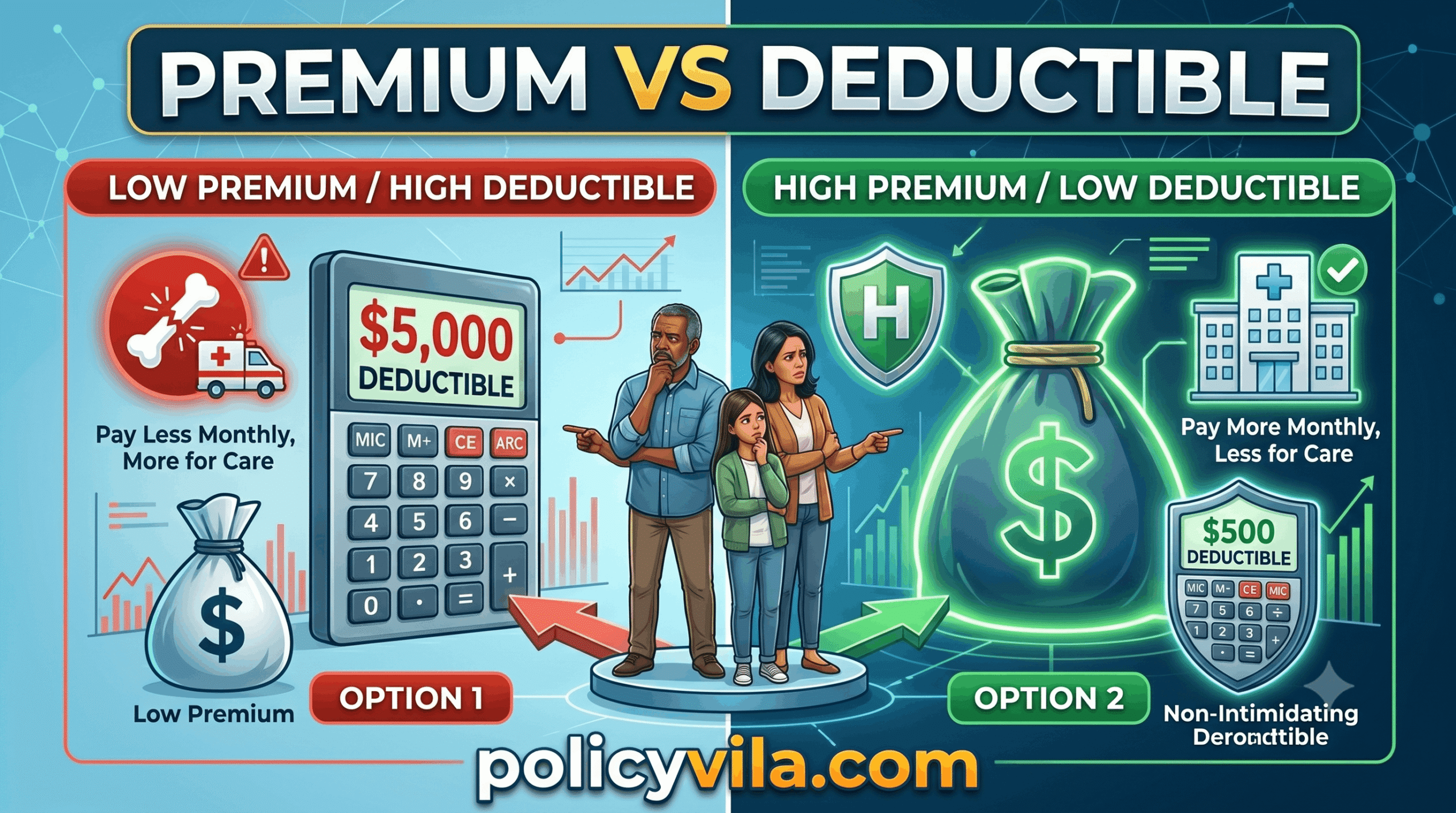
Low-Deductible vs. High-Deductible at a Glance
| Factor | Low-Deductible Plan | High-Deductible Plan |
|---|---|---|
| Monthly premium | Higher | Lower |
| Upfront cost when care is needed | Lower | Higher |
| Best suited for | Frequent care needs, chronic conditions | Healthy individuals, strong emergency savings |
| HSA eligibility | Rarely eligible | Often eligible |
| Budget predictability | More predictable monthly cost | More predictable if healthy, riskier if not |
Frequently Asked Questions
Does the deductible reset if I switch plans mid-year?
In most cases, yes — switching to a new plan, even with the same insurer, typically means starting over on the deductible under the new plan’s terms, though this can vary, so it’s worth confirming directly.
Do prescription costs count toward my deductible?
It depends on the plan. Some plans apply prescription costs toward the medical deductible, while others use a separate pharmacy deductible or tiered copay structure. Checking your plan’s specific pharmacy benefits clarifies this.
What happens to my deductible progress if I change jobs and get new coverage?
Deductible progress generally doesn’t transfer between different insurance plans, even if the new plan is offered through a new employer, since each plan tracks its own deductible independently.
Can I negotiate medical bills that count toward my deductible?
Sometimes. Providers and hospitals may be willing to negotiate self-pay rates or set up payment plans, particularly for larger bills, though this doesn’t change what counts toward your deductible — it can just make the amount more manageable to pay.
Does an out-of-network visit count toward my in-network deductible?
Usually not, or only partially — many plans track separate deductibles for in-network and out-of-network care, with the out-of-network deductible typically set higher.
If I don’t use much healthcare, does an unused deductible carry over to next year?
No. Deductibles reset at the start of each new plan year regardless of how much or how little was used the year before.
Are mental health services subject to the same deductible as physical health services?
Under most plans, yes — mental health and substance use services are generally required to be covered comparably to medical and surgical benefits, though specific cost-sharing details can still vary by plan.
Does having a baby or major surgery guarantee I’ll hit my deductible?
Often, yes, particularly with childbirth or significant surgery, since these tend to generate substantial covered costs early in the plan year — though the exact amount still depends on the specific procedures and negotiated rates involved.
Can I have both an HSA and a Flexible Spending Account (FSA)?
Generally not at the same time under most rules, since HSAs typically require an HSA-eligible high-deductible plan and restrict combining with a general-purpose FSA, though a limited-purpose FSA may sometimes be allowed. Checking with your plan administrator clarifies your specific situation.
Is a lower deductible always the safer financial choice?
Not necessarily. A lower deductible usually comes with a higher premium paid every month regardless of whether care is used, so for a healthy household with minimal medical needs, the higher fixed premium can end up costing more over the year than the lower deductible would have saved.

Final Thoughts
The deductible is often the single biggest factor separating what a health plan looks like on paper from what it actually costs when care is needed. A low premium can be a good deal for a healthy household with savings in reserve — or an expensive surprise for a family that ends up needing more care than expected.
The most reliable way to compare plans is to estimate total realistic annual cost — premium, deductible, and likely coinsurance — rather than focusing on the monthly number alone. Reviewing coverage each year, rather than assuming last year’s plan still fits, keeps that estimate accurate as both health needs and plan terms shift over time.
6 thoughts on “Health Insurance Deductibles Explained: What Every Family Must Know in 2026”