

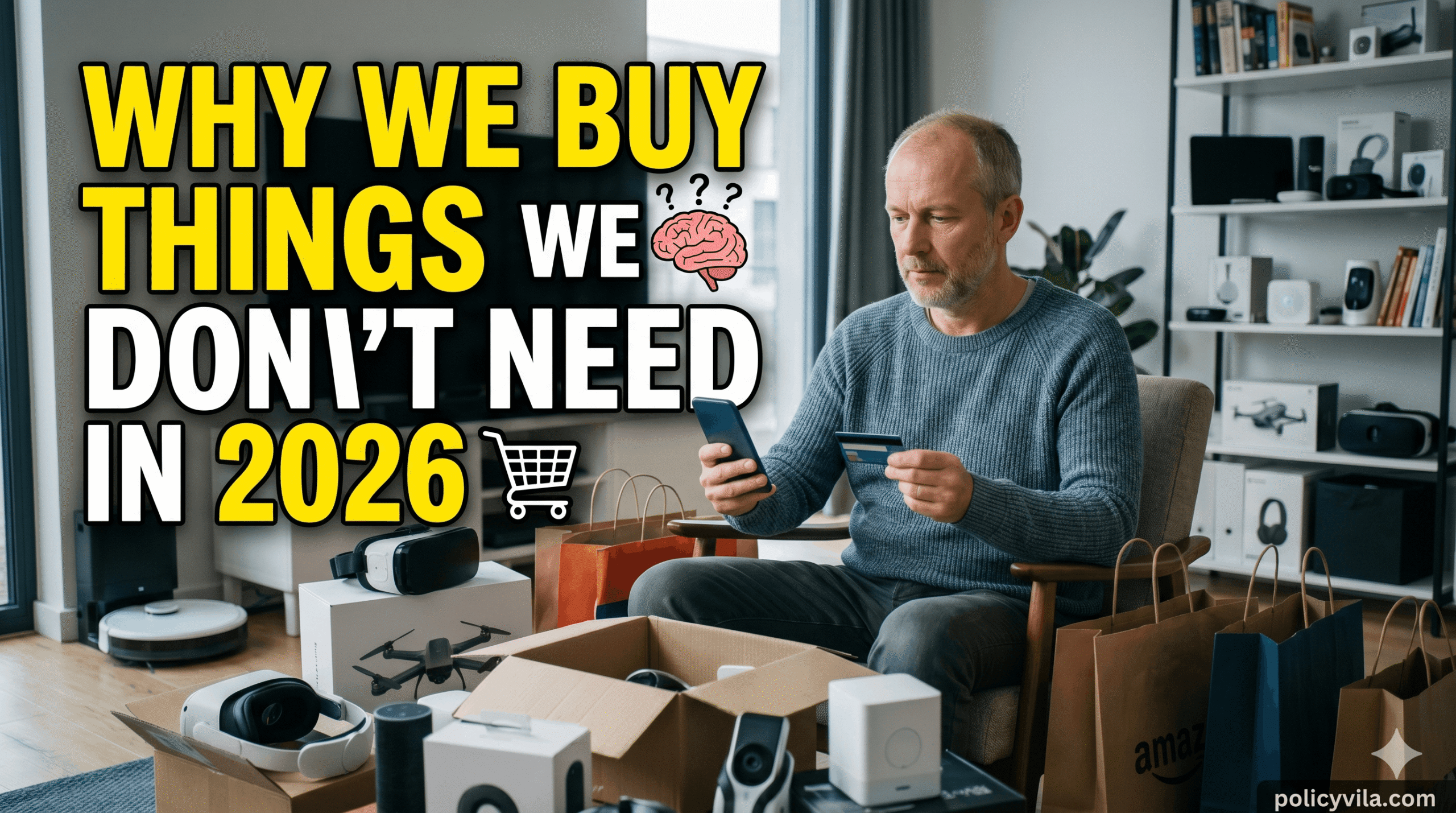
This isn’t a discipline problem unique to careless shoppers. Doctors, accountants, and people who can build a spreadsheet in their sleep do the exact same thing. The reason sits in how spending decisions actually get made: rarely through pure logic, and usually through some mix of emotion, habit, social pressure, and design choices retailers have spent years refining. Understanding that mechanism is what makes it possible to interrupt it.
Quick Answer
Most unplanned purchases happen because the brain’s emotional response to a product — the anticipation, the social comparison, the fear of missing a deal — moves faster than deliberate, cost-benefit thinking. Retailers design checkout flows, pricing displays, and marketing specifically around that gap. The most reliable countermeasure isn’t willpower in the moment; it’s a short built-in delay (24 hours to a week, depending on the price) between wanting something and paying for it, plus giving your money a defined job before it reaches your account.
Why Spending Has Gotten So Easy
Buying something used to take effort — driving somewhere, comparing options in person, handing over physical cash. Most of that friction is gone now, and each piece that disappeared removed a natural pause point where people used to reconsider.
Digital Payments Reduce the “Pain of Paying”
Handing over cash creates a visible, physical connection to spending that a tap or a saved card number doesn’t. Behavioral economists call this reduced sting the “pain of paying,” and the less of it you feel, the easier it becomes to keep spending without noticing the total climb.
One-Click and Saved Payment Methods
Every extra step between wanting something and paying for it is a chance to reconsider. Retailers know this, which is why checkout has been steadily simplified to remove exactly those steps — less time to think usually means more purchases completed.
Buy Now, Pay Later
Installment plans change the question people ask themselves. Instead of “can I afford $1,200,” the question becomes “can I afford $100 a month” — a much easier yes, even when the total cost hasn’t changed. Multiple BNPL plans running at once can also become genuinely hard to track, which is part of why missed installment payments have become more common as the option has spread.
The Real Cost of Unplanned Spending
Everyone knows unnecessary purchases cost money in the moment. The bigger cost is usually invisible because it’s spread across years.
Lost Savings, Compounded
An extra $10 a day in impulse spending is easy to shrug off in isolation. Add it up and it’s $300 a month, or $3,600 a year — money that could have gone toward a real goal instead of a drawer of things you stopped noticing within a week.
Debt That Fills the Gap
When spending outpaces income, the difference usually gets covered by credit cards, financing plans, or BNPL. That shifts the cost of today’s purchase onto future income, which is exactly the mechanism that turns a series of small decisions into a real debt balance.
Goals That Quietly Slip
Financial goals rarely die from one big purchase. They erode from thousands of small ones — the emergency fund that never quite gets funded, the retirement contribution that stays at the same percentage for years, the down payment that’s always a year away.
The Emotional Side
Overspending isn’t only a numbers problem. Regret, guilt, and tension with a partner over money are common, and the emotional discomfort often shows up quickly after the excitement of the purchase fades — sometimes within hours.
How Your Brain Actually Decides to Buy
Most people assume they evaluate a purchase logically and then decide. In practice, it usually runs the other way: an emotional reaction fires first, and the logical justification gets built afterward to support a decision that’s already been made.
The Emotional Response
This part of the decision reacts fast and chases pleasure, comfort, and immediate reward. Seeing a limited-time sale on something you’ve wanted triggers an instant reaction to how good it will feel to own it and how bad it would feel to miss the deal — long before any cost-benefit thinking kicks in.
The Deliberate Response
This is the part that weighs cost, budget impact, and long-term consequences. It’s also the part that takes the most mental energy, which means it’s the first thing to weaken when you’re tired, stressed, or distracted — a large share of impulse purchases happen late at night or right after a hard day for exactly this reason.
Present Bias
Given a choice between spending $100 today or saving it for a goal that pays off later, the emotional reward of spending arrives immediately while the reward of saving is abstract and delayed. Humans are wired to weight the immediate reward more heavily, which is why “I’ll start saving next month” is such a common, and commonly broken, promise.
Dopamine Peaks Before the Purchase, Not After
The excitement of browsing, comparing, and filling a cart often outpaces the satisfaction of actually owning the item. That’s why some people chase the next purchase almost as soon as the last one arrives — the anticipation itself is the reward, and it fades fast once the transaction is done.
Decision Fatigue
Every choice made throughout a day draws down the same limited pool of mental energy. By evening, self-control is measurably weaker and impulse purchases become more likely — which is not a coincidence retailers have missed; plenty of marketing timing (evening email blasts, late-night flash sales) is built around exactly this dip.
The Psychological Triggers Behind Most Purchases
A handful of recurring patterns show up across nearly every unplanned purchase. Recognizing them by name is often enough to catch yourself mid-decision.
read also: Credit Score Secrets Banks Don’t Want You to Know in 2026
Instant Gratification
Saving feels abstract; spending feels real and immediate. Someone who gets a bonus and buys a new TV instead of saving part of it is acting on this exact pull — the payoff of spending is available right now, while the payoff of saving requires trusting a future that hasn’t happened yet.
Fear of Missing Out (FOMO)
A label reading “only 3 left in stock” can push someone to buy something they hadn’t planned to, simply because the fear of losing the option feels stronger than the appeal of the product itself.
Social Proof
Thousands of reviews, a bestseller tag, or a large purchase count all signal to the brain that something must be worth having, even when that popularity has nothing to do with whether it fits your own needs or budget.
Scarcity and Urgency
“Limited edition,” “ending tonight,” and “exclusive offer” all work the same way: they create pressure to decide fast, before the deliberate part of your thinking has time to catch up.
Status Spending
Some purchases are less about the object and more about what it signals to other people — success, taste, achievement. A car bought mainly to impress others rather than to meet a transportation need is a common version of this.
Emotional Comfort Spending
Shopping can genuinely improve mood in the short term, which is exactly why it becomes a coping mechanism for stress, boredom, or loneliness. The relief is real but temporary, and the financial consequence outlasts the mood it was meant to fix.
Convenience
Food delivery apps, one-tap reordering, and same-day shipping all trade a bit more money for a bit less effort. Individually, that trade rarely feels significant. Repeated daily, it can add up to a meaningfully larger monthly bill than the same choices made with a little more friction.
Advertising and Emotional Association
Most modern advertising sells a feeling rather than a feature. A watch ad rarely dwells on how it tells time; it shows success and lifestyle instead, so the product becomes linked to an emotional outcome the brain finds hard to resist even when it’s fully aware of the tactic.
Influencer and Social Media Spending
Recommendations from people you follow carry a trust that traditional ads don’t, simply because the relationship feels personal. Repeated exposure to a product through someone you already like makes that product feel familiar and desirable well before you’ve made an independent judgment about whether you actually want it.
Lifestyle Inflation
As income rises, spending often rises right alongside it — a bigger apartment, a nicer car, more frequent dining out — while savings stay flat. This is one of the most common reasons higher earners don’t build wealth any faster than more modest earners who save consistently.
Subscription Creep
A single $9.99 monthly charge feels negligible. Five or six of them, quietly renewing in the background, can easily total $75–$150 a month without ever triggering the kind of scrutiny a single large purchase would.
The Free Shipping Effect
Facing an $8 shipping fee on a $42 order, many people will add a $12 item they didn’t plan to buy just to unlock free shipping — spending more to avoid a smaller, more visible charge.
Anchoring
Seeing “$500, now $299” shifts attention toward the $201 saved rather than toward the more useful question of whether the item is worth $299 on its own. The original price becomes a reference point that makes the sale price look like a win regardless of actual value.
Sale Pricing
Discounts trigger a genuine sense of reward, even when the underlying purchase wasn’t needed at all. Buying something unnecessary at 40% off is still spending money you didn’t need to spend — the only real savings come from not buying it.
How Retailers Design Around These Triggers
None of the patterns above are accidental from the seller’s side. Companies invest heavily in understanding consumer psychology, and several tactics show up repeatedly across industries.
- Emotional storytelling in advertising — selling confidence, belonging, or achievement instead of product specifications.
- Manufactured scarcity — countdown timers, low-stock warnings, and limited releases designed to short-circuit deliberation.
- Displayed social proof — review counts, star ratings, and “bestseller” labels that reduce hesitation.
- Price anchoring — showing an inflated original price next to the sale price to make the discount feel larger than the value itself.
- Frictionless payment — saved cards, auto-renewals, and one-click checkout that reduce the “pain of paying.”
- Loyalty and reward programs — structured to encourage spending toward the next tier or reward, sometimes past the point of actual need.
- Personalization — recommendations and offers built from your own browsing and purchase history, timed to feel relevant rather than random.
None of this means consumers are powerless against it. It does mean the fight isn’t really against a single product on a shelf — it’s against a system built specifically to make that product hard to walk past.
Signs Your Spending Is Emotionally Driven
A few patterns tend to show up consistently when purchases are being driven by feelings rather than genuine need:
- You shop specifically to improve a bad mood
- Excitement during the purchase turns to regret shortly after
- Browsing online stores has become a leisure activity in itself
- Every achievement becomes an excuse to buy something
- Purchases happen mainly out of boredom, not need
- You struggle to explain, out loud, why you bought something
- You feel pressure to keep up with new releases or trends
- Sales cause you to abandon a budget you’d otherwise stick to
- You hide purchases from a partner or family member
- Non-essential purchases regularly go on credit rather than available cash
- You replace working items well before they need replacing
- The anticipation before buying feels better than actually owning the item
None of these on their own is a red flag. Several of them showing up together, repeatedly, is usually a sign that spending has become a coping tool rather than a considered choice.
Common Spending Mistakes and Better Alternatives
Confusing Wants With Needs
Emotion blurs this line more often than people expect. A simple 48-hour wait on non-essential purchases gives that blur time to clear.
Shopping Without a List
Unplanned trips leave room for impulse decisions to fill the gaps. A list, even a short one, closes most of that room.
Chasing Discounts Instead of Needs
A 40% discount on something you didn’t need is still 60% of money spent on something you didn’t need. Buy only what was already on the list before the sale started.
Dismissing Small Purchases
Individually negligible costs add up to real money over a year. Tracking every category, not just the big ones, is what catches this.
Letting Lifestyle Rise With Income
Direct a portion of every raise straight to savings before it has a chance to become a new baseline for spending.
Ignoring Subscriptions
Recurring charges become invisible fast. A quarterly review is usually enough to catch what’s no longer worth paying for.
Comparing Yourself to Others
Social comparison, especially through social media, creates spending pressure that has nothing to do with your own goals. Redirecting attention to your own numbers is the more useful comparison.
Skipping Regular Spending Reviews
Bad habits persist mainly because nobody’s looking at them closely. A short monthly review is usually enough to catch drift before it becomes a pattern.
Emotional Spending vs. Intentional Spending
| Emotional Spending | Intentional Spending |
|---|---|
| Driven by feelings in the moment | Driven by defined goals |
| Often impulsive | Planned in advance |
| Short-term satisfaction | Long-term payoff |
| Frequently followed by regret | Reinforces confidence |
| Reactive to stress or mood | Guided by stated priorities |
| Tends to increase debt | Tends to support stability |
Spending Myths vs. Facts
| Myth | Fact |
|---|---|
| Small purchases don’t really matter | Small, repeated purchases are exactly what tends to create the largest long-term impact |
| A higher income automatically solves money problems | Spending habits shape financial outcomes just as much as income does |
| Buying on sale always saves money | An unnecessary purchase still costs money, no matter the discount |
| Wealthy people tend to spend more | Many people who build real wealth spend carefully and intentionally, regardless of income |
| Shopping is a harmless way to relieve stress | Repeated emotional spending can become a genuine financial problem over time |
| Expensive products are always better value | Price and value aren’t the same thing |
| Budgeting restricts freedom | A working budget is usually what creates more financial freedom, not less |
How to Take Control of Your Spending
Understanding why these purchases happen is useful, but it only pays off once it turns into a system you actually follow.
Build in a Pause
A short delay between wanting something and paying for it gives the emotional reaction time to fade and the deliberate thinking time to catch up. A reasonable scale: 24 hours for anything under $100, 48 hours for $100–$500, and a full week for anything larger.
Give Every Dollar a Job
Money without an assigned purpose — bills, savings, investments, discretionary spending — is far easier to spend without noticing. Assigning categories ahead of time closes that gap.
Reduce Exposure to Triggers
Unsubscribing from marketing emails, removing saved payment methods, deleting shopping apps you browse out of boredom, and unfollowing accounts that consistently push products can all meaningfully cut down on how often temptation shows up in the first place.
Keep Goals Visible
A specific target — an emergency fund, a down payment, a vacation you’re actually planning — makes it easier to weigh an impulse purchase against something concrete rather than an abstract idea of “saving more.”
A 4-Week Spending Reset
Week 1: Get a Clear Picture
Track every expense, review recent statements, and list every subscription currently running. The goal here is simply visibility — you can’t fix what you haven’t actually looked at.
Week 2: Cut the Obvious Leaks
Cancel subscriptions you’re not using, start applying the pause rule to non-essential purchases, and shift toward cooking more meals at home if delivery has crept up. Aim for a meaningful reduction, not perfection.
Week 3: Build Structure
Put a simple budget in place, automate a savings transfer so it happens before you see the money, and set a monthly limit for discretionary spending.
Week 4: Look Further Ahead
Set a concrete one-year goal, outline a plan for any debt you’re carrying, and schedule a recurring monthly check-in so the habits from the first three weeks don’t quietly slide back.
Frequently Asked Questions
Is it possible to be too strict with a spending pause and miss genuinely good opportunities?
It can happen, particularly with time-limited deals on things you’d already planned to buy. The pause is meant to filter out impulse purchases, not planned ones — if something was already on your list before the sale started, there’s little reason to delay it further.
Does using cash instead of cards actually reduce spending?
For many people, yes. Physically handing over cash creates a more noticeable sense of loss than tapping a card, which is part of why some people use cash deliberately for categories where they tend to overspend, like dining out or entertainment.
Why do I feel worse after an impulse purchase than I expected?
The excitement of buying something is often tied to anticipation, which peaks before the purchase and fades quickly afterward. Once that fades, what’s left is just the item itself and the money spent, which is why the letdown can feel disproportionate to how excited you were minutes earlier.
Are Buy Now, Pay Later plans always a bad idea?
Not inherently, especially for a single planned purchase you were already going to make. The risk grows when multiple BNPL plans run simultaneously, since the combined monthly obligations can become harder to track than a single line-item purchase would have been.
How do I tell the difference between a genuine treat and emotional spending?
A planned, occasional reward tied to an actual event or achievement tends to feel intentional and doesn’t require hiding or justifying afterward. Spending that shows up mainly in response to stress, boredom, or a bad mood, and that you’d rather not mention to a partner, leans toward the emotional side.
Can tracking every expense become counterproductive?
For some people, extremely granular tracking becomes a source of anxiety rather than clarity. If detailed tracking feels overwhelming, tracking total spending by broad category each week usually delivers most of the same insight with far less effort.
Does lifestyle inflation ever make sense?
Some increase in spending alongside income is reasonable and expected. The problem isn’t spending more as you earn more — it’s spending all of the increase, so that savings stay flat no matter how much income grows.
Final Thoughts
The psychology of spending isn’t really about money at all — it’s about behavior, and behavior responds to systems more reliably than it responds to willpower alone. Retailers have spent years designing around exactly the triggers described here, which means the fight was never a fair one to begin with when it’s fought purely in the moment of decision.
What actually works is built ahead of time: a pause before non-essential purchases, money assigned a purpose before it arrives, and fewer daily invitations to spend. None of that requires eliminating spending altogether. It just means the next time you feel the pull toward an unplanned purchase, you have one useful question ready: are you buying this because you need it, or because something was designed to make you want it?
1 thought on “The Psychology of Spending: Why We Buy Things We Don’t Need in 2026”