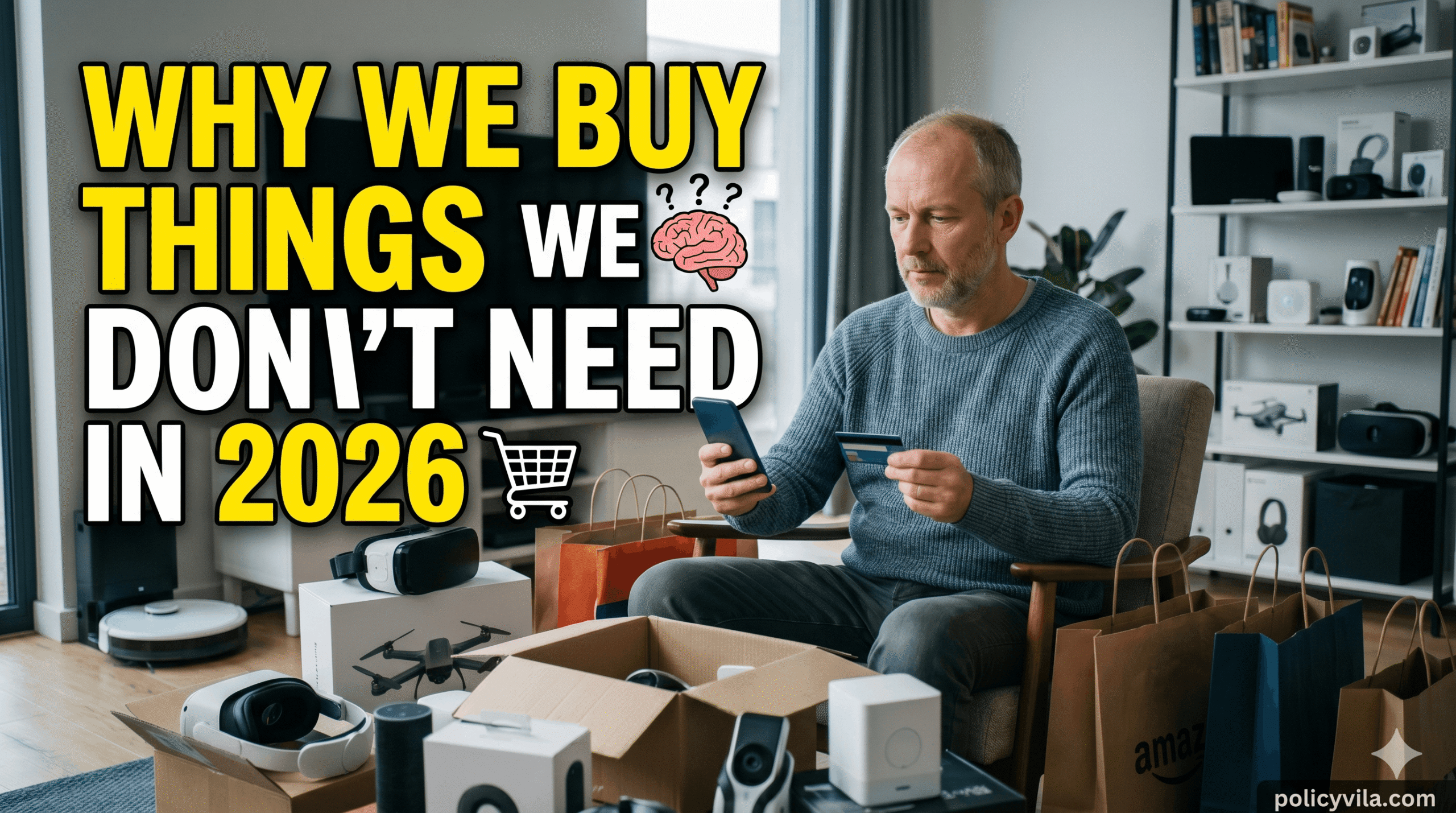

The Psychology of Spending: Why We Buy Things We Don’t Need in 2026

Hook Introduction

Imagine this: The Psychology of Spending

You walk into a store planning to buy a tube of toothpaste that costs less than five dollars.

How Spending Triggers Affect Savings, Debt, and Financial Freedom
Why We Buy Things We Don’t Need in 2026

Twenty minutes later, you’re standing at the checkout counter with a shopping cart full of items you never intended to buy.

A scented candle.

A new water bottle.

A discounted phone accessory.

A bag of snacks.

A seasonal decoration.

Suddenly, a quick errand has turned into a $150 shopping trip.

If this situation sounds familiar, you’re not alone.

Millions of people make spending decisions every day that seem irrational when viewed afterward. What’s surprising is that these decisions are not limited to careless shoppers or people who struggle with money. Even highly educated, financially responsible individuals regularly buy things they don’t truly need.

Why does this happen?

The answer lies in understanding the psychology of spending.

Human beings rarely make purchasing decisions based purely on logic. Emotions, habits, social influences, marketing strategies, and subconscious triggers often play a much larger role than most people realize.

Understanding these influences matters because spending habits directly affect nearly every aspect of personal finance, including:

  • Savings growth
  • Debt levels
  • Financial stress
  • Investment opportunities
  • Long-term wealth building
  • Financial freedom

Many people focus heavily on increasing income. The Psychology of Spending

Far fewer focus on understanding the psychological forces that influence where that income goes.

In 2026, learning how spending decisions are made may be just as important as learning how to earn more money.


Why Understanding Spending Psychology Matters

The world has never made spending easier.

Just a few decades ago, buying something often required planning, travel, and physical cash.

Today, purchases can happen within seconds.

A few taps on a smartphone can order products from across the world and have them delivered within days—or sometimes hours.

Several trends have dramatically changed consumer behavior.

Easy Online Shopping

Online shopping has removed many of the traditional barriers that once slowed spending.

Consumers no longer need to:

  • Drive to a store
  • Compare products physically
  • Carry cash
  • Wait until business hours

Convenience has become one of the most powerful spending triggers in modern life.


Digital Wallets Reduce Spending Friction

Paying with cash creates a visible and emotional connection to spending.

Digital payments often eliminate that feeling.

When people use:

  • Mobile payment apps
  • Digital wallets
  • Stored credit cards
  • Contactless payments

they may experience less awareness of how much money is leaving their accounts.

Psychologists often refer to this as reducing the “pain of paying.”

The easier a payment feels, the easier it becomes to spend.


One-Click Purchasing

Retailers understand that every additional step between desire and purchase creates an opportunity for consumers to reconsider.

That is why many companies invest heavily in simplifying the checkout process.

One-click purchasing removes decision points and increases impulsive buying behavior.

The less time available for reflection, the more likely emotional spending becomes.


Buy Now Pay Later Services

One of the fastest-growing trends in consumer finance is Buy Now Pay Later (BNPL).

These services allow consumers to receive products immediately while spreading payments over time.

While convenient, they can create an illusion that purchases are more affordable than they actually are.

Instead of asking:

“Can I afford this?”

Consumers may begin asking:

“Can I afford this monthly payment?”

That shift in thinking can dramatically increase spending.


Consumer Spending Is Increasingly Psychological

Modern businesses invest billions of dollars understanding human behavior.

Retailers study:

  • Consumer habits
  • Emotional triggers
  • Website behavior
  • Shopping patterns
  • Decision-making psychology

Every product placement, promotional email, and discount offer is designed to influence behavior.

Understanding spending psychology helps consumers recognize these influences and make more intentional financial decisions.


The Hidden Cost of Unnecessary Spending

Most people understand that unnecessary spending costs money.

What many fail to recognize is the true long-term cost.

The consequences often extend far beyond the purchase itself.

Lost Savings Opportunities

Every unnecessary purchase represents money that could have been saved.

Consider a person who spends an extra $10 per day on impulse purchases.

That amount may seem insignificant.

However:

  • $10 per day equals $300 per month
  • $300 per month equals $3,600 per year

Over several years, the impact becomes substantial.

Small spending habits often create surprisingly large financial consequences.


Increased Debt

Many purchases are not made using available cash.

Instead, consumers frequently rely on:

When spending exceeds available income, debt often fills the gap.

The result is a cycle where future income becomes committed to paying for past purchases.


Delayed Financial Goals

Every dollar spent unnecessarily is a dollar unavailable for important goals.

These goals may include:

  • Emergency savings
  • Retirement contributions
  • Home ownership
  • Education funding
  • Investment opportunities

Many financial dreams are not destroyed by one large purchase.

They are delayed by thousands of small purchases accumulated over time.


Emotional Stress

Overspending creates more than financial consequences.

It often creates emotional consequences as well.

Common effects include:

  • Anxiety
  • Financial guilt
  • Relationship tension
  • Reduced confidence
  • Stress about future expenses

Many people experience regret shortly after making purchases that felt exciting moments earlier.

This emotional cycle contributes to unhealthy spending habits and financial frustration.


The Biggest Myth About Overspending

One of the most common misconceptions about spending is the belief that people overspend because they lack discipline or intelligence.

In reality, the situation is far more complex.

Many intelligent individuals struggle with spending decisions.

Doctors.

Lawyers.

Business owners.

Financial professionals.

Highly educated people often make emotional purchases just like everyone else.

Why?

Because spending behavior is deeply connected to psychology.

Human beings are emotional creatures first and logical creatures second.

Most spending decisions occur in environments specifically designed to encourage purchasing.

Retailers understand:

  • Emotional triggers
  • Behavioral biases
  • Social influence
  • Reward systems

Consumers are not simply fighting against products.

They are often fighting against sophisticated systems built to encourage spending.

This does not mean people are powerless.

It simply means that improving financial habits requires understanding behavior—not just understanding money.

The individuals who gain control over their finances are often the ones who learn how their minds influence their spending decisions.

Recognizing these psychological influences is the first step toward making smarter financial choices and building a healthier relationship with money.

How Your Brain Makes Spending Decisions

Most people believe they make purchasing decisions logically.

In reality, the human brain often decides emotionally first and justifies the purchase later.

This is one of the most important concepts in the psychology of spending.

When you see a product, your brain processes information through two systems:

The Emotional Brain

The emotional part of the brain seeks:

  • Pleasure
  • Comfort
  • Excitement
  • Social approval
  • Immediate rewards

It reacts quickly and instinctively.

For example, imagine seeing a limited-time sale on a pair of shoes you’ve wanted for months.

Your emotional brain immediately focuses on:

  • How good the shoes look
  • How happy you’ll feel wearing them
  • The fear of missing the deal

The emotional brain loves instant gratification.


The Logical Brain

The logical brain evaluates:

  • Cost
  • Budget impact
  • Long-term consequences
  • Financial priorities

However, logical thinking requires effort.

When people are tired, stressed, distracted, or overwhelmed, logical decision-making often weakens.

This is why many impulse purchases happen:

  • Late at night
  • After work
  • During stressful periods
  • When shopping emotionally

The emotional brain frequently wins because it responds faster.


The Power of Instant Gratification

Human beings naturally prefer immediate rewards over future rewards.

Psychologists call this present bias.

For example:

Option A:

Spend $100 today on something enjoyable.

Option B:

Save $100 for a future goal.

The emotional reward from spending arrives immediately.

The reward from saving arrives later.

This difference heavily influences consumer behavior.

Many spending decisions are actually battles between today’s desires and tomorrow’s goals.


Dopamine and Spending

One of the biggest reasons shopping feels enjoyable is dopamine.

Dopamine is a neurotransmitter associated with:

  • Anticipation
  • Motivation
  • Pleasure
  • Reward

Interestingly, dopamine often peaks before the purchase rather than after it.

Consumers frequently experience excitement while:

  • Browsing products
  • Filling shopping carts
  • Comparing options

Once the purchase is complete, excitement often fades.

This explains why some people continually seek new purchases.

They become attached to the anticipation rather than the actual product.


Decision Fatigue

Every day people make hundreds of decisions.

Examples include:

  • What to wear
  • What to eat
  • Work-related choices
  • Family responsibilities
  • Financial decisions

As the day progresses, mental energy declines.

This phenomenon is known as decision fatigue.

When decision fatigue increases:

  • Self-control decreases
  • Impulse spending increases
  • Emotional purchases become more likely

Retailers understand this behavior.

Many shopping experiences are designed to encourage purchases when consumers are mentally tired.


Psychological Trigger #1: Instant Gratification

One of the strongest spending triggers is the desire for immediate satisfaction.

Humans naturally prefer rewards they can enjoy right now.

Saving money often feels abstract.

Buying something feels real.

Why It Works

The brain values immediate rewards more heavily than future benefits.

Even when people know saving is the better choice, immediate pleasure often feels more compelling.

Real-Life Example

A person receives a bonus at work.

Instead of saving part of it, they purchase a new television because the enjoyment is immediate.

Financial Impact

Repeated instant gratification can lead to:

  • Reduced savings
  • Increased debt
  • Delayed financial goals

Over time, small decisions accumulate into significant financial consequences.


Psychological Trigger #2: Fear of Missing Out (FOMO)

FOMO is one of the most powerful emotional spending triggers.

Consumers frequently worry they will miss opportunities if they do not act quickly.

Why It Works

Humans dislike losing opportunities.

The fear of missing a deal often feels stronger than the satisfaction of gaining something valuable.

Real-Life Example

An online retailer displays:

“Only 3 left in stock.”

Even if the product was not originally needed, urgency encourages immediate action.

Financial Impact

FOMO frequently leads to:

  • Impulse purchases
  • Overspending
  • Buyer’s remorse

Many consumers later realize they purchased because of urgency rather than actual need.


Psychological Trigger #3: Social Proof

People often look to others when making decisions.

This behavior is known as social proof.

Why It Works

Humans are social creatures.

If many people appear to like something, we assume it must have value.

Real-Life Example

An online product displays:

  • 50,000 purchases
  • Thousands of positive reviews
  • Bestseller labels

Consumers become more likely to buy because others have already approved the product.

Financial Impact

Social proof can encourage spending on products that may not align with personal financial priorities.

Popularity does not always equal necessity.


Psychological Trigger #4: Scarcity Marketing

Scarcity creates urgency.

When something appears limited, people often value it more.

Why It Works

The brain interprets scarcity as importance.

If something might disappear, consumers become more motivated to acquire it.

Real-Life Example

Common phrases include:

  • Limited edition
  • Ending tonight
  • Last chance
  • Exclusive offer

These messages create pressure to act quickly.

Financial Impact

Scarcity marketing often bypasses logical evaluation and encourages emotional purchases.


Psychological Trigger #5: Status Spending

Many purchases are influenced by how people want to be perceived.

Why It Works

Humans naturally seek social acceptance and status.

Certain products communicate:

  • Success
  • Wealth
  • Popularity
  • Achievement

Real-Life Example

Someone purchases a luxury vehicle primarily to impress others rather than because they need it.

Financial Impact

Status spending can become expensive because it often prioritizes appearance over financial stability.

Some individuals spend heavily to look wealthy while neglecting savings and investments.


Psychological Trigger #6: Emotional Comfort Spending

Many people use shopping as a coping mechanism.

Why It Works

Purchases can temporarily improve mood.

Shopping may provide relief from:

  • Stress
  • Anxiety
  • Boredom
  • Loneliness
  • Frustration

Real-Life Example

After a difficult day at work, someone buys expensive items online despite not needing them.

The purchase creates temporary emotional relief.

Financial Impact

Emotional spending often becomes habitual.

Over time, this pattern can lead to:

  • Growing debt
  • Reduced savings
  • Financial guilt

The emotional problem remains while the financial problem grows.


Psychological Trigger #7: Convenience Spending

Convenience has become one of the strongest spending influences in modern life.

Why It Works

People naturally prefer options requiring less effort.

The easier something is to buy, the more likely people are to purchase it.

Real-Life Example

Food delivery apps allow consumers to order meals within seconds.

While convenient, repeated use often costs significantly more than preparing meals at home.

Financial Impact

Convenience spending frequently creates:

  • Higher monthly expenses
  • Reduced awareness of spending
  • Smaller savings balances

The individual purchases may seem small, but repeated convenience costs can add up quickly over time.

Psychological Trigger #8: Advertising Influence

Advertising has existed for generations, but modern advertising is more sophisticated than ever.

Companies no longer market products only through television commercials and billboards. In 2026, advertising follows consumers across websites, social media platforms, search engines, mobile apps, and even streaming services.

Why It Works

Most advertising is designed to create emotional associations rather than simply provide information.

Advertisers often connect products with:

  • Happiness
  • Success
  • Confidence
  • Popularity
  • Security
  • Freedom

As a result, consumers may begin associating a product with positive emotions instead of evaluating whether they actually need it.

Real-Life Example

A luxury watch advertisement rarely focuses on telling time.

Instead, it may feature successful professionals, luxury lifestyles, and images of achievement.

The product becomes linked to status and success.

Financial Impact

Repeated exposure to advertising increases the likelihood of spending on products that offer emotional satisfaction rather than practical value.

Over time, constant advertising can significantly influence spending habits without consumers realizing it.


Psychological Trigger #9: Influencer Spending

Social media has transformed consumer behavior.

Influencers now play a major role in shaping purchasing decisions.

Why It Works

People often trust recommendations from individuals they follow online.

When influencers regularly showcase products, lifestyles, and purchases, followers may view those choices as normal or desirable.

This creates a sense of familiarity and trust.

Real-Life Example

A content creator posts videos featuring expensive skincare products, clothing brands, or technology gadgets.

Followers repeatedly see these products and become more likely to purchase them.

Financial Impact

Influencer-driven spending can encourage consumers to buy products they had never considered before.

Many purchases occur because of social influence rather than genuine need.


Psychological Trigger #10: Lifestyle Inflation

Lifestyle inflation occurs when spending increases alongside income.

This is one of the most common barriers to wealth building.

Why It Works

As people earn more money, they often feel entitled to spend more money.

Small upgrades gradually become larger upgrades.

The process feels natural.

Real-Life Example

A worker receives a promotion and decides to:

  • Upgrade their car
  • Move into a larger apartment
  • Spend more on dining out
  • Increase entertainment spending

Although income increases, savings remain unchanged.

Financial Impact

Lifestyle inflation prevents many high-income earners from building significant wealth.

Higher income does not automatically create financial security if spending rises just as quickly.


Psychological Trigger #11: Subscription Psychology

Subscriptions have become a normal part of modern life.

Many consumers pay for:

  • Streaming services
  • Fitness apps
  • Music platforms
  • Cloud storage
  • Software memberships

Why It Works

Subscriptions break large expenses into smaller monthly payments.

Small charges often feel insignificant.

As a result, consumers pay less attention to them.

Real-Life Example

A person subscribes to five services at $15 per month.

Individually, each charge seems minor.

Together, they total $75 every month or $900 per year.

Financial Impact

Subscription accumulation can quietly drain financial resources while remaining largely unnoticed.

Many people continue paying for services they rarely use.


Psychological Trigger #12: The Free Shipping Effect

Free shipping is one of the most effective sales tools in modern retail.

Why It Works

Consumers dislike paying additional charges after selecting products.

Free shipping feels like a reward.

As a result, people often spend more money to avoid a smaller shipping fee.

Real-Life Example

A customer has $42 worth of products in an online cart.

The website offers free shipping on orders over $50.

Instead of paying an $8 shipping fee, the customer adds another $12 product.

The total purchase becomes larger than originally planned.

Financial Impact

Consumers frequently spend extra money to save a smaller amount.

The desire to avoid shipping costs often leads to unnecessary purchases.


Psychological Trigger #13: The Anchoring Effect

The anchoring effect is a powerful psychological principle that influences how people evaluate prices.

Why It Works

The first number consumers see becomes a reference point.

Future prices are judged relative to that number.

Real-Life Example

A retailer displays:

  • Original Price: $500
  • Sale Price: $299

Consumers focus on the $201 discount rather than asking whether the item is worth $299.

The original price becomes the anchor.

Financial Impact

Anchoring can create the illusion of value even when a purchase is unnecessary.

Consumers may buy products because they appear discounted rather than because they need them.


Psychological Trigger #14: Sale Pricing Tricks

Sales create excitement and urgency.

Retailers understand that consumers love the feeling of getting a deal.

Why It Works

Discounts activate reward centers in the brain.

People often experience satisfaction from saving money—even when spending money was unnecessary.

Real-Life Example

A shopper purchases three items during a seasonal sale because the discounts appear attractive.

However, none of the products were originally planned purchases.

Financial Impact

Buying something unnecessary at a discount still costs money.

Many consumers mistake discounted spending for saving.

True savings occur when money remains unspent.


Why Smart People Still Overspend

Many people assume that financial mistakes occur because of a lack of knowledge.

Behavioral finance research tells a different story.

Even highly intelligent individuals regularly make poor financial decisions.

Knowledge alone does not eliminate psychological biases.

Intelligence Does Not Remove Emotion

A person may fully understand:

  • Budgeting
  • Saving
  • Investing
  • Debt management

Yet still make emotional purchases.

Why?

Because spending decisions often occur under emotional conditions rather than logical conditions.

Stress, excitement, boredom, and social pressure can influence anyone.


Decision-Making Biases Affect Everyone

Human brains rely on shortcuts known as cognitive biases.

These shortcuts help simplify decision-making but can also create financial mistakes.

Common biases include:

  • Confirmation bias
  • Loss aversion
  • Present bias
  • Social proof bias
  • Anchoring bias

These biases affect people regardless of education level or income.


High Income Can Create Overconfidence

Ironically, higher earners sometimes overspend more than lower earners.

A larger paycheck can create a false sense of financial security.

People may believe:

  • “I can afford it.”
  • “It’s only a small purchase.”
  • “I’ll make more money next month.”

Repeated over time, these decisions can significantly reduce wealth-building potential.


Emotional Spending Often Feels Rational

One reason overspending is difficult to recognize is that the brain frequently creates logical justifications after emotional decisions.

For example:

A person may emotionally want a new smartphone.

After deciding to buy it, they begin listing reasons:

  • Better productivity
  • Improved camera quality
  • Longer battery life

The logical explanation comes after the emotional desire.

This process makes unnecessary purchases feel reasonable.


The Environment Matters More Than Most People Realize

Consumers do not make spending decisions in isolation.

They are surrounded by influences such as:

  • Advertising
  • Social media
  • Friends
  • Family
  • Retail design
  • Digital marketing

Modern shopping environments are carefully designed to encourage purchasing behavior.

Even financially responsible people can be influenced by these systems.


Awareness Creates Better Decisions

The goal is not to eliminate spending.

The goal is to understand why spending decisions occur.

When consumers recognize psychological triggers, they gain the ability to pause before purchasing and ask important questions:

  • Do I actually need this?
  • Am I solving a real problem?
  • Am I buying because of emotion?
  • Will this purchase matter in six months?

These questions create space for intentional decision-making.

And intentional decision-making is one of the most important skills for building long-term financial success.

Modern Spending Traps in 2026

Consumer spending has changed dramatically over the past decade.

In 2026, people can spend money faster, easier, and more frequently than at any point in history.

Many modern spending traps are designed to feel convenient and harmless.

However, when repeated over months and years, these habits can quietly undermine savings goals, increase debt, and slow wealth-building progress.

Understanding these traps is one of the most effective ways to improve financial decision-making. The Psychology of Spending


Modern Spending Trap #1: Buy Now Pay Later (BNPL)

Buy Now Pay Later services have become extremely popular.

They allow consumers to divide purchases into smaller installments rather than paying the full amount upfront.

Popular examples include:

  • Interest-free installment plans
  • Flexible payment apps
  • Retail financing programs

Why It Feels Attractive

A $400 purchase suddenly appears more affordable when presented as:

“$33 per month for 12 months.”

Consumers focus on the monthly payment rather than the total cost.

Real-World Example

A shopper wants a new laptop.

Instead of asking:

“Can I afford $1,200?”

They begin asking:

“Can I afford $100 per month?”

This subtle shift changes spending behavior.

Financial Risk

Many consumers hold multiple BNPL plans simultaneously.

While each payment may appear manageable, the combined obligations can become difficult to track.

This often leads to:

  • Cash flow problems
  • Missed payments
  • Increased financial stress
Consumer Psychology and Smart Money Management Tips for 2026
Why We Buy Things We Don’t Need in 2026

Modern Spending Trap #2: One-Click Shopping

Technology companies have worked hard to remove friction from purchasing.

One-click checkout systems allow purchases within seconds.

Why It Works

The less time available for reflection, the less likely consumers are to reconsider purchases.

Traditional shopping required:

  • Traveling to stores
  • Waiting in lines
  • Carrying cash

Today’s purchasing process can be completed before logical thinking catches up.

Real-World Example

A consumer sees a product while scrolling social media.

Within two minutes:

  • The product is in their cart
  • Payment information is already saved
  • The purchase is complete

No meaningful evaluation occurs.

Financial Risk

One-click systems encourage impulsive buying behavior and reduce spending awareness.


Modern Spending Trap #3: Subscription Overload

Subscription-based business models continue to grow rapidly.

Many households now pay for:

  • Video streaming
  • Music services
  • Software platforms
  • Cloud storage
  • Gaming memberships
  • Fitness applications

Why It Works

Small monthly charges feel insignificant.

A $9.99 charge rarely creates concern.

However, dozens of small charges can create a substantial financial burden.

Real-World Example

A consumer subscribes to:

  • Three streaming services
  • Two productivity apps
  • One fitness platform
  • Several premium memberships

The combined cost exceeds $150 monthly.

Financial Risk

Consumers often underestimate recurring expenses because individual subscriptions seem inexpensive. The Psychology of Spending


Modern Spending Trap #4: Mobile Shopping Apps

Shopping apps place stores directly inside consumers’ pockets.

Why It Works

Accessibility increases purchasing frequency.

Products are available:

  • During lunch breaks
  • Before bedtime
  • While commuting
  • During moments of boredom

Shopping becomes entertainment.

Real-World Example

Someone opens a shopping app merely to browse.

Minutes later they receive:

  • Personalized recommendations
  • Limited-time offers
  • Discount notifications

What began as browsing often ends with spending.

Financial Risk

Frequent exposure increases temptation and encourages unnecessary purchases.

read also: 2026 Smart Money Secrets: How to Save More, Borrow Smart & Build Wealth Fast


Modern Spending Trap #5: Social Media Shopping

Social media platforms are no longer just communication tools.

They have evolved into powerful sales environments.

Why It Works

Products are integrated seamlessly into content.

Consumers often encounter products while relaxed and entertained.

This lowers resistance to marketing messages.

Real-World Example

A user watches a lifestyle video.

Within minutes they see:

  • Fashion recommendations
  • Home décor products
  • Beauty products
  • Technology gadgets

Each item appears connected to an attractive lifestyle.

Financial Risk

Social media shopping encourages emotional purchasing and comparison spending.


Modern Spending Trap #6: Personalized Advertising

Modern advertising is incredibly targeted.

Companies analyze:

  • Search history
  • Shopping behavior
  • Website visits
  • Social media activity

This data helps advertisers show products consumers are most likely to purchase.

Why It Works

Advertisements become highly relevant.

Consumers feel as though products are appearing exactly when needed.

Real-World Example

A person researches hiking boots online.

For weeks afterward, advertisements for hiking gear appear across multiple platforms.

Repeated exposure increases purchase likelihood.

Financial Risk

Personalized advertising continuously reintroduces temptation and increases spending opportunities.


Modern Spending Trap #7: Flash Sales

Flash sales create urgency through short deadlines.

Why It Works

People fear missing opportunities.

When consumers believe a deal may disappear soon, they often make decisions faster.

Real-World Example

A retailer advertises:

  • 4-hour sale
  • Midnight deadline
  • Limited inventory

Consumers rush to purchase before evaluating whether the product is necessary.

Financial Risk

Urgency frequently overrides thoughtful decision-making.

Many flash-sale purchases would never occur under normal circumstances.


How Companies Use Psychology to Increase Sales

Successful companies do far more than sell products.

They study human behavior.

Large corporations invest millions of dollars understanding:

  • Decision-making
  • Consumer emotions
  • Spending triggers
  • Behavioral patterns

Their goal is simple:

Increase purchasing behavior.


Strategy #1: Creating Emotional Connections

Most advertisements focus on emotions rather than product features.

Why?

Because emotions drive behavior.

Companies often sell:

  • Confidence
  • Happiness
  • Success
  • Security
  • Belonging

rather than the actual product itself.

Example

A vehicle advertisement rarely focuses only on engine specifications.

Instead, it may showcase:

  • Adventure
  • Family memories
  • Freedom
  • Achievement

The emotional experience becomes the selling point. The Psychology of Spending


Strategy #2: Using Scarcity

Scarcity creates perceived value.

When something appears limited, consumers often want it more.

Common examples include:

  • Limited editions
  • Exclusive releases
  • Countdown timers
  • Low-stock warnings

These tactics encourage immediate action. The Psychology of Spending


Strategy #3: Leveraging Social Proof

People naturally follow group behavior.

Companies display:

  • Customer reviews
  • Star ratings
  • Purchase counts
  • Testimonials

to increase trust and reduce hesitation.

Consumers often think:

“If thousands of people bought it, it must be good.”


Strategy #4: Anchoring Prices

Retailers frequently display higher prices before showing discounts.

This makes the discounted price appear more attractive.

Example

Original Price: $500

Sale Price: $299

Consumers compare against the original price rather than determining actual value independently.


Strategy #5: Reducing the Pain of Paying

Companies constantly seek ways to make spending feel easier.

Methods include:

  • Digital wallets
  • Auto-renewals
  • Subscription billing
  • One-click checkout
  • Financing plans

The less noticeable payment becomes, the easier it is to spend.


Strategy #6: Reward Programs

Loyalty programs encourage repeat purchases.

Consumers often spend more money to:

  • Earn points
  • Unlock rewards
  • Reach status levels

The pursuit of rewards can sometimes lead to unnecessary spending.


Strategy #7: Personalized Experiences

Artificial intelligence now allows companies to personalize shopping experiences.

Consumers receive:

  • Product recommendations
  • Customized discounts
  • Individualized promotions

These systems increase relevance and improve conversion rates.


The Important Takeaway

Companies are not simply competing for your money.

They are competing for your attention, emotions, habits, and decision-making processes.

The most financially successful consumers are not necessarily those with the highest incomes.

They are often the individuals who recognize psychological spending traps before acting on them.

Awareness creates control.

And control is one of the most valuable financial skills anyone can develop in 2026.

15 Signs Your Spending Is Emotionally Driven

Many people believe they only spend money when they genuinely need something.

In reality, emotions often influence purchasing decisions far more than logic.

Recognizing emotional spending patterns is one of the first steps toward gaining control over your finances. The Psychology of Spending

1. You Shop When You’re Stressed

After a difficult day, shopping becomes a way to improve your mood.

2. You Frequently Experience Buyer’s Remorse

You feel excited during the purchase but regret it shortly afterward.

3. You Use Shopping as Entertainment

Browsing online stores becomes a regular leisure activity.

4. You Buy Things to Reward Yourself

Every achievement becomes an excuse for spending.

5. You Make Purchases When You’re Bored

Shopping fills empty moments rather than meeting actual needs.

6. You Struggle to Explain Why You Bought Something

If asked, you can’t clearly justify the purchase.

7. You Shop to Feel Better Emotionally

Sadness, loneliness, frustration, or anxiety trigger spending.

8. You Frequently Purchase Trendy Products

You feel pressure to keep up with new releases.

9. You Buy Things Because Others Have Them

Social comparison influences your decisions.

10. You Ignore Your Budget During Sales

Discounts cause you to abandon spending plans.

11. You Hide Purchases From Family Members

This often indicates guilt or awareness that spending was unnecessary.

12. You Rely on Credit Cards for Non-Essential Purchases

Future income is used to support current desires.

13. You Frequently Upgrade Working Products

You replace items before replacement is truly necessary.

14. You Feel Excitement Mainly Before the Purchase

The anticipation feels better than actually owning the item.

15. Shopping Temporarily Improves Your Mood

The emotional benefit fades quickly, creating a cycle of repeated spending.

read also: The Simple Budgeting Mistake That Costs People Thousands Every Year

Emotional Spending Habits and Impulse Buying Behavior Explained
Why We Buy Things We Don’t Need in 2026

Common Spending Mistakes

Even financially responsible people occasionally make mistakes.

The difference is that successful money managers recognize and correct them quickly. The Psychology of Spending

Mistake #1: Confusing Wants With Needs

Why It Happens

Emotions blur the line between necessity and desire.

Financial Consequences

Overspending and reduced savings.

Better Alternative

Wait 48 hours before making non-essential purchases.


Mistake #2: Shopping Without a Plan

Why It Happens

Impulse decisions take over.

Financial Consequences

Unexpected expenses accumulate.

Better Alternative

Create shopping lists before making purchases.


Mistake #3: Chasing Discounts

Why It Happens

People focus on savings rather than spending.

Financial Consequences

Buying unnecessary items.

Better Alternative

Only purchase items already planned.


Mistake #4: Ignoring Small Purchases

Why It Happens

Individual costs seem insignificant.

Financial Consequences

Hundreds or thousands of dollars disappear annually.

Better Alternative

Track all spending categories.


Mistake #5: Lifestyle Inflation

Why It Happens

Income increases lead to spending increases.

Financial Consequences

Savings remain stagnant despite higher earnings.

Better Alternative

Direct part of every raise toward savings. The Psychology of Spending


Mistake #6: Subscription Neglect

Why It Happens

Recurring payments become invisible.

Financial Consequences

Money leaks every month.

Better Alternative

Review subscriptions quarterly.


Mistake #7: Emotional Spending

Why It Happens

Shopping temporarily improves mood.

Financial Consequences

Debt and financial stress increase.

Better Alternative

Develop healthier coping mechanisms.


Mistake #8: Relying on Credit Cards for Everyday Spending

Why It Happens

Credit feels easier than cash.

Financial Consequences

Interest charges accumulate.

Better Alternative

Use credit strategically and pay balances in full.


Mistake #9: Comparing Yourself to Others

Why It Happens

Social media creates unrealistic expectations.

Financial Consequences

Pressure-driven purchases.

Better Alternative

Focus on personal financial goals.


Mistake #10: Not Reviewing Spending Habits

Why It Happens

Many people avoid financial analysis.

Financial Consequences

Bad habits continue unnoticed.

Better Alternative

Conduct monthly spending reviews.


Emotional Spending vs Intentional Spending

Emotional Spending Intentional Spending
Driven by feelings Driven by goals
Often impulsive Planned in advance
Provides short-term satisfaction Supports long-term success
Frequently creates regret Creates confidence
Focuses on immediate pleasure Focuses on value
Influenced by stress and mood Influenced by priorities
Difficult to control consistently Easier to manage
Often increases debt Supports financial stability
Reactive behavior Purposeful behavior
Weakens financial progress Strengthens wealth building

Spending Myths vs Facts

Myth Fact
I deserve every purchase that makes me happy. Happiness and financial health require balance.
Small purchases don’t matter. Small purchases often create major long-term impacts.
Higher income automatically solves money problems. Spending habits matter just as much as income.
Sales always save money. Buying unnecessary items is still spending.
Credit cards provide free money. Every balance eventually requires repayment.
Wealthy people spend more. Many wealthy people spend carefully and intentionally.
Shopping is harmless stress relief. Emotional spending can become financially damaging.
I can start saving later. Delaying savings often delays financial freedom.
Expensive products are always better. Price and value are not always the same.
Budgeting restricts freedom. Good budgeting creates more financial freedom.

Why Awareness Matters

Most spending mistakes occur automatically.

People rarely wake up intending to damage their finances.

Instead, emotional decisions accumulate over time.

One unnecessary purchase rarely causes financial hardship.

Hundreds of unnecessary purchases often do.

The encouraging news is that awareness changes behavior.

Once you recognize emotional spending patterns, you become far more capable of making intentional financial decisions.

And intentional decisions are the foundation of financial freedom. The Psychology of Spending

How to Take Control of Your Spending Habits

Understanding spending psychology is valuable, but awareness alone is not enough.

Real financial progress happens when awareness turns into action.

The goal is not to eliminate spending entirely. The goal is to spend intentionally and ensure your money supports your priorities rather than your impulses.

Create a Spending Pause

One of the most effective techniques is introducing a delay between desire and purchase.

Try: The Psychology of Spending

  • 24 hours for purchases under $100
  • 48 hours for purchases between $100 and $500
  • 7 days for major purchases

This simple pause allows emotions to settle and logical thinking to return.

Give Every Dollar a Purpose

People often spend aimlessly when money has no assigned job.

Create categories for:

  • Bills
  • Savings
  • Investments
  • Entertainment
  • Personal spending

Money with a purpose is less likely to disappear impulsively.

Remove Temptation

Reduce exposure to spending triggers.

Examples include:

  • Unsubscribing from marketing emails
  • Removing saved payment methods
  • Deleting shopping apps
  • Unfollowing influencer accounts that encourage spending

Focus on Financial Goals

Specific goals create motivation.

Examples:

  • Emergency fund
  • Home down payment
  • Vacation savings
  • Retirement investments

When goals are visible, unnecessary purchases become easier to resist. The Psychology of Spending

The Psychology of Spending: Why People Buy Things They Don't Need in 2026
Why We Buy Things We Don’t Need in 2026

30-Day Spending Reset Challenge

This challenge helps rebuild healthier spending habits over four weeks.

Week 1: Awareness

Objective: Understand where your money goes.

Tasks:

  • Track every expense
  • Review bank statements
  • Identify impulse purchases
  • List recurring subscriptions
  • Calculate total monthly discretionary spending

Goal:

Develop complete spending awareness.


Week 2: Spending Reduction

Objective: Eliminate unnecessary financial leaks.

Tasks:

  • Cancel unused subscriptions
  • Avoid impulse purchases
  • Use a shopping list
  • Cook more meals at home
  • Implement the 24-hour spending rule

Goal: The Psychology of Spending

Reduce unnecessary spending by at least 10%.


Week 3: Financial Control

Objective: Create stronger systems.

Tasks:

  • Build a simple budget
  • Automate savings transfers
  • Set monthly spending limits
  • Review financial goals
  • Establish emergency fund contributions

Goal:

Create sustainable financial habits.


Week 4: Long-Term Planning

Objective: Build future-focused behavior.

Tasks:

  • Set 1-year financial goals
  • Create debt reduction plans
  • Review investment opportunities
  • Establish monthly financial reviews
  • Develop spending rules

Goal: The Psychology of Spending

Shift focus from short-term gratification to long-term success.


Expert Money Psychology Tips

These practical recommendations can significantly improve financial decision-making.

1. Never Shop When Emotional

Avoid major purchases when:

  • Stressed
  • Angry
  • Lonely
  • Frustrated

2. Use Cash Occasionally

Cash increases spending awareness.

3. Create a “Wish List”

Wait before purchasing non-essential items.

4. Avoid Recreational Browsing

Browsing often becomes buying.

5. Track Spending Weekly

Small reviews prevent large problems.

6. Focus on Value, Not Price

Cheap purchases can still be expensive mistakes.

7. Sleep Before Large Purchases

Time reduces emotional influence.

8. Automate Savings First

Pay yourself before spending.

9. Set Financial Goals You Can Visualize

Specific goals improve motivation.

10. Limit Exposure to Advertising

Less exposure often means less temptation.

11. Review Subscriptions Quarterly

Recurring expenses deserve attention.

12. Avoid Comparison Spending

Your finances are not a competition.

13. Understand Your Spending Triggers

Identify emotional patterns.

14. Reward Progress Wisely

Celebrate financial wins without creating setbacks.

15. Think About Future Freedom

Every spending decision affects future opportunities.


Frequently Asked Questions

1. Why do people buy things they don’t need?

Most unnecessary purchases are driven by emotions, habits, social influences, and psychological triggers rather than actual needs.

2. What is emotional spending?

Emotional spending occurs when purchases are made to improve mood or cope with feelings instead of solving practical needs.

3. Is impulse buying always bad?

Not necessarily. Occasional impulse purchases are normal. Problems arise when impulse spending becomes frequent or damages financial goals.

4. How can I stop impulse purchases?

Use waiting periods, remove shopping apps, create budgets, and avoid shopping when emotional.

5. Why do sales make people spend more?

Sales create urgency and activate reward systems in the brain, making purchases feel more attractive.

6. What role does social media play in spending?

Social media increases exposure to products, lifestyles, and influencer recommendations that can encourage spending.

7. How do companies influence consumer behavior?

Companies use advertising, scarcity, social proof, personalization, and behavioral psychology to increase sales.

8. Can spending habits be changed?

Yes. Consistent awareness and intentional financial systems can dramatically improve spending behavior over time.

9. Why do higher-income earners still struggle financially?

Because spending habits often grow alongside income through lifestyle inflation.

10. What is the most important lesson about spending psychology?

Most spending decisions are emotional before they become logical. Understanding this helps consumers make better financial choices.


Final Thoughts

The psychology of spending is not really about money.

It is about behavior.

Every day, consumers make countless decisions influenced by emotions, habits, social pressures, advertising, convenience, and subconscious triggers.

These influences affect everyone.

They affect students.

They affect professionals.

They affect high-income earners and low-income earners alike.

Financial success is rarely determined by intelligence alone.

It is often determined by awareness.

People who understand why they spend are better equipped to control how they spend.

The goal is not perfection.

The goal is progress.

Small improvements in spending behavior can create significant improvements in financial outcomes over time.

The next time you feel the urge to make an unplanned purchase, pause for a moment and ask yourself one simple question:

“Am I buying this because I need it, or because something influenced me to want it?”

That single question can become one of the most powerful financial tools you’ll ever use. The Psychology of Spending

Why We Buy Things We Don't Need in 2026
Why We Buy Things We Don’t Need in 2026

Leave a Comment