

Then the mortgage servicer’s payment portal loads, and the option isn’t there. Checking account. Savings account. Routing number. No Visa, no Mastercard. That’s not an oversight — most mortgage lenders simply don’t accept credit cards directly, and the workarounds that do exist come with fees and trade-offs worth understanding before you use one.
Quick Answer
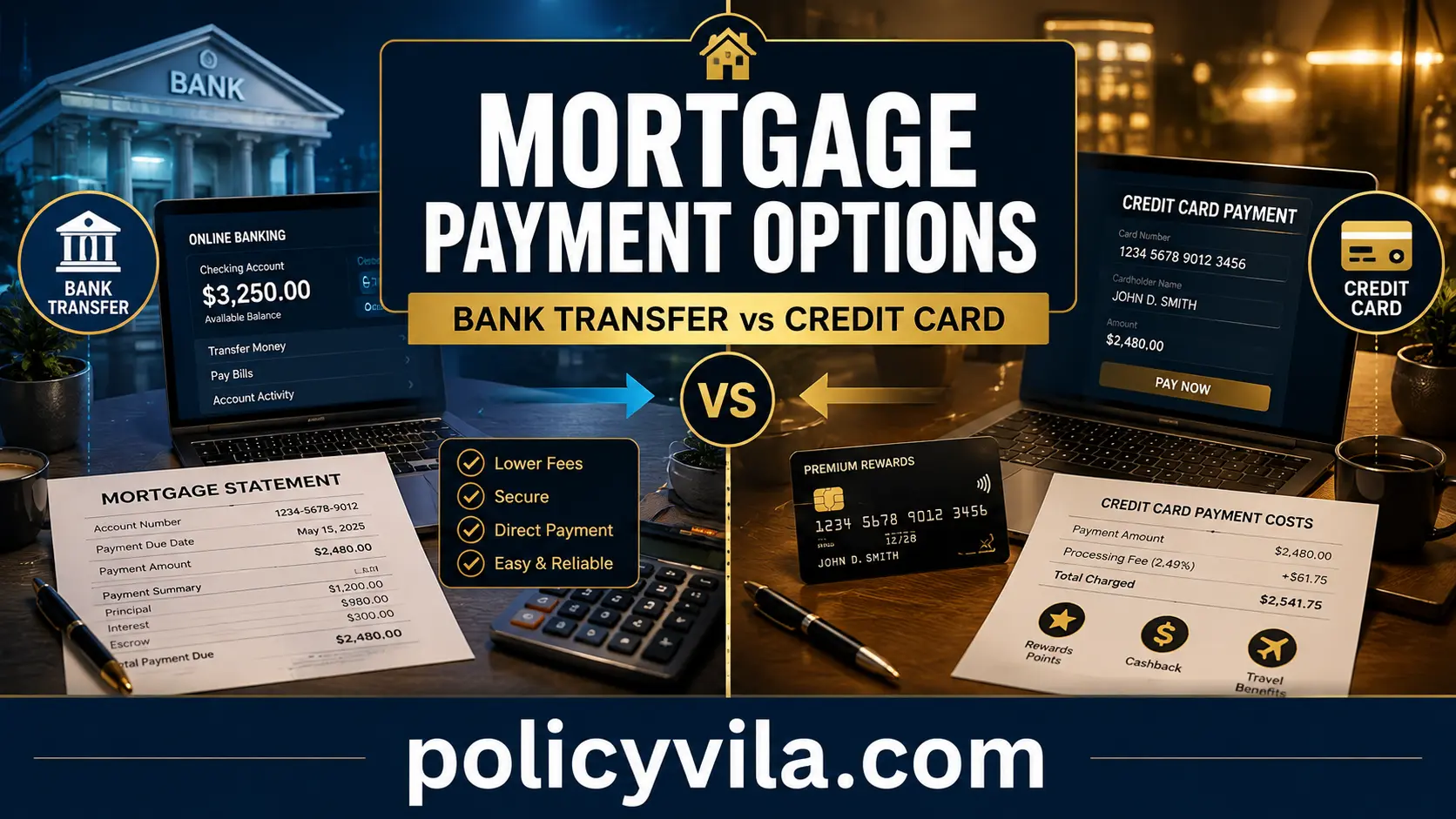
Most mortgage lenders don’t accept credit card payments directly. A small number of third-party payment services — Plastiq is the best-known example — let you charge a credit card and have them forward the payment to your mortgage servicer as an ACH transfer or check, typically for a fee of around 2.9% to 3% of the payment amount. On a $2,000 mortgage payment, that’s roughly $58 to $60 added to the bill every time you use it. Whether that’s worth it depends on your card’s rewards rate, whether you’ll pay off the balance before interest accrues, and what it does to your credit utilization.
Table of Contents
- Why Mortgage Lenders Don’t Take Credit Cards Directly
- How Third-Party Payment Services Actually Work
- The Real Cost of a Processing Fee
- Do the Rewards Actually Beat the Fee?
- What It Does to Your Credit Utilization
- The Bigger Risk: Carrying the Balance
- Why a Cash Advance Is a Different — and Worse — Option
- Pros and Cons
- When It Might Be Worth Considering
- When to Avoid It
- Better Alternatives for a Cash-Flow Gap
- Common Mistakes
- Checklist Before You Swipe
- Frequently Asked Questions
Why Mortgage Lenders Don’t Take Credit Cards Directly
Retailers generally build credit card processing costs into their prices. Mortgage servicers work differently: they’re collecting a fixed, recurring loan repayment, not selling a product with margin to absorb a processing fee. Accepting card payments directly would mean either eating that cost across potentially millions of monthly payments or passing it on to borrowers — and most servicers have simply opted out of the card networks altogether in favor of bank transfers, automatic ACH withdrawals, online banking portals, and mailed checks.
None of this is about disliking credit cards specifically. It’s a cost and reliability decision: bank transfers are cheaper to process, easier to automate, and more predictable for a lender handling a large volume of monthly payments.

How Third-Party Payment Services Actually Work
Since most lenders won’t take a card directly, a small industry of third-party payment services has grown around bridging that gap. Plastiq is the most widely used example: you charge your mortgage payment to a credit card through Plastiq, and Plastiq forwards the money to your mortgage servicer as an ACH transfer or a mailed check — a format your lender already accepts. To your mortgage company, the payment looks like a normal bank transfer. The credit card only enters the picture one step earlier, between you and Plastiq.
Card network restrictions apply. Plastiq has generally accepted Mastercard and Discover for mortgage payments, while Visa has not been accepted for this use, and American Express acceptance has changed over time — it was dropped in 2023 and later reinstated, so eligibility can shift. Some credit card issuers also restrict or flag these transactions in their own terms, and a handful of issuers, including Bank of America, don’t allow their cards to be used for mortgage payments through services like this at all. Before relying on this method, confirm current eligibility directly with the payment service, your card issuer, and your mortgage servicer — all three need to cooperate for the payment to go through smoothly.
The Real Cost of a Processing Fee
Plastiq’s fee for credit and debit card payments has generally run in the range of about 2.9% to 3% of the transaction. On a mortgage-sized payment, that percentage turns into a real dollar amount fast:
| Monthly Mortgage Payment | Illustrative Fee at ~2.9% | Total Charged |
|---|---|---|
| $1,500 | $44 | $1,544 |
| $2,000 | $58 | $2,058 |
| $2,500 | $73 | $2,573 |
| $3,000 | $87 | $3,087 |
These are illustrative figures based on a roughly 2.9% fee — actual rates vary by provider and can range differently depending on the source. If you did this every month rather than as a one-time bridge, that fee compounds into a real annual cost: a $58 monthly fee adds up to about $696 a year, money that isn’t going toward your mortgage principal or anything else.
Do the Rewards Actually Beat the Fee?
The appeal is obvious — a large, unavoidable monthly bill suddenly becomes an opportunity to earn cash back, points, or miles. The math doesn’t always cooperate.
A standard 2% cashback card earning on a $2,000 mortgage payment generates about $40 in rewards. A roughly 2.9% processing fee on that same payment costs about $58. Net result: a $18 loss, before even considering whether the balance gets paid off before interest applies. For this specific transaction to make financial sense, your reward rate generally needs to exceed the processing fee percentage — which is a higher bar than most standard cashback cards clear.
There are narrower exceptions. Some niche products, including certain Bilt Mastercard and Made card offerings, have been built specifically to let cardholders earn rewards on rent or mortgage-type payments without the standard third-party processing fee — though eligibility, participating landlords or servicers, and reward structures vary and should be confirmed directly with the card issuer rather than assumed. Outside of a product specifically designed for this purpose, run the actual numbers on your reward rate against the processing fee before assuming a mortgage payment is a smart way to rack up points.
What It Does to Your Credit Utilization
Even a technically successful payment can affect something beyond your bank balance: your credit utilization, meaning how much of your available revolving credit is currently in use.
Say you have $20,000 in available credit and a $4,000 existing balance — 20% utilization. Add a $2,500 mortgage payment to that card, and the balance jumps to $6,500, pushing utilization to 32.5%. Nothing about your mortgage changed; only the number your credit card issuer reports did.
| Available Credit | Mortgage Payment Added | Utilization Increase (Illustrative, No Prior Balance) |
|---|---|---|
| $10,000 | $2,500 | 25% |
| $15,000 | $2,500 | 16.7% |
| $20,000 | $2,500 | 12.5% |
| $30,000 | $2,500 | 8.3% |
Credit card issuers typically report your balance at a specific point in the billing cycle — not necessarily after you’ve paid it off. If that report happens to land while the mortgage charge is still sitting on the card, your utilization could appear elevated on your credit report even if you fully intend to pay it off before the statement due date. That timing detail matters most if you’re planning to apply for a refinance, a home equity loan, or other financing in the near future, since utilization is one factor lenders commonly review.
The Bigger Risk: Carrying the Balance
The processing fee is a known, fixed cost. The bigger financial risk is unplanned: what happens if the credit card balance isn’t paid off before interest starts accruing.
Credit card interest rates are typically far higher than mortgage interest rates. A homeowner who charges a mortgage payment and then carries that balance for even a few months can end up paying substantially more in interest than the processing fee alone — effectively replacing lower-cost mortgage debt with higher-cost revolving debt. What looked like a way to solve a temporary cash shortfall can quietly become a more expensive, ongoing problem if the balance lingers.
Why a Cash Advance Is a Different — and Worse — Option
Some homeowners consider taking a cash advance against their credit card and depositing that cash to cover the mortgage payment directly, bypassing a third-party service entirely. This is generally the most expensive version of this idea. Cash advances typically carry a separate, higher APR than regular purchases, usually start accruing interest immediately with no grace period, and often come with an upfront cash advance fee on top of that. Compared to a standard purchase-based transaction through a payment service — where at least a grace period may apply if the balance is paid in full — a cash advance stacks extra costs on top of the same fundamental risk. Treat it as a last resort, not a routine option.
[Relevant image: homeowner comparing mortgage payment options including bank transfer, third-party credit card service, and cash advance]
Pros and Cons of Paying a Mortgage With a Credit Card
| Pros | Cons / Limitations |
|---|---|
| Can bridge a short, well-defined cash-flow gap | Processing fees around 2.9%–3% often exceed standard cashback rewards |
| May earn credit card rewards on an otherwise unrewarded expense | Not every lender, card issuer, or card network supports it |
| Some niche cards are built specifically for fee-free rewards on housing payments | Can temporarily raise credit utilization right before a loan application |
| Avoids a missed or late mortgage payment in a genuine emergency | Carrying the balance can mean paying much higher interest than the mortgage itself |
When It Might Be Worth Considering
This approach tends to make more sense as a short, deliberate bridge rather than a routine habit:
- A brief, predictable cash-flow gap — for example, a paycheck arriving a few days late or reimbursement funds still processing, with repayment realistically expected almost immediately
- A one-time emergency expense collision — a major repair landing in the same month as the mortgage due date, where the credit card balance can be eliminated quickly afterward
- A confirmed, favorable rewards situation — you’ve actually run the math on the processing fee versus your card’s reward rate and confirmed the balance will be paid in full before interest applies
When to Avoid It
- You already carry a high revolving balance — adding a mortgage-sized charge increases pressure rather than relieving it
- You can only make minimum payments — a mortgage-sized balance at minimum payments can take a long time to pay off, with interest accumulating throughout
- You’re chasing rewards without checking the math — a fee that exceeds your reward rate is a net loss regardless of how many points you earn
- You’re about to apply for major financing — a refinance, home equity loan, or other large loan application generally goes more smoothly with stable, lower credit utilization beforehand
- You’re doing this every single month — a repeated pattern turns a one-time bridge into an ongoing, fee-generating habit

Better Alternatives for a Cash-Flow Gap
Build a small mortgage payment cushion
Setting aside even modest amounts throughout the month, rather than scrambling right before the due date, reduces how often a shortfall happens in the first place.
Automate the payment
Automatic ACH payments reduce the risk of a missed due date and remove the last-minute decision-making that leads to reaching for a credit card.
Review the monthly budget for flexibility
Discretionary spending, subscriptions, and the timing of larger purchases can sometimes be adjusted to free up room without borrowing.
Keep a separate emergency fund
A dedicated reserve for unexpected expenses — repairs, medical bills, a temporary income gap — provides flexibility without creating new debt.
Contact your mortgage servicer directly
If you’re facing a genuine hardship, many servicers have formal short-term assistance or forbearance options that don’t involve taking on high-interest debt. It’s worth asking before assuming a credit card is the only path forward.
Common Mistakes
Assuming every mortgage lender or card works the same way
Fix: Confirm current eligibility with the payment service, your card issuer, and your mortgage servicer — all three need to line up.
Focusing on rewards without checking the fee
Fix: Compare your card’s actual reward percentage against the processing fee percentage before assuming you’ll come out ahead.
Not accounting for payment processing time
Fix: Submit well before your due date — a payment routed through a third-party service takes extra steps and business days to reach the lender.
Ignoring the utilization timing
Fix: If you’re planning to apply for financing soon, avoid pushing a large balance onto a card right before your statement closing date.
Treating a cash advance like a normal purchase
Fix: Understand that cash advances typically carry a higher rate, start accruing interest immediately, and often add an upfront fee — check your card’s specific terms before using this option.
Letting a one-time bridge become a monthly habit
Fix: If the credit card is covering the mortgage payment more than once, address the underlying cash-flow gap directly rather than continuing to pay the recurring fee.
Checklist Before You Swipe
- Confirm your mortgage servicer, card issuer, and any third-party payment service all support this transaction
- Check the current processing fee and compare it against your card’s actual reward rate
- Confirm you can pay off the full balance before interest applies
- Check how the added balance affects your credit utilization, especially before any planned loan application
- Submit the payment with enough lead time to account for processing delays
- Avoid a cash advance unless you fully understand its separate, higher cost structure
- If this becomes a recurring need, address the underlying budget gap instead of repeating the fee every month

Frequently Asked Questions
Can I pay my mortgage with a credit card directly through my lender?
Generally, no. Most mortgage servicers only accept bank transfers, ACH payments, or checks. A credit card payment usually has to go through a third-party service that forwards the money to the lender in an accepted format.
What is the typical fee for paying a mortgage with a credit card through a service like Plastiq?
Fees have generally run around 2.9% to 3% of the payment amount, though the exact rate can vary and should be confirmed directly with the provider before you commit to a payment.
Which credit cards can I use with a mortgage payment service?
It depends on the specific service and your card issuer’s own terms — some services have accepted Mastercard and Discover for mortgage payments while excluding Visa, and American Express eligibility has changed over time. Confirm current network and issuer restrictions before assuming your card will work.
Will paying my mortgage with a credit card help or hurt my credit score?
It depends on your overall credit profile and timing. On-time mortgage payments themselves are unaffected by the method, but a large balance added to a credit card can temporarily raise your utilization, which is one factor that can influence your score — particularly if the balance is still showing when your statement closes.
Is it ever actually profitable to pay a mortgage with a rewards credit card?
It can be, but only in specific situations: your reward rate needs to exceed the processing fee, and you need to pay off the balance before interest applies. Standard 1%–2% cashback cards often fall short of this bar once a roughly 2.9% fee is factored in; certain niche cards built specifically for rent or mortgage-type payments are a narrower exception worth researching separately.
Can I use a balance transfer offer to pay my mortgage?
Generally, no. Balance transfers move existing revolving debt from one credit account to another — they aren’t designed to function as a mortgage payment method, and most mortgage balances can’t simply be transferred onto a credit card this way.
Is a cash advance a good way to pay a mortgage with a credit card?
Usually not. Cash advances typically carry a higher interest rate than regular purchases, begin accruing interest immediately with no grace period, and often include an additional upfront fee — making this generally the most expensive version of using a credit card for a mortgage payment.
How far in advance should I submit a credit-card-funded mortgage payment?
Earlier than you would a direct bank transfer. Routing a payment through a third-party service adds processing steps and business days, so submitting close to your due date increases the risk of a late payment if something in the chain is delayed.
Does using a credit card change my mortgage terms in any way?
No. The payment method doesn’t affect your interest rate, loan balance, escrow calculations, or contract terms — it only changes how the money physically reaches your mortgage servicer.
What should I do instead if I’m worried about missing a mortgage payment?
Consider contacting your mortgage servicer directly — many offer short-term hardship or forbearance options — before assuming a high-fee credit card payment is the only alternative. Building a small dedicated cushion for housing costs and automating your payment can also reduce how often this situation comes up.

The Bottom Line
Paying a mortgage with a credit card is occasionally possible, but it’s rarely the straightforward win it might look like in the moment. A processing fee in the range of 2.9% to 3% frequently outweighs standard cashback rewards, a large charge can temporarily inflate your credit utilization at an inconvenient time, and carrying the balance even briefly can mean paying meaningfully more in interest than the fee alone.
The better question usually isn’t whether the payment can technically go through — it’s whether there’s a lower-cost way to solve the same underlying problem. A short-term cash cushion, an automated payment schedule, or a direct conversation with your mortgage servicer about hardship options will often leave you in a stronger financial position than routing a mortgage payment through a credit card and hoping the math works out.