

A personal finance calendar takes a different approach. Instead of reviewing your entire financial life at once, it assigns one specific money review to each month of the year. This guide walks through a full 12-month version you can adapt, along with a simple process for running each review in about 30 minutes.
Quick Answer
A personal finance calendar is a 12-month schedule where each month has one focused financial review — spending, budget accuracy, subscriptions, and so on — instead of trying to audit everything at once. Each review takes about 30 minutes and ends with one concrete action, so by December you’ve covered your full financial picture without ever facing an overwhelming all-at-once review.
What Is a Personal Finance Calendar?
A personal finance calendar is a 12-month schedule that pairs each month with one specific financial review, rather than asking you to evaluate your entire financial life at once. Instead of “how is my money doing overall,” each month asks one narrow question — is my budget realistic, what subscriptions am I still paying for, where does my impulse spending happen.
It’s a different tool than a budget. A budget tells you how you plan to spend your money. A personal finance calendar tells you when to check whether a specific part of that plan still matches reality. It’s also different from a financial dashboard, which shows several metrics at once — the calendar spreads that review out so no single session becomes overwhelming.
Why the Timing Matters
Financial problems tend to grow quietly. An extra $150 a month in small purchases barely registers in January, but by December that same pattern has become the new normal. Reviewing one area every month catches these shifts while they’re still small and easy to adjust — before a full-year review reveals a habit that’s already twelve months old.
Why a Once-a-Year Review Isn’t Enough
Many people review their finances exactly once, usually in December — checking income, expenses, and savings, then setting goals for the year ahead. The problem is that a single annual review only surfaces problems after they’ve already existed for months.
A monthly rhythm catches things an annual check-in misses, such as:
- A spending category that’s been quietly climbing for several months
- Actual expenses that no longer match a budget written months earlier
- Small recurring charges that have added up unnoticed
- A gradual shift in lifestyle spending
- Rising monthly financial pressure that isn’t reflected in any single transaction
None of this requires obsessive tracking. It just requires checking one thing, regularly, before it becomes twelve things at once.

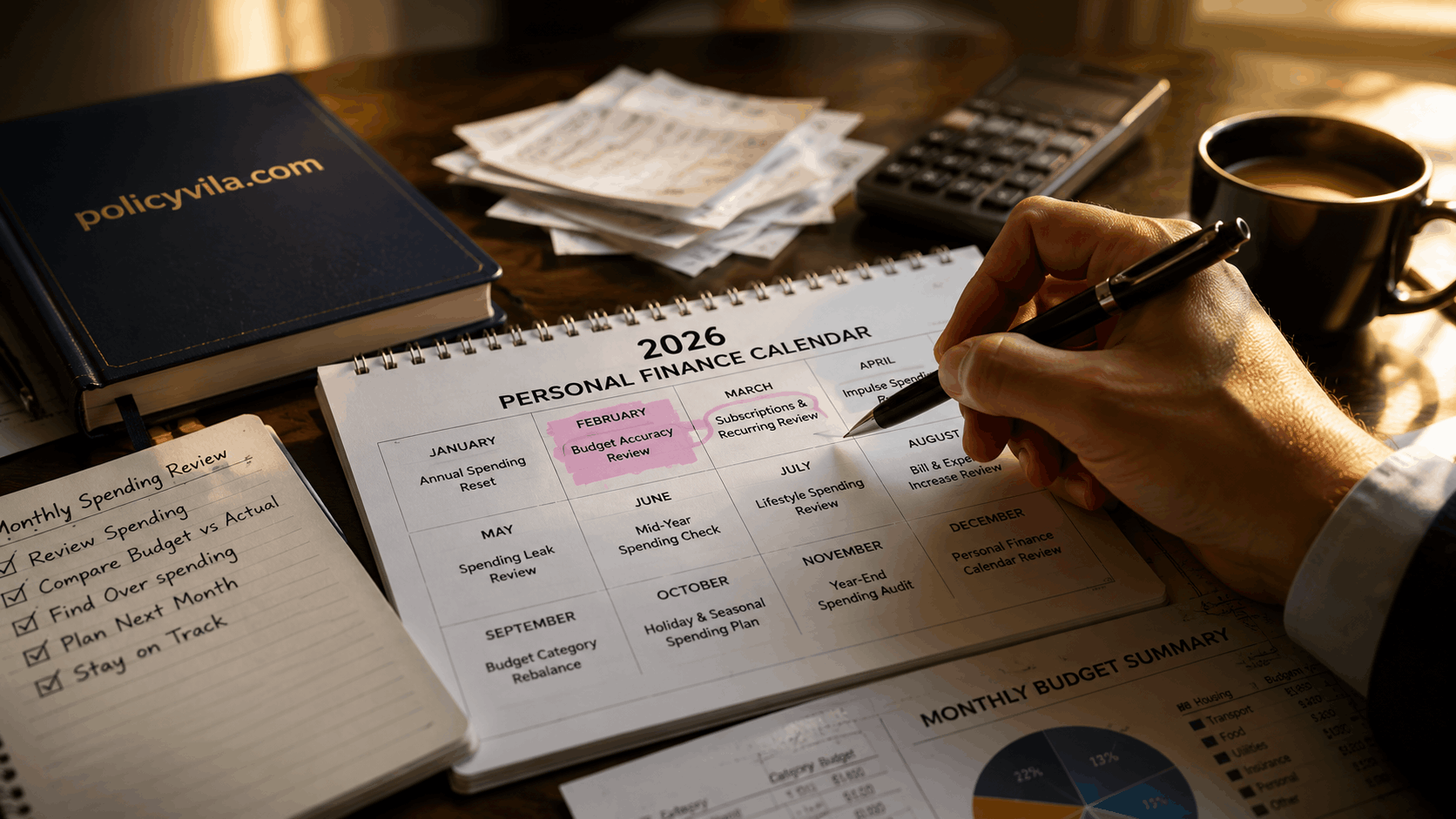
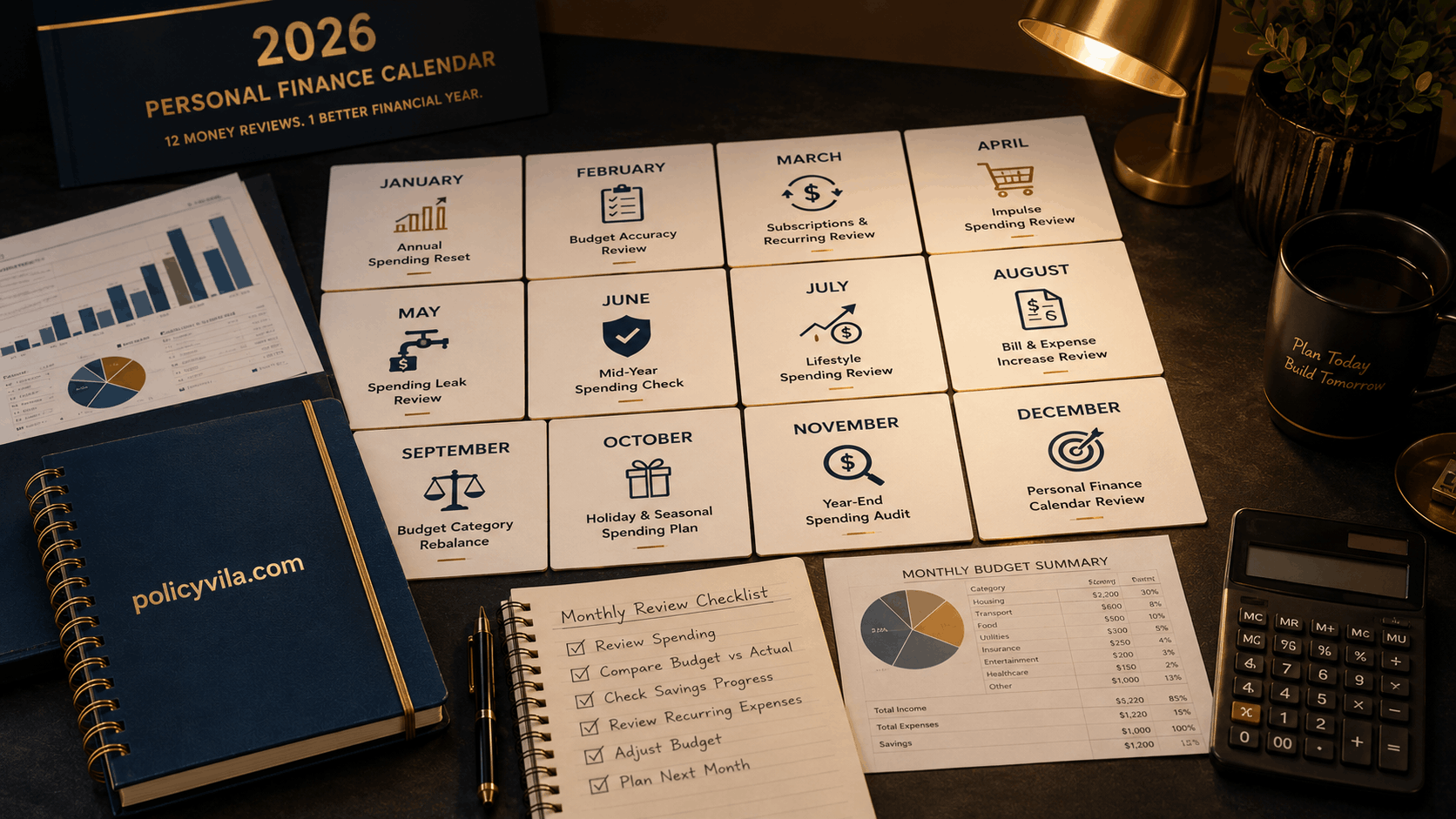
The 12-Month Calendar
Each month below focuses on one review. Adapt the order to your own financial calendar — for example, moving the seasonal-spending review earlier if your biggest costs land in a different part of the year.
January — Annual Spending Reset
Look back at the full previous year rather than a single month. The goal isn’t to judge every purchase — it’s to spot patterns. Which categories took the biggest share of spending? Which one surprised you? Did anything shift noticeably partway through the year?
Action: Identify your three biggest spending categories and write one observation about each.
February — Budget Accuracy
Many budgets are built around what someone wishes they’d spend, not what their actual records show. Compare your planned numbers against real spending for a few recent months. If a category is wrong every single month, the issue is usually the target, not your discipline.
Action: Adjust one budget category using your actual spending data.
March — Subscriptions and Recurring Expenses
Recurring charges are easy to ignore precisely because they’re automatic. Go through your monthly charges and, for each one, ask whether you still use it, whether the cost has changed, and whether it still matches a current need. The point isn’t to cancel everything — it’s to know what you’re actually paying for.
Action: Mark each recurring expense as essential, useful, or needs review.
April — Impulse Spending
Impulse purchases aren’t always expensive — they’re often small and repeated. Review anything you bought without planning to and look for a common thread: stress, convenience, a particular time of day or type of week.
Action: Identify one personal spending trigger and set a simple rule for that situation.
May — Spending Leaks
A spending leak is a small expense that happens often enough to add up — a delivery fee here, a convenience upgrade there. None of it is inherently wasteful; the question is whether the pattern reflects your actual priorities.
Action: Find one repeated spending pattern worth understanding better.
June — Mid-Year Spending Check
By June you have six months of data, enough to compare against where you started. Look at the trend rather than any single unusual month — has a category grown steadily, or was it a one-time spike?
Action: Choose one category to watch more closely for the rest of the year.
July — Lifestyle Spending
As income changes, lifestyle spending often rises with it — sometimes faster than people realize. This review isn’t about avoiding every upgrade; it’s about noticing whether spending is growing faster than your broader financial progress.
Action: Identify one lifestyle expense worth a conscious second look.
August — Expense Increases
Compare current costs against earlier in the year, particularly housing, transportation, utilities, and regular services. A higher expense isn’t automatically a problem — the key is whether you noticed it and adjusted for it.
Action: Identify the category with the biggest increase and note why it changed.
September — Budget Rebalance
If a budget category runs over once, that’s normal variation. If it runs over every month, the target — not the behavior — probably needs to change. Use real spending numbers rather than a figure that looks tidy on paper.
Action: Adjust one budget category based on actual spending patterns.
October — Seasonal Spending Preparation
Many households see predictable cost increases later in the year. Reviewing this in October creates awareness before the expenses land, rather than after.
Action: Write down three predictable seasonal expenses and note when to expect them.
November — Year-End Spending Audit
Look across the full year for recurring patterns: categories that kept rising, budget problems that kept repeating, lifestyle shifts, and areas that got easier to manage. The goal is understanding, not fixing everything at once.
Action: Write down the three biggest financial lessons from the year’s spending.
December — Calendar Review
Look back across all twelve reviews. Which ones actually changed something? Which financial pattern kept showing up? This review sets up next year’s calendar.
Action: Choose the three monthly reviews you want to repeat next year.

The Calendar at a Glance
| Month | Review Focus | Main Question | Primary Action |
|---|---|---|---|
| January | Annual spending reset | Where did my money go? | Identify three major spending patterns |
| February | Budget accuracy | Is my budget realistic? | Adjust one budget category |
| March | Recurring expenses | What payments repeat? | Review each recurring cost |
| April | Impulse spending | What triggers unplanned purchases? | Identify one spending trigger |
| May | Spending leaks | Which small costs repeat? | Find one repeated pattern |
| June | Mid-year check | How has spending changed? | Select one category to monitor |
| July | Lifestyle spending | Has my lifestyle cost increased? | Review one lifestyle expense |
| August | Expense increases | What became more expensive? | Record the biggest increase |
| September | Budget rebalance | Which category is always over? | Adjust one budget target |
| October | Seasonal spending | What expenses are predictable? | List three seasonal costs |
| November | Spending audit | What did I learn this year? | Record three financial lessons |
| December | Calendar review | Which reviews helped most? | Select next year’s priorities |
Running a Monthly Review in 30 Minutes
A monthly review doesn’t need a whole weekend. A simple six-step process keeps it short and repeatable.
- Collect the numbers. Gather only what that month’s review needs — not every financial document you own.
- Compare against the previous month. A single number rarely tells you much; a change between two months usually does.
- Identify one unusual change. Not a list of ten issues — one change worth attention.
- Find the biggest issue. This isn’t always the largest purchase — a repeated small pattern can matter more.
- Choose one action. Something realistic: adjust a category, change a rule, update a target.
- Record the result. A short note creates context for next month’s review.
The 10-10-10 Method
If you want an even simpler structure, split the 30 minutes into three even blocks:
- First 10 minutes: Review the actual spending numbers for the month’s focus area.
- Next 10 minutes: Look for one unusual change or repeated pattern — don’t try to explain every transaction.
- Final 10 minutes: Pick one practical action for the month ahead.
The simplicity is the point. A five-minute-to-set-up, 30-minute review is far easier to repeat twelve times than an elaborate financial audit.
Tools for Tracking It
No special software is required.
- Spreadsheet: Twelve rows, one per month, with columns for the review, the main question, the action taken, and the result.
- Notebook: One page per month — write the review at the top, observations below.
- Printable calendar: Useful if you want the review visible somewhere you’ll actually see it, like a kitchen or home office wall.
The format matters far less than whether you actually use it every month.
15 Questions to Ask During Any Monthly Review
Not every question applies to every month — pick the ones that fit that month’s focus.
- What spending increased this month?
- Which category surprised me?
- Did my lifestyle spending change?
- What expense repeated more than expected?
- Did I spend based on need or convenience?
- Which budget category was unrealistic?
- Did my overall spending pattern shift?
- What expense deserves a closer look?
- Did I make more unplanned purchases than usual?
- Which spending habit was easiest to control this month?
- Which financial decision created the most pressure?
- Did a regular expense get more expensive?
- What pattern showed up more than once?
- Which category should I watch next month?
- What’s the one action I should take right now?
Signs Your Spending Needs Closer Attention
A monthly review is useful precisely because these signs are easy to miss otherwise.
- You can’t explain where your money went. If a chunk of income disappears every month with no clear cause, that’s worth a closer look.
- Spending rises steadily, month after month. A gradual climb usually points to a lifestyle or recurring-cost shift, not a single bad month.
- Your budget is wrong every time. If actual spending consistently misses the plan, the plan needs updating.
- Small expenses keep repeating. Individually harmless, collectively significant.
- You regularly use credit for ordinary spending. Worth reviewing your monthly cash flow directly.
- Income rises but financial pressure doesn’t ease. A raise doesn’t automatically translate into more breathing room if spending grows at the same pace.
Personal Finance Calendar vs Traditional Budgeting
| Feature | Traditional Budget | Personal Finance Calendar |
|---|---|---|
| Primary purpose | Plan spending | Schedule financial reviews |
| Review frequency | Often monthly, all categories | One specific review each month |
| Main focus | Income and expenses | Monthly financial awareness |
| Spending control | Budget targets | Pattern review and one action |
| Long-term benefit | Spending structure | Consistent, sustainable awareness |
The two aren’t competing tools. A calendar doesn’t replace a budget — it creates a regular schedule for checking whether that budget still matches your real life.
Using the Calendar as a Couple or Family
The same monthly structure works for households, with one adjustment: the goal is understanding shared patterns, not assigning blame for who spent what. Pick one recurring day each month — the same day is easier to remember than a new date every time — and walk through that month’s review together.
For a February budget-accuracy review, for example, both partners can ask what changed, what surprised them, and what one action they want to take together. A short, focused monthly conversation tends to build more shared awareness than occasional arguments about money after the fact.
Mistakes to Avoid
- Trying to fix everything at once. A review that surfaces ten problems becomes a chore instead of a habit. Pick one priority.
- Tracking too many numbers. Stick to what that month’s review actually needs.
- Reviewing money every single day. Daily checking often creates stress without adding useful information — the calendar is built around a structured, spaced-out rhythm on purpose.
- Ignoring trends in favor of single unusual months. One odd month rarely matters; a repeated pattern does.
- Setting budget targets that don’t match real life. Use your own data, not an aspirational number.
- Comparing your spending to someone else’s. Household finances vary too much for this to be useful.
- Skipping the review after a bad month. A difficult month often contains the most useful information.
- Leading with guilt instead of data. Guilt rarely explains why a pattern changed; the numbers usually do.
- Never recording the action taken. Without a written note, it’s hard to check progress next month.
- Overcomplicating the system. A complicated calendar is easier to abandon — one focused review per month is enough.
Building Your Own Calendar
- List the 12 months. A simple January-through-December list is enough to start.
- Assign one review per month. Resist the urge to add more than one major focus to a given month.
- Pick a recurring review date. Choose something easy to remember — payday, the first weekend, the last day of the month.
- Write the main question. One clear question keeps the review from sprawling.
- Record one action. Decide what you’ll actually do as a result of the review.
- Check the result next month. Look back at the previous action before starting the new review — this is what turns twelve isolated check-ins into a feedback loop.

Printable Template
| Month | Money Review | Main Question | Action Taken | Result |
|---|---|---|---|---|
| January | ||||
| February | ||||
| March | ||||
| April | ||||
| May | ||||
| June | ||||
| July | ||||
| August | ||||
| September | ||||
| October | ||||
| November | ||||
| December |
Copy this structure into a spreadsheet or notebook as a starting point, then adjust the monthly focus areas to match your own financial priorities.
Frequently Asked Questions
How is this different from just checking my bank app regularly?
Checking a balance shows you a number; a monthly review asks a specific question about a specific pattern, which is what actually leads to a decision or action.
What if my biggest financial priority doesn’t fit one of these 12 topics?
Swap it in. The calendar is a framework, not a fixed list — replace any month’s focus with whatever matters most in your own financial life.
Should I use the same 30-minute process for every month?
The six-step process or the 10-10-10 method both work as a default, but a simpler month, like reviewing subscriptions, may take less time than a full annual spending reset.
What if I don’t have detailed spending records to review?
Start by collecting a few months of statements before your first review — even a rough categorization is enough to spot patterns.
Is this system useful for someone without debt or major financial problems?
Yes. The reviews are as much about maintaining awareness and catching small shifts early as they are about solving existing problems.
Can I run the calendar quarterly instead of monthly?
You can, but spacing reviews out further makes it harder to catch a pattern while it’s still small — monthly is the interval the system is built around.
What happens if I skip several months in a row?
Pick back up with whichever review feels most relevant right now rather than trying to complete every missed month — the goal is the habit, not a perfect streak.
Final Thoughts
Financial organization doesn’t require checking every number every day. A personal finance calendar creates a simple rhythm instead: one month, one review, one action.
That routine won’t produce a perfect financial system, but it builds something more durable — a repeatable habit that keeps your money visible throughout the year, so changes get caught while they’re still small enough to adjust easily.