
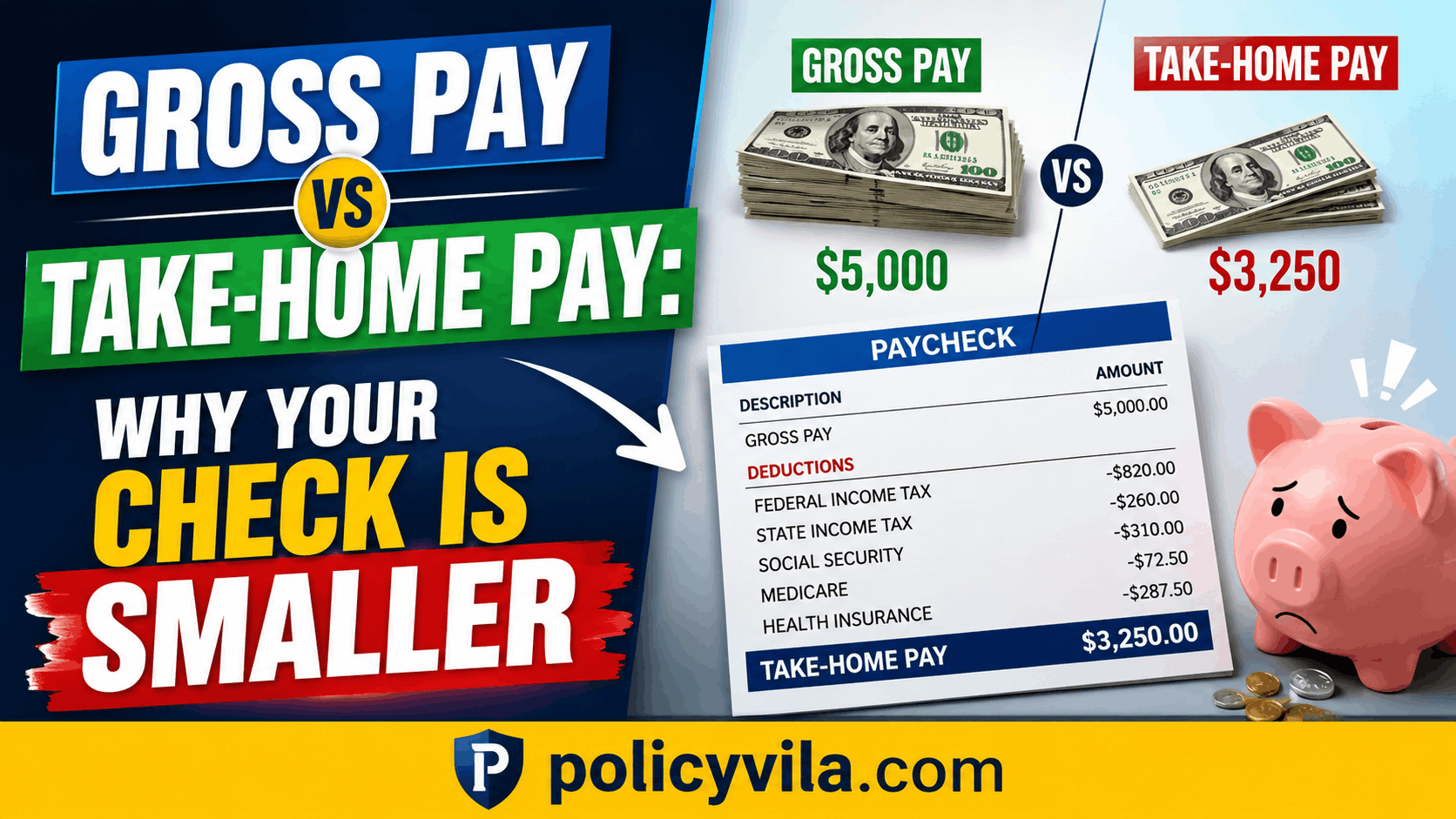
This guide breaks down exactly where that money goes, how payroll calculates each deduction, and how to use the right number when you build a budget, compare job offers, or negotiate a raise.
Quick Answer
Gross pay is your total earnings before anything is withheld — salary, hourly wages, overtime, bonuses, and commissions combined. Take-home pay (also called net pay) is what’s left after federal and state taxes, Social Security, Medicare, and any benefits you’ve elected — like health insurance or retirement contributions — are subtracted. For most employees, take-home pay lands somewhere between 70% and 85% of gross pay, depending on income level, location, and benefit choices.
What Is Gross Pay?
Gross pay is everything you earn in a pay period before a single deduction is applied. It’s the number employers put in job postings and offer letters, and it’s the starting figure every payroll system uses before calculating anything else.
Depending on your role, gross pay can include:
- Base salary or hourly wages
- Overtime pay
- Performance bonuses
- Sales commissions
- Holiday or shift-differential pay
- Other incentive payments
Gross Pay for Salaried Employees
A salaried employee’s gross pay is usually the same each pay period, calculated by dividing annual salary across the payroll schedule.
| Annual Salary | Payroll Schedule | Gross Pay Per Check |
|---|---|---|
| $72,000 | Monthly | $6,000 |
| $72,000 | Semimonthly | $3,000 |
| $72,000 | Biweekly | Approximately $2,769 |
The figure stays fairly consistent, but it can shift if a bonus is paid out, a raise takes effect mid-cycle, or unpaid leave is taken.
Gross Pay for Hourly Employees
Hourly workers calculate gross pay by multiplying the hourly rate by hours worked, plus any overtime.
| Earnings | Amount |
|---|---|
| Regular hours (80 hrs × $25) | $2,000 |
| Overtime pay | $375 |
| Gross Pay | $2,375 |
Example: Sarah, a project coordinator, earns a $5,000 base salary this month plus a $500 performance bonus and $250 in overtime. Her gross pay for the period is $5,750 — before any tax or benefit deduction is applied.
What Is Take-Home Pay?
Take-home pay, also called net pay, is what’s actually deposited into your bank account or printed on your paycheck after every required tax and every benefit you’ve elected has been subtracted from gross pay. It’s the number that determines what you can actually spend, save, or invest.
Deductions That Typically Reduce Take-Home Pay
- Federal income tax
- State income tax (in states that collect it)
- Social Security tax
- Medicare tax
- Health, dental, and vision insurance premiums
- Retirement plan contributions
- Other elected benefits, such as HSA or FSA contributions
Some of these are required by law and apply to nearly every paycheck. Others depend entirely on the benefits you choose during enrollment.

Gross Pay vs Take-Home Pay at a Glance
| Gross Pay | Take-Home Pay |
|---|---|
| Total earnings before deductions | Final amount you actually receive |
| Includes salary, overtime, bonuses, commissions | What’s left after taxes and benefit deductions |
| The figure used in job offers and postings | The figure to use for budgeting |
| Always the higher number | Always the lower number |
| Starting point of a payroll calculation | Ending point of a payroll calculation |
A simple way to remember it: gross pay is what you earn, take-home pay is what you receive.
Where the Difference Actually Goes
The gap between gross and net pay isn’t money that disappears — it’s redirected to specific obligations and benefits. Payroll deductions fall into two categories: mandatory and voluntary.
Mandatory Deductions
These are required by federal or state law, and employees generally have no ability to opt out of them.
| Deduction | What It Funds |
|---|---|
| Federal income tax | Federal government programs and services; amount depends on income, filing status, and withholding elections |
| State income tax | State government programs, where applicable — some states don’t collect income tax at all |
| Social Security tax | Retirement, disability, and survivor benefits |
| Medicare tax | Healthcare coverage for eligible older adults and certain individuals with disabilities |
Voluntary Deductions
These depend on the benefits you actively choose during onboarding or open enrollment.
| Deduction | What It Provides |
|---|---|
| Health insurance | Medical coverage for you and, if elected, your dependents |
| Dental and vision insurance | Coverage for routine and specialist dental or eye care |
| Retirement contributions (401(k), etc.) | Long-term retirement savings, often with an employer match |
| HSA or FSA contributions | Set-aside funds for qualified medical or dependent-care expenses |
| Life or disability insurance | Financial protection for you or your beneficiaries |
Choosing voluntary benefits is a trade-off: each one reduces take-home pay today in exchange for coverage or savings later. There’s no universally “correct” mix — it depends on your health needs, family situation, and financial goals.
Pre-Tax vs Post-Tax Deductions
Not all deductions are treated the same way by the tax system. The distinction between pre-tax and post-tax deductions explains why two employees earning identical salaries can end up with different take-home pay.
Pre-Tax Deductions
Pre-tax deductions are subtracted from gross pay before certain taxes are calculated, which can lower the portion of income subject to those taxes. Common examples:
- Traditional 401(k) contributions
- Employer-sponsored health insurance premiums
- HSA contributions
- FSA contributions
- Certain commuter benefit programs
Post-Tax Deductions
Post-tax deductions are subtracted after taxes have already been calculated, so they typically don’t reduce taxable income. Common examples:
- Roth 401(k) or Roth IRA contributions made through payroll
- Life insurance above certain employer-provided thresholds
- Union dues
- Wage garnishments
- Charitable payroll donations
| Pre-Tax Deductions | Post-Tax Deductions |
|---|---|
| Subtracted before certain taxes are calculated | Subtracted after taxes are calculated |
| May lower taxable income | Generally doesn’t lower taxable income |
| Common for health insurance and traditional retirement plans | Common for Roth accounts, garnishments, and union dues |
Neither option is inherently better — a Roth account, for instance, is a deliberate trade of a smaller tax break today for tax-free withdrawals later. The right mix depends on your current tax bracket and retirement timeline.

How Payroll Turns Gross Pay Into Take-Home Pay
Every paycheck goes through the same sequence, whether you’re paid weekly, biweekly, or monthly.
- Calculate gross pay — base wages, overtime, bonuses, and commissions are totaled.
- Apply pre-tax deductions — health insurance, traditional retirement contributions, HSA, and FSA amounts are subtracted first.
- Calculate payroll taxes — federal income tax, state income tax (if applicable), Social Security, and Medicare are withheld based on the reduced taxable amount.
- Apply post-tax deductions — Roth contributions, garnishments, union dues, and similar items are subtracted.
- Arrive at net pay — the remaining amount is your take-home pay.
- Issue payment — sent via direct deposit, paper check, or payroll card.
A Full Worked Example
The table below is a simplified, educational illustration — actual withholding depends on your income, location, filing status, and benefit elections.
| Payroll Item | Amount |
|---|---|
| Gross Pay | $5,000 |
| Federal Income Tax | -$520 |
| State Income Tax | -$180 |
| Social Security Tax | -$310 |
| Medicare Tax | -$72 |
| Health Insurance Premium | -$215 |
| Retirement Contribution | -$250 |
| Estimated Take-Home Pay | $3,453 |
Nothing in that $1,547 gap is lost. It’s split between taxes that fund public programs, insurance that covers healthcare costs, and retirement contributions building future savings. Seeing each line item helps explain a paycheck that otherwise looks like it’s missing money.
Why Take-Home Pay Changes Even When Salary Doesn’t
A fixed salary doesn’t guarantee an identical paycheck every period. Several things can shift the final number:
- Bonus payments — a bonus raises gross pay for that period, which can also raise the tax withheld on that check.
- Overtime — additional hours increase gross pay, but deductions scale up with it.
- Benefits enrollment — adding a dependent to health coverage, or enrolling in a new plan during open enrollment, increases premium deductions.
- Retirement contribution changes — raising your 401(k) contribution percentage lowers take-home pay immediately in exchange for higher long-term savings.
- Withholding updates — submitting a new W-4 or state withholding form changes how much tax is held back.
- Payroll corrections — occasional fixes to prior errors in hours, overtime, or deductions can temporarily change a check.
Hourly vs Salaried: Does It Matter?
Hourly Employees
Hourly pay fluctuates with hours worked, so gross pay — and therefore take-home pay — can change every period.
| Week | Hours Worked | Gross Pay |
|---|---|---|
| Week 1 | 40 | $1,000 |
| Week 2 | 45 | $1,187.50 |
Even though gross pay rose in Week 2, deductions rose alongside it, so take-home pay increased by less than the raw hourly gain would suggest.
Salaried Employees
Salaried gross pay is more predictable, but net pay can still move due to bonuses, benefit changes, withholding adjustments, or retirement contribution changes — consistency in salary doesn’t guarantee an identical paycheck every time.
Which Number Should You Budget With?
Always build a budget around take-home pay, not gross pay. Gross pay includes money you’ll never see in your account, and budgeting against it almost guarantees overspending.
| Monthly Gross Pay | Actual Take-Home Pay | Budgeting Gap If You Use Gross Pay |
|---|---|---|
| $6,000 | $4,650 | $1,350 overestimated |
To estimate your own take-home pay, factor in your annual salary, payroll schedule, expected federal and state tax withholding, Social Security and Medicare, and any benefits you’ve elected. Online payroll calculators can give a reasonable estimate, but your actual paycheck depends on your employer’s specific payroll system and your individual elections.
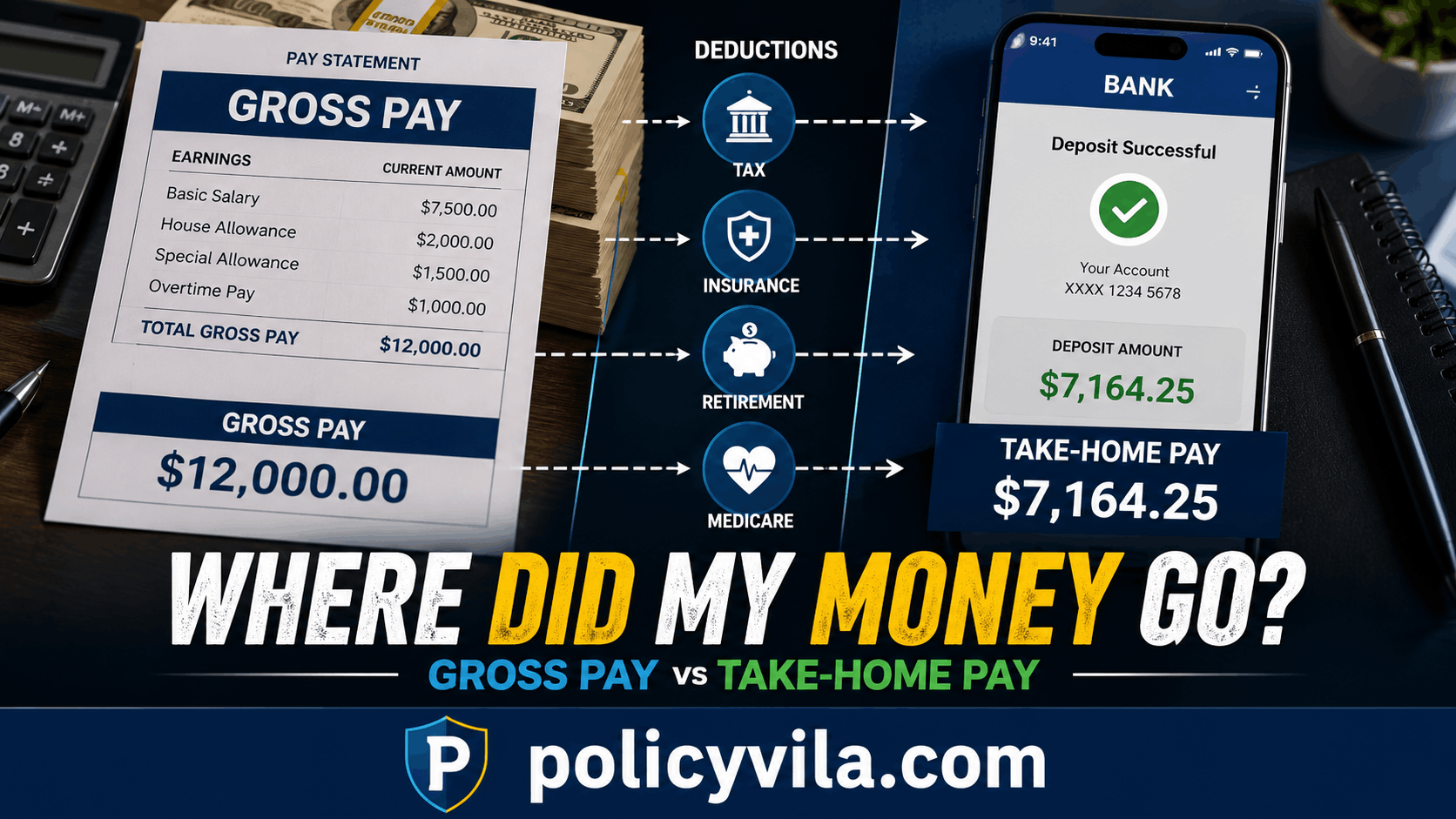
How to Read a Pay Stub
A pay stub is the itemized record behind your take-home pay. Knowing what each section shows makes it far easier to catch errors.
| Section | What It Shows |
|---|---|
| Employee Information | Name and employee ID |
| Pay Period | The dates the paycheck covers |
| Gross Pay | Total earnings before deductions |
| Payroll Taxes | Federal, state, Social Security, and Medicare withholding |
| Benefits | Insurance premium deductions |
| Retirement | Employee contributions to retirement accounts |
| Net Pay | The final deposited or issued amount |
| Year-to-Date Totals | Cumulative earnings and deductions for the year |
How Payroll Schedule Changes the Size of Each Check
The same annual salary looks different depending on how often you’re paid.
| Payroll Schedule | Paychecks Per Year |
|---|---|
| Weekly | 52 |
| Biweekly | 26 |
| Semimonthly | 24 |
| Monthly | 12 |
A monthly paycheck looks larger only because it covers a longer period — it isn’t extra money. Biweekly checks are smaller individually but arrive more often, and twice a year (in most calendars) a biweekly schedule produces three paychecks in a single month instead of two.
Common Payroll Mistakes to Watch For
Payroll systems are generally accurate, but errors happen. Review each pay stub for:
- Incorrect hours worked
- Missing overtime pay
- Wrong salary or hourly rate
- Duplicate deductions
- Incorrect tax withholding
- Benefit enrollment errors, such as a missing or extra dependent
If anything looks off, contact your payroll or HR department promptly — most errors are easier to correct the same pay period they occur in.
read also: Best Debt Consolidation Loans in 2026: 9 Top Options to Lower Payments and Get Out of Debt Faster
Can You Increase Your Take-Home Pay?
In some situations, yes — though the right approach depends on your circumstances and shouldn’t come at the cost of long-term financial security.
- Review your withholding to make sure you’re not over-withholding throughout the year
- Reassess benefit elections annually rather than leaving them on autopilot
- Negotiate salary increases when your role or market value has grown
- Build skills that support promotions or higher-paying roles
Cutting retirement contributions will raise take-home pay in the short term, but it comes with a real long-term cost — treat that trade-off carefully rather than as a default fix.
Common Misunderstandings
“My employer kept my money.”
Payroll deductions are processed according to tax law and the benefits you’ve elected — the money is redirected, not withheld arbitrarily.
“A higher salary means a proportionally larger paycheck.”
Not exactly. As income rises, tax withholding typically rises with it, so take-home pay grows more slowly than gross pay does.
“Gross pay is the money I can spend.”
Only take-home pay reflects what’s actually available to spend, save, or invest.
“A bonus always shows up as the full amount advertised.”
Bonuses are still subject to payroll deductions, so the deposited amount will usually be less than the headline figure.
Frequently Asked Questions
Is gross pay the same as annual salary?
Not exactly. Annual salary is your total yearly compensation before deductions, while gross pay usually refers to earnings for a single pay period.
Why did my take-home pay drop even though my salary didn’t change?
Common causes include a new benefit election, an increased retirement contribution, an updated tax withholding form, or a payroll correction from a prior period.
Do all states have state income tax deductions?
No. Several states don’t collect state income tax, so employees there won’t see that line item on their pay stub.
Does overtime pay get taxed at a higher rate?
Overtime earnings are taxed the same way as regular wages, but because they increase your total pay for that period, the dollar amount withheld can be higher.
What’s the difference between a 401(k) deduction and an HSA deduction?
A 401(k) contribution builds retirement savings, while an HSA contribution is set aside for qualified medical expenses — both are commonly pre-tax, but they serve different purposes.
Why do two coworkers with the same salary have different take-home pay?
Differences usually come from filing status, tax withholding elections, state of residence, and the specific benefits each employee has chosen.
Does a raise always increase take-home pay by the full raise amount?
No. A raise increases gross pay by the full amount, but take-home pay increases by less once additional tax withholding is applied.

Final Thoughts
Gross pay and take-home pay answer two different questions. Gross pay tells you what you’ve earned; take-home pay tells you what you actually have to work with. Confusing the two is one of the most common causes of an overstretched budget, especially right after a raise or a new job.
The habit worth building is simple: check your pay stub every period, understand what each deduction is doing, and always plan your spending around the number that actually lands in your account.