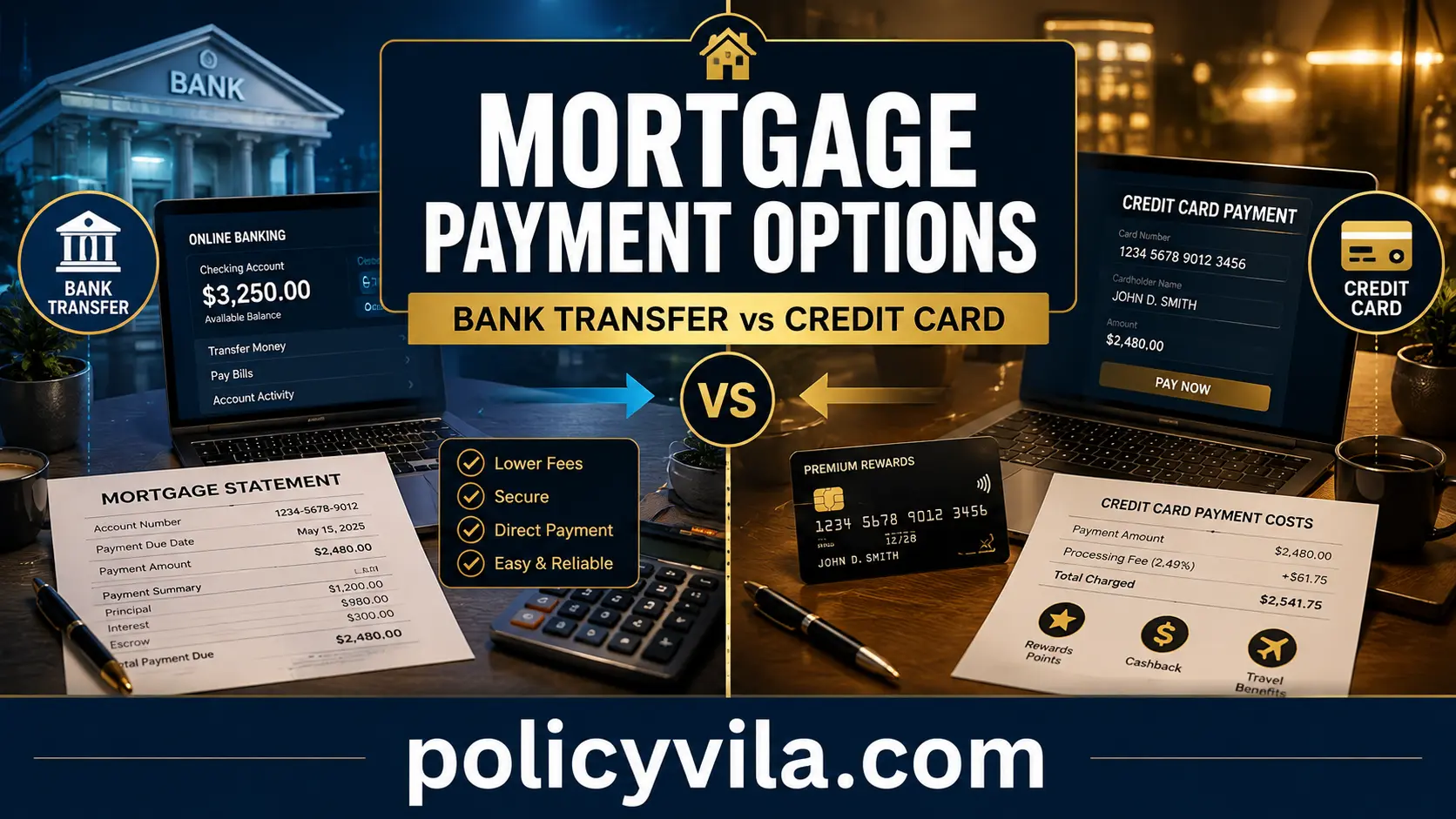

For a moment, it seems like the perfect solution. Can I Pay My Mortgage With a Credit Card
Your monthly mortgage payment is due in a few days, but your checking account is tighter than expected after covering home repairs, utility bills, and everyday expenses. Meanwhile, your credit card still has a healthy available limit—and it even offers cash back on purchases.
A simple question naturally comes to mind:
Can I pay my mortgage with a credit card?
At first glance, the idea appears practical. You avoid missing a payment, you may earn rewards, and you gain a little extra time before money actually leaves your bank account.
Unfortunately, mortgage payments don’t work the same way as grocery bills, utility payments, or online shopping. Most mortgage lenders don’t simply allow card payments, and even when they do become possible through other methods, additional fees, restrictions, and financial consequences can quickly outweigh the convenience.
Understanding the difference between what is technically possible and what makes financial sense is essential before using a credit card for a home loan payment.
This article explores the real mechanics behind mortgage payments, explains where credit cards fit into the process, and examines the financial trade-offs every homeowner should understand before making a decision.
The Mortgage Payment Question Millions Ask
Every month, millions of American homeowners make the same payment.
Yet very few stop to think about how that payment reaches the mortgage lender.
Most mortgages are paid through:
- Bank account transfers
- Automatic ACH withdrawals
- Online banking
- Mailed checks
- Mortgage servicing company payment portals
Credit cards are noticeably absent from that list.
That isn’t accidental.
Mortgage lending operates differently from traditional consumer purchases because of transaction costs, payment processing rules, and financial regulations.
Unlike retailers that build credit card processing costs into product pricing, mortgage companies generally receive fixed monthly payments. Accepting credit cards would require them to absorb merchant processing fees or pass those costs to borrowers.
As a result, direct credit card payments remain uncommon throughout the mortgage industry.
Mortgage Payments Are Designed Around Bank Transfers
Mortgage servicing companies typically encourage payment methods that move money directly from a borrower’s bank account.
These methods are:
- Less expensive to process
- Faster to reconcile
- Easier to automate
- More predictable for lenders
Electronic bank transfers also reduce transaction fees compared with credit card networks.
For lenders processing thousands—or even millions—of monthly mortgage payments, those savings become significant.
Homeowners Often Discover the Limitation Too Late
Many borrowers first encounter this issue after logging into their mortgage payment portal.
They expect to see familiar payment choices such as:
- Visa
- Mastercard
- American Express
Instead, they’re usually presented with:
- Checking account
- Savings account
- Routing number
- Account number
At that point, many homeowners begin searching for alternatives that might allow a mortgage payment using a credit card.
Quick Answer
Can you pay your mortgage with a credit card?
Sometimes—but usually not directly through your mortgage lender.
In certain situations, third-party payment services may make it technically possible, although convenience fees, processing costs, and financial considerations often change whether it is actually worthwhile.
Where Credit Cards Actually Fit Into Mortgage Payments
Although most lenders don’t directly accept credit cards, that doesn’t necessarily mean using one is impossible.
Instead, the payment process may involve an additional step.
Rather than paying the mortgage company directly, some homeowners use third-party payment platforms that charge a credit card on the customer’s behalf and then send payment to the mortgage servicer using an accepted method, such as an electronic bank transfer or mailed check.
From the lender’s perspective, the payment still arrives in an approved format.
From the homeowner’s perspective, the funding source becomes the credit card.
This distinction explains why the answer to the mortgage payment question isn’t simply “yes” or “no.”
Direct Payments and Indirect Payments Are Different
Understanding this difference helps eliminate much of the confusion surrounding mortgage payments.
| Payment Method | Typical Availability |
|---|---|
| Direct credit card payment to mortgage lender | Rare |
| Bank account transfer | Very common |
| Automatic ACH payment | Very common |
| Third-party payment service funded by a credit card | Sometimes available |
| Paper check | Common |
Notice that the credit card usually enters the process before the lender receives payment—not at the lender itself.
Convenience Comes With Additional Costs
Whenever another company processes a payment between the borrower and the mortgage lender, someone must pay for that service.
Most third-party payment providers charge convenience fees based on either:
- A percentage of the transaction amount
- A fixed processing fee
For smaller purchases, these fees may seem manageable.
For a mortgage payment of several thousand dollars, however, even a modest percentage can significantly increase the overall cost.
This is one reason financial professionals often recommend calculating the total expense before choosing a credit card payment option.

Credit Card Rewards Don’t Always Offset Processing Fees
Many rewards credit cards advertise:
- Cash back
- Travel points
- Airline miles
- Hotel rewards
These benefits naturally encourage homeowners to wonder whether mortgage payments could generate valuable rewards.
In practice, the numbers don’t always work in the borrower’s favor.
A homeowner might earn rewards from the credit card purchase while simultaneously paying a processing fee that exceeds the value of those rewards.
The transaction may technically earn points but still cost more overall.
Evaluating both sides of the equation is more important than focusing on rewards alone.
Expert Note
A payment method can be possible without being financially beneficial.
The smartest decision isn’t determined by whether a credit card can complete the transaction—it depends on the total cost, repayment plan, available cash flow, and long-term financial impact.
Mortgage Payment Flexibility Depends on Multiple Factors
Whether a homeowner can use a credit card may vary based on:
- The mortgage servicing company
- Available payment methods
- Third-party payment options
- Applicable processing fees
- Credit card issuer policies
- Individual financial circumstances
For this reason, there is no universal answer that applies to every mortgage in the United States.
The important takeaway is that mortgage payments and credit card payments operate under different systems, and understanding those systems helps homeowners make more informed financial decisions rather than relying on assumptions.
When Mortgage Companies Usually Say No
One of the biggest surprises for first-time homeowners is discovering that most mortgage lenders simply don’t provide a “Pay with Credit Card” button.
This isn’t because lenders dislike credit cards.
It’s because the mortgage industry operates under a completely different payment model than traditional retail businesses.
When you purchase clothing, electronics, or airline tickets, merchants generally accept the cost of processing credit card transactions as part of doing business.
Mortgage companies work differently.
Their goal is to receive scheduled loan payments efficiently while keeping servicing costs as low as possible.
Every additional processing fee reduces operational efficiency.
Mortgage Payments Aren’t Traditional Purchases
A mortgage payment isn’t a retail transaction.
It is the repayment of a long-term loan.
That distinction affects how payments are processed.
Unlike shopping transactions, mortgage payments involve:
- Loan servicing systems
- Escrow management
- Interest calculations
- Principal reduction
- Payment posting schedules
Adding credit card networks into this process introduces additional costs and administrative complexity.
For many lenders, the benefits simply don’t outweigh those costs.
Credit Card Processing Isn’t Free
Every time a customer uses a credit card, processing fees are generally charged by payment networks.
Although the exact amount varies, these fees can represent a noticeable percentage of the transaction.
For example:
If thousands of borrowers paid large monthly mortgage balances using credit cards, the servicing company could face substantial annual processing expenses.
Instead of absorbing those costs, many lenders avoid direct credit card acceptance altogether.
Why Mortgage Servicers Prefer Bank Payments
Electronic bank transfers remain the preferred payment method because they are:
- Reliable
- Secure
- Lower cost
- Easier to automate
- Faster to reconcile
Automatic ACH withdrawals also reduce missed payments and simplify monthly servicing operations.
From a lender’s perspective, bank transfers create fewer administrative challenges than credit card payments.
Late Payments Create Different Problems
Some homeowners consider using a credit card because they are concerned about making their mortgage payment on time.
While this may seem like a practical short-term solution, relying on borrowed money to pay another debt can create additional financial pressure if the credit card balance isn’t repaid quickly.
Instead of solving one payment obligation, it may simply move the balance from one lender to another—potentially at a higher interest rate.
Understanding this distinction is important before treating credit cards as an emergency mortgage payment strategy.
Financial Reality Check
A mortgage company generally wants one thing:
A reliable monthly payment.
It usually doesn’t matter whether the money originates from:
- Your paycheck
- Your savings
- Your checking account
What matters is that the payment arrives through an approved payment method.
Because bank transfers remain the most efficient option, direct credit card acceptance continues to be uncommon throughout much of the mortgage industry.
The Role of Third-Party Payment Services
Even though most lenders don’t directly accept credit cards, a separate industry has developed to bridge that gap.
These companies don’t change the lender’s payment rules.
Instead, they change how the money reaches the lender.
The homeowner pays the service provider with a credit card.
The provider then delivers the mortgage payment to the lender using an accepted payment method.
To the mortgage servicer, the payment appears like a normal bank transfer or check.
To the homeowner, the funding source was the credit card.
How the Process Typically Works
The payment journey usually follows this sequence:
Credit Card
↓
Third-Party Payment Service
↓
Mortgage Servicer
↓
Mortgage Account
The mortgage lender never directly processes the credit card transaction.
The third-party company handles that step before forwarding payment.
Convenience Usually Has a Price
Providing this extra layer of service isn’t free.
Most payment services charge convenience fees for processing credit card transactions.
These fees often depend on:
- Payment amount
- Card network
- Service provider
- Transaction type
For homeowners making large monthly mortgage payments, even a relatively small percentage fee can noticeably increase the total cost.
Timing Matters
Mortgage payments are deadline-sensitive.
When using any intermediary service, borrowers should consider:
- Processing times
- Business days
- Payment posting schedules
- Holidays
- Cutoff times
Submitting payment too close to the due date could increase the risk of delays, depending on how quickly funds move through each stage of the payment process.
Planning ahead becomes especially important when another company is involved between the borrower and the lender.
Third-Party Services Don’t Change Loan Terms
Using an intermediary doesn’t modify:
- Mortgage interest rate
- Loan balance
- Monthly payment amount
- Escrow calculations
- Mortgage contract
It simply changes the route the payment takes before reaching the mortgage company.
Understanding Processing Fees
For many homeowners, the biggest surprise isn’t whether a mortgage can be paid with a credit card.
It’s discovering how much the payment may actually cost after processing fees are added.
A credit card transaction may look simple on the surface, but several parties are involved behind the scenes.
Payment networks, financial institutions, processors, and service providers all play a role in moving money securely from the cardholder to the final recipient.
Someone pays for that convenience.
When it comes to mortgage payments, that “someone” is often the borrower.
Every Card Transaction Has a Cost
Unlike an ACH bank transfer, which is designed specifically for moving funds between financial institutions, credit card transactions pass through multiple payment networks.
Those networks help:
- Verify the transaction
- Prevent fraud
- Authorize payment
- Transfer funds
- Complete settlement
These services aren’t free.
As a result, many third-party mortgage payment platforms charge a convenience fee before forwarding the payment to the mortgage lender.
A Small Percentage Can Become a Large Dollar Amount
Mortgage payments are typically much larger than everyday purchases.
Even a modest processing fee can have a noticeable financial impact.
| Monthly Mortgage Payment | Example Processing Fee | Total Payment |
|---|---|---|
| $1,500 | $45 | $1,545 |
| $2,000 | $60 | $2,060 |
| $2,500 | $75 | $2,575 |
| $3,000 | $90 | $3,090 |
Illustrative example only. Actual fees vary depending on the payment provider and transaction.
Although the percentage may appear relatively small, the total dollar amount increases quickly as mortgage payments become larger.

Fees Continue Every Month
Another important consideration is frequency.
Unlike one-time purchases, mortgages are recurring obligations.
If a homeowner pays an additional fee every month, those charges may accumulate over an entire year.
| Monthly Fee | Estimated Annual Cost |
| $30 | $360 |
| $45 | $540 |
| $60 | $720 |
| $75 | $900 |
Looking at annual costs often provides a clearer picture than evaluating a single monthly payment.
Convenience Should Be Measured Against Total Cost
Many homeowners focus on one advantage:
“I’ll earn credit card rewards.”
However, the better financial question is:
“Will those rewards exceed the processing fees?”
Sometimes they do.
Many times they don’t.
The answer depends on:
- Reward percentage
- Processing fee
- Credit card interest
- Repayment timeline
- Overall financial discipline
Looking at only one side of the equation can produce misleading conclusions.
Rewards vs Real Costs
Reward programs make credit cards attractive.
Cash back.
Travel miles.
Hotel points.
Statement credits.
These incentives encourage spending—but mortgage payments require a different analysis because the transaction amount is unusually large.
Rewards Are Only Part of the Equation
Imagine a homeowner earns rewards on a large mortgage payment.
At first glance, the transaction appears beneficial.
But additional questions matter:
- Was a processing fee charged?
- Will the credit card balance be paid in full?
- Will interest begin accumulating?
- Did credit utilization increase significantly?
If the payment creates interest charges or expensive fees, rewards alone may not compensate for the added cost.
Carrying the Balance Changes Everything
The biggest financial risk often isn’t the mortgage payment itself.
It’s failing to pay the credit card balance before interest begins accumulating.
A homeowner who carries the balance for several months may end up paying substantially more than the original mortgage amount because credit card interest rates are generally much higher than mortgage interest rates.
Instead of solving a temporary cash-flow challenge, the borrower may simply replace lower-cost debt with more expensive debt.
Looking Beyond Cashback
Some borrowers focus exclusively on earning points.
A more balanced evaluation considers:
| Factor | Should Be Reviewed? |
| Processing fee | ✔ |
| Reward value | ✔ |
| Credit card interest | ✔ |
| Repayment ability | ✔ |
| Credit utilization | ✔ |
| Monthly cash flow | ✔ |
Strong financial decisions evaluate the complete picture rather than a single incentive.
Before You Swipe Your Card
Ask yourself these questions first: Can I Pay My Mortgage With a Credit Card
- Can I repay the full credit card balance before interest is charged?
- Will the processing fee exceed my rewards?
- Is this a temporary solution or a recurring habit?
- Could this payment increase my credit utilization?
- Am I creating more expensive debt?
Credit Utilization Can Change the Picture
Many homeowners evaluate a credit card mortgage payment by asking one question:
“Can I make the payment?”
A more important question is:
“What happens to my credit profile after I make the payment?”
Even if a mortgage payment is processed successfully, placing a large balance on a credit card can temporarily affect your overall credit health.
That doesn’t automatically mean your credit score will fall dramatically, but it does mean credit utilization deserves careful attention.
What Is Credit Utilization?
Credit utilization measures how much of your available revolving credit is currently being used.
For example:
- Total available credit: $20,000
- Current balance: $4,000
Credit utilization:
20%
Now imagine adding a $2,500 mortgage payment to that same card.
Your balance increases to $6,500, raising utilization to:
32.5%
Nothing about your mortgage changed.
Only the balance reported on the credit card changed. Can I Pay My Mortgage With a Credit Card
Why Utilization Matters
Credit utilization is one factor that lenders may review when evaluating creditworthiness.
Higher utilization can sometimes indicate that a borrower is relying more heavily on available credit.
Lower utilization generally reflects greater borrowing flexibility.
Although every credit profile is different, keeping revolving balances under control is often viewed more favorably than regularly approaching credit limits.
A Temporary Increase Can Still Matter
Some homeowners assume:
“I’ll pay the balance next month, so it doesn’t matter.”
Sometimes that’s true.
However, credit card issuers typically report balances at specific points during the billing cycle—not necessarily after you’ve made a payment.
If a high balance is reported before it’s paid off, your utilization ratio may temporarily appear higher.
For homeowners planning to apply soon for:
- A mortgage refinance
- A home equity loan
- An auto loan
- New credit cards
- Other financing
that temporary increase could become more important.

Large Mortgage Payments Use Credit Quickly
Mortgage payments are often one of the largest monthly household expenses.
Even homeowners with strong credit limits may notice utilization increase significantly after placing a mortgage payment on a card.
| Available Credit | Mortgage Payment | Utilization Increase* |
|---|---|---|
| $10,000 | $2,500 | 25% |
| $15,000 | $2,500 | 16.7% |
| $20,000 | $2,500 | 12.5% |
| $30,000 | $2,500 | 8.3% |
Illustrative example assuming no existing balance.
The smaller the available credit limit, the larger the utilization impact.
Financial Reality Check
A mortgage payment made with a credit card doesn’t just affect your monthly cash flow.
It may also influence:
- Available credit
- Credit utilization
- Monthly revolving balances
- Borrowing flexibility
Looking beyond the payment itself provides a more complete financial picture. Can I Pay My Mortgage With a Credit Card
Balance Transfers and Mortgage Payments
Balance transfers often appear in advertisements promising:
- Low introductory rates
- Temporary promotional offers
- Interest savings
Because of those promotions, some homeowners wonder whether a balance transfer can be used to simplify mortgage payments.
The answer isn’t always straightforward.
A Balance Transfer Doesn’t Replace Mortgage Payments
A balance transfer moves existing debt from one credit account to another.
It does not normally function as a mortgage payment method.
In most situations, borrowers cannot simply transfer a mortgage balance onto a credit card using a standard balance transfer offer.
Mortgage loans and revolving credit products operate under different lending structures.
Promotional Rates Have Time Limits
Even when promotional financing is available, introductory offers generally last for a limited period.
After that promotional window expires, the remaining balance may become subject to the card’s standard interest rate.
Borrowers should understand:
- Promotional period length
- Applicable transfer fees
- Standard interest rates after promotion
- Repayment expectations
before assuming promotional financing creates long-term savings. Can I Pay My Mortgage With a Credit Card
Fees Can Offset Promotional Benefits
Many balance transfer offers include:
- Transfer fees
- Eligibility requirements
- Credit approval conditions
Those additional costs should always be evaluated alongside any advertised promotional rate.
Focusing only on the introductory offer may overlook the total financial impact.
Homeowner Decision Matrix
| Situation | May Be Reasonable? |
| Temporary cash-flow interruption | Sometimes |
| Routine monthly payment strategy | Usually not |
| Chasing reward points only | Rarely |
| Preparing for a major loan application | Usually avoid |
| Able to repay immediately | More favorable |
| Carrying balances month after month | Less favorable |
Short-Term Convenience vs Long-Term Cost
For many homeowners, paying a mortgage with a credit card isn’t about earning rewards.
It’s about buying time.
An unexpected expense, delayed paycheck, emergency repair, or temporary cash-flow shortage can make a credit card appear to be the easiest solution.
The immediate problem disappears.
The mortgage payment is made.
But the financial story doesn’t end there.
The real question isn’t whether the payment goes through.
It’s what happens after the transaction appears on the credit card statement. Can I Pay My Mortgage With a Credit Card
Convenience Has a Price Tag
Using borrowed money to pay another debt changes the structure of your finances.
Instead of owing only the mortgage lender, you may now owe:
- The mortgage lender (through the completed payment)
- The credit card issuer (for the charged balance)
If that balance isn’t repaid quickly, interest may begin accumulating.
Over time, the convenience of one payment can become significantly more expensive than originally expected.
Comparing the Financial Impact
| Situation | Short-Term Result | Long-Term Impact |
|---|---|---|
| Bank account payment | Mortgage paid | No additional debt created |
| Credit card paid in full immediately | Mortgage paid | Processing fee may be the only extra cost |
| Credit card balance carried for months | Mortgage paid | Additional interest may increase total borrowing cost |
| Repeated monthly card payments | Temporary flexibility | Higher revolving debt and ongoing fees |
The payment method changes more than convenience—it changes the overall financial outcome.
Temporary Solutions Can Become Permanent Habits
One credit card mortgage payment during an emergency may not create major financial stress.
Making that decision every month is different.
Repeated reliance on credit cards for essential housing costs can gradually create:
- Higher monthly debt obligations
- Larger revolving balances
- Reduced financial flexibility
- More expensive borrowing
The risk often develops slowly rather than all at once.

Situations Where It Might Make Sense
Although paying a mortgage with a credit card isn’t the preferred strategy for most homeowners, there are situations where it may deserve consideration.
The key difference is that these situations are generally temporary, not long-term financial plans. Can I Pay My Mortgage With a Credit Card
Temporary Cash-Flow Gap
Unexpected timing differences can happen.
Examples include:
- Waiting for a reimbursement
- Payroll arriving a few days late
- Insurance claim funds still processing
- Temporary banking delays
When repayment is expected almost immediately, some homeowners may evaluate a credit card as a short-term bridge rather than ongoing financing.
Emergency Expenses Occur Simultaneously
Imagine a homeowner experiences:
- A major plumbing repair
- Vehicle repairs
- Medical expenses
during the same month a mortgage payment becomes due.
Temporary financing may provide breathing room while other financial obligations are organized.
The important factor remains having a realistic plan to eliminate the balance quickly.
Rewards Occasionally Offset Costs
In certain situations, homeowners may determine that:
- Processing fees remain relatively low
- Rewards provide meaningful value
- The balance will be paid before interest begins
Only after comparing the complete financial picture can someone determine whether rewards actually outweigh total transaction costs.
This calculation differs for every borrower.
Situations Where It Usually Doesn’t
Some financial situations make paying a mortgage with a credit card significantly less attractive.
Recognizing these circumstances may help homeowners avoid unnecessary borrowing costs.
Carrying Existing Credit Card Debt
If a homeowner already maintains high revolving balances, adding another large charge may increase financial pressure even further.
Instead of improving flexibility, it can reduce available credit while increasing future repayment obligations.
Paying Only the Minimum Amount
Making only minimum credit card payments after charging a mortgage can significantly extend repayment time.
Even though the mortgage itself has been paid, the homeowner may spend months—or longer—repaying the credit card balance.
Chasing Rewards Without Calculating Costs
Reward programs are attractive.
But they shouldn’t become the primary reason for choosing an expensive payment method.
If fees exceed reward value, the transaction produces a net financial loss regardless of how many points are earned. Can I Pay My Mortgage With a Credit Card
Preparing for Major Financing
Homeowners planning to apply for:
- Mortgage refinancing
- Home equity financing
- Investment property loans
- Large personal loans
may prefer avoiding unusually high revolving balances shortly beforehand.
Maintaining stable credit usage often provides greater financial flexibility during lending evaluations.
Common Payment Myths
Myth
“Paying my mortgage with a credit card always improves my credit.”
Reality
Responsible credit management matters far more than simply placing large payments on a card.
Myth
“If I earn rewards, I automatically save money.”
Reality
Rewards should always be compared against processing fees and possible interest charges.
Myth
“Every mortgage lender accepts credit cards.”
Reality
Many mortgage companies continue to prefer bank transfers and ACH payments.
Myth
“A successful payment means it was the smartest financial choice.”
Reality
A transaction can be technically successful while still increasing overall borrowing costs.
Smarter Ways to Manage Mortgage Payments
Most financial professionals don’t ask whether a homeowner can use a credit card for a mortgage payment.
Instead, they ask a more practical question:
“Is there a lower-cost way to achieve the same goal?”
In many cases, the answer is yes. Can I Pay My Mortgage With a Credit Card
Building a reliable payment strategy often reduces financial stress more effectively than relying on revolving credit every month.
Build a Mortgage Payment Cushion
One of the simplest long-term strategies is creating a dedicated reserve for housing expenses.
Instead of waiting until payment day, many homeowners gradually set aside small amounts throughout the month.
Even modest weekly contributions can make the next mortgage payment easier to manage without depending on borrowed money.
Benefits include:
- Reduced financial pressure
- Greater payment confidence
- Lower reliance on credit
- Better monthly budgeting
Automate Payments Whenever Possible
Automatic mortgage payments offer more than convenience.
They also reduce the likelihood of:
- Missed due dates
- Late payment fees
- Forgotten payments
- Last-minute financial decisions
Many homeowners find that automation removes unnecessary stress from monthly budgeting while keeping housing payments consistent.
Review Monthly Cash Flow
Mortgage affordability isn’t determined only by income.
Cash flow matters just as much.
Reviewing monthly expenses may reveal opportunities to improve payment flexibility without using a credit card.
Examples include:
- Reducing discretionary spending
- Adjusting subscription services
- Improving utility efficiency
- Revisiting household budgets
- Scheduling large purchases outside mortgage week
Small adjustments often create enough flexibility to cover housing expenses comfortably.
Keep Emergency Savings Separate
Unexpected expenses happen.
Roof repairs.
Medical bills.
Vehicle breakdowns.
Job interruptions.
An emergency fund provides flexibility without creating new debt.
Although building savings takes time, many homeowners view it as one of the strongest long-term alternatives to relying on revolving credit. Can I Pay My Mortgage With a Credit Card
Review Your Mortgage Payment Schedule
Some borrowers simply benefit from understanding exactly when money enters and leaves their accounts.
A monthly payment calendar can highlight opportunities to:
- Align payroll with mortgage due dates
- Schedule automatic transfers
- Reduce overdraft risk
- Improve household budgeting
Planning often solves problems that borrowing cannot.
Mortgage Payment Checklist
Before considering a credit card, review the following questions. Can I Pay My Mortgage With a Credit Card
Financial Preparation Checklist
✔ Do I have enough available cash this month?
✔ Will a processing fee apply?
✔ Can I repay the entire credit card balance immediately?
✔ Will this payment significantly increase my credit utilization?
✔ Am I paying for convenience or solving a genuine short-term problem?
✔ Have I compared other payment options first?
If several answers raise concerns, another payment strategy may provide a stronger financial outcome.
Homeowner Decision Matrix
| Situation | Recommended Approach |
|---|---|
| Stable monthly income | Bank transfer or ACH |
| Temporary cash-flow interruption | Evaluate all available options carefully |
| Existing credit card balance | Avoid increasing revolving debt if possible |
| Emergency financial situation | Focus on minimizing long-term borrowing costs |
| Planning future loan applications | Maintain healthy revolving credit balances |
| Long-term budgeting | Build dedicated mortgage reserves |
This framework isn’t about finding one universal answer.
It’s about choosing the payment method that best supports your overall financial stability.
Quick Recap
Before paying a mortgage with a credit card, remember: Can I Pay My Mortgage With a Credit Card
- Mortgage lenders usually prefer bank transfers.
- Third-party payment services may introduce additional fees.
- Credit card rewards don’t always exceed processing costs.
- Credit utilization may temporarily increase.
- Carrying a balance can significantly increase total borrowing costs.
- Strong budgeting often provides a better long-term solution than revolving credit.
Key Takeaways
- Paying a mortgage with a credit card is sometimes possible, but rarely straightforward.
- Processing fees, repayment ability, and credit utilization deserve careful consideration.
- Convenience should always be evaluated alongside total financial cost.
- Temporary solutions should not become permanent financial habits.
- A well-planned mortgage payment strategy usually provides greater long-term stability than relying on revolving credit.

Frequently Asked Questions
1. Can I pay my mortgage with a credit card directly?
In most cases, no. Most mortgage lenders and mortgage servicing companies do not accept direct credit card payments. Some homeowners use third-party payment services that process the credit card transaction and then forward the payment to the lender using an approved method.
2. Will paying my mortgage with a credit card improve my credit score?
Not necessarily. While making payments on time is important, placing a large mortgage payment on a credit card may increase your credit utilization, which could temporarily affect your credit profile depending on your overall financial situation.
3. Do mortgage companies charge extra fees for credit card payments?
Many lenders don’t accept direct credit card payments. If you use a third-party payment service, processing or convenience fees may apply. The total cost depends on the service provider and transaction amount.
4. Can I earn credit card rewards on a mortgage payment?
In some situations, yes. If a third-party payment platform accepts your credit card, you may earn eligible rewards based on your card’s program. However, always compare the value of those rewards with any processing fees before deciding.
5. Is paying a mortgage with a rewards credit card worth it?
It depends. If the processing fee is greater than the rewards earned—or if you carry the credit card balance and pay interest—the overall cost may exceed any benefits.
6. Can I use a balance transfer to pay my mortgage?
Generally, no. Balance transfers are designed to move existing revolving credit balances between credit card accounts. They are not typically intended for making regular mortgage payments.
7. Are third-party mortgage payment services safe to use?
Many established payment services use secure payment technology, but homeowners should always review processing fees, payment timelines, and service terms before submitting a mortgage payment through any intermediary.
8. What is the biggest disadvantage of paying a mortgage with a credit card?
The biggest drawback is the potential for additional costs. Processing fees, higher credit utilization, and credit card interest can make the payment significantly more expensive than paying directly from a bank account.
9. What payment method do most mortgage lenders prefer?
Most mortgage lenders prefer electronic bank transfers, automatic ACH payments, or other direct banking methods because they are reliable, cost-effective, and easier to process than credit card transactions.
10. What should I consider before paying my mortgage with a credit card?
Before making the payment, review:
- Any processing fees
- Your available credit
- Your ability to repay the balance quickly
- The impact on credit utilization
- Whether the convenience outweighs the total financial cost
Evaluating the complete financial picture helps homeowners make more informed long-term decisions.
Final Perspective
Mortgage payments represent one of the largest recurring financial commitments most households will ever manage.
Because of that, every payment decision deserves more attention than simply asking whether a transaction can be completed.
Using a credit card may occasionally provide short-term flexibility during unusual financial circumstances, but convenience alone should never determine a long-term payment strategy.
The strongest financial decisions balance affordability, cash flow, borrowing costs, and future financial goals—not just today’s immediate need.
Understanding how mortgage payments, processing fees, credit utilization, and repayment obligations work together allows homeowners to make informed choices with greater confidence.
In personal finance, the smartest payment method is rarely the one that appears easiest in the moment—it’s the one that supports lasting financial stability while keeping future borrowing costs under control. Can I Pay My Mortgage With a Credit Card