
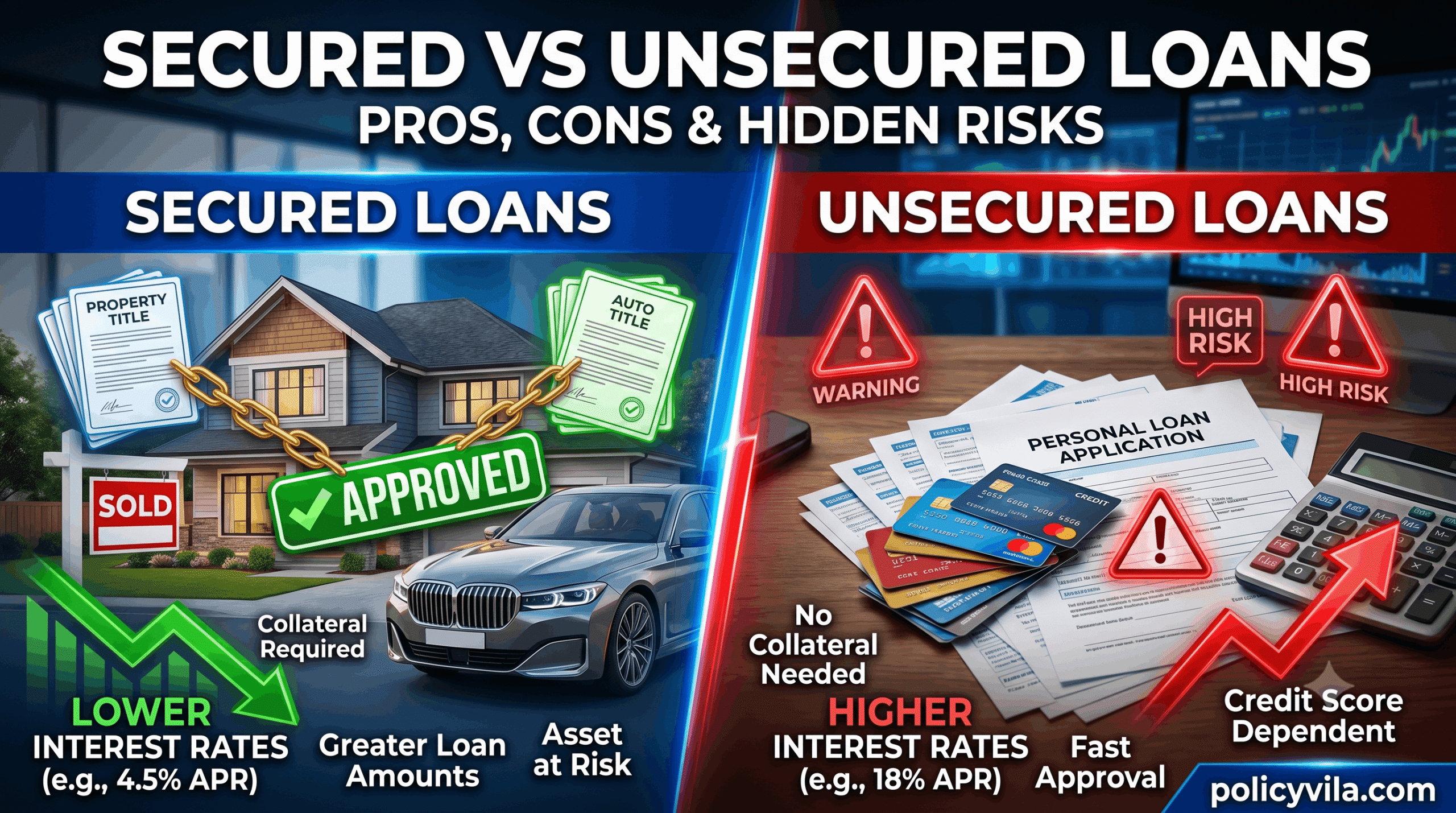
That trade-off — a lower rate against a real asset on the line — is the entire decision behind secured versus unsecured borrowing. This guide breaks down how each works, where the real risks sit, and how to figure out which one actually fits your situation rather than just your interest rate quote.
Quick Answer
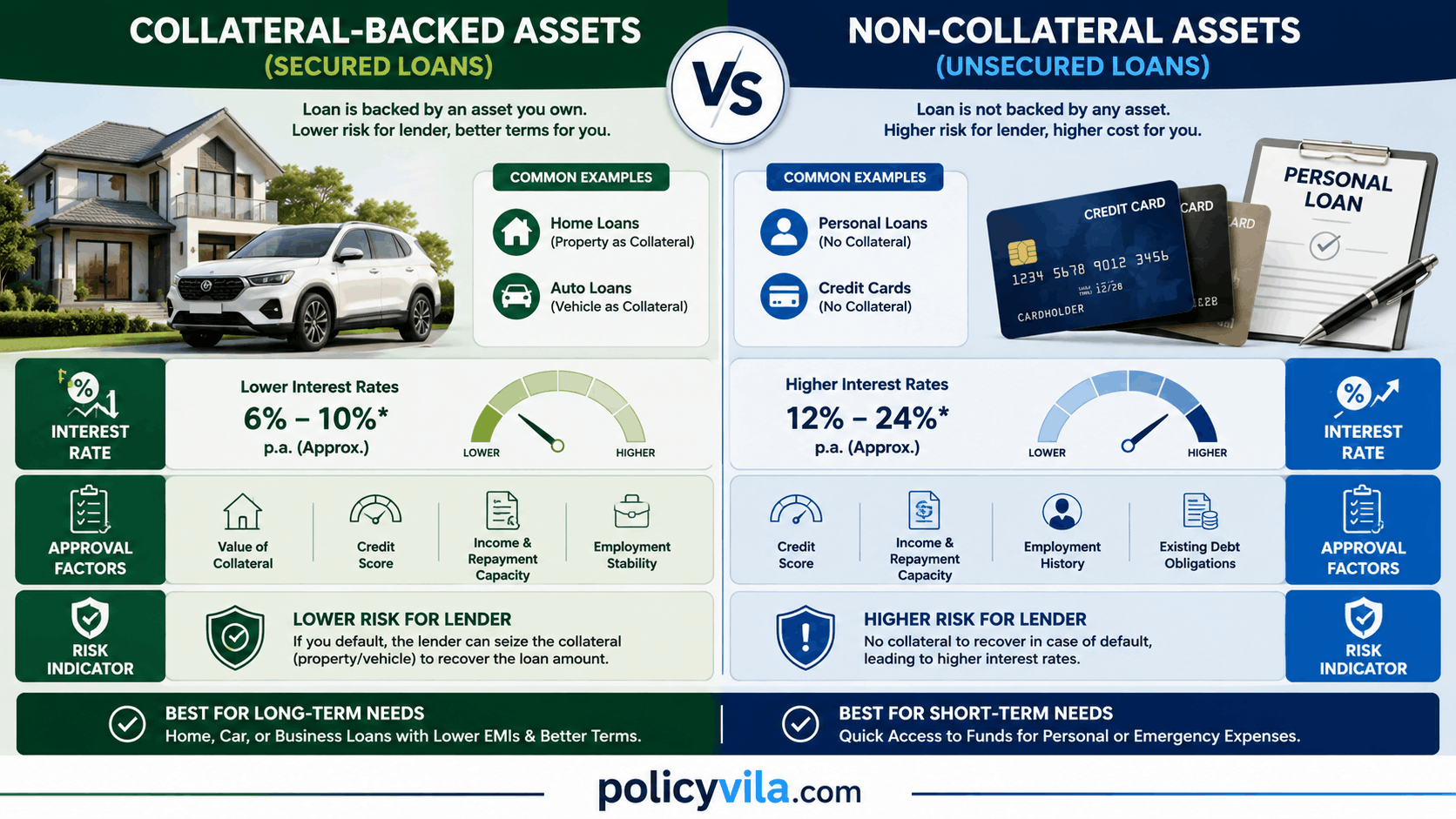
A secured loan is backed by collateral — a home, car, or savings account the lender can seize if you default. An unsecured loan relies only on your creditworthiness. Secured loans typically come with lower interest rates and higher borrowing limits, but put a specific asset at risk. Unsecured loans protect your property but usually cost more in interest and are harder to qualify for with weaker credit. Large, long-term purchases like a home or car generally call for secured financing; smaller, short-term needs like debt consolidation or emergency expenses often fit unsecured loans better.
What a Loan Actually Involves
A loan is money you borrow and agree to repay over time, usually with interest added as the lender’s compensation for taking on risk. Before approving one, lenders generally look at your credit score, income, employment history, existing debt, and payment track record — the stronger that profile, the better the terms you’re likely to see.
People borrow for a wide range of reasons: buying a home or car, covering a medical bill, funding a renovation, paying for school, or consolidating higher-interest debt into one payment. What separates a secured loan from an unsecured one isn’t the reason you’re borrowing — it’s whether you’re putting up an asset to get better terms.
What a Secured Loan Is
A secured loan is backed by collateral: an asset you pledge to the lender that they can seize and sell if you stop making payments. Because that collateral lowers the lender’s risk, secured loans usually come with better interest rates and higher borrowing limits than unsecured options.
Common Types
- Mortgages — the home itself is the collateral.
- Auto loans — the vehicle can be repossessed if payments stop.
- Home equity loans and HELOCs — borrowed against equity built up in your property.
- Secured personal loans — backed by savings accounts, certificates of deposit, or other assets some lenders will accept.
Here’s the mechanism in practice: a borrower takes out a $30,000 auto loan and later falls behind on payments. The lender can repossess and sell the vehicle to recover some or all of what’s owed. That fallback is exactly why secured loans tend to come with friendlier terms — the lender isn’t relying purely on your promise to pay.
What an Unsecured Loan Is
An unsecured loan requires no collateral. Instead, approval and pricing depend almost entirely on your credit score, income, debt-to-income ratio, and payment history. Because the lender has no asset to fall back on, unsecured loans generally carry higher interest rates than secured ones.
Common Types
- Personal loans
- Credit cards
- Most federal student loans
- Medical financing
- Many debt consolidation loans
You won’t lose a specific asset if you fall behind on an unsecured loan, but that doesn’t mean there’s no consequence. Missed payments still damage your credit score and can lead to collections or, eventually, a lawsuit and wage garnishment depending on your state and the lender’s approach.
Secured vs. Unsecured: Side-by-Side
| Feature | Secured Loans | Unsecured Loans |
|---|---|---|
| Collateral | Required | Not required |
| Typical interest rates | Lower | Higher |
| Approval flexibility | Often more flexible, thanks to collateral | More dependent on credit strength |
| Typical loan amounts | Higher | Lower |
| Repayment terms | Often longer | Usually shorter |
| Funding speed | Can take longer, due to appraisal or title checks | Often faster |
| Primary risk | Losing the pledged asset | Credit and collections damage |
| Best suited for | Large, planned purchases | Smaller or shorter-term needs |
Pros and Cons of Each
Secured Loan Advantages
- Lower interest rates. A secured loan might carry a 6–8% APR where a comparable unsecured personal loan runs 12% or higher — a gap that adds up to real money over several years.
- Higher borrowing limits. Home equity, in particular, can unlock financing well beyond what an unsecured loan would offer.
- More accessible for weaker credit. Collateral gives the lender a cushion, which can help borrowers with a thinner or bumpier credit history qualify.
- Longer repayment terms. Mortgages often run 15–30 years, auto loans 3–7 years, and home equity loans 5–20 years — all of which can lower the monthly payment, though at the cost of more total interest.

Secured Loan Risks
- Losing the asset. Missed payments can lead to foreclosure on a home or repossession of a vehicle.
- Higher lifetime interest. A longer term with a lower monthly payment can still mean paying more in total interest than a shorter, higher-payment loan.
- Temptation to over-borrow. Higher available limits can encourage borrowing more than you actually need.
Unsecured Loan Advantages
- No asset at risk. Your home, car, and savings stay out of the equation entirely.
- Faster approval. Without an appraisal or title check, many online lenders can approve and fund a loan within days.
- Flexible use. Funds can typically go toward almost anything — debt consolidation, medical bills, a wedding, home repairs.
Unsecured Loan Risks
- Higher cost. Interest rates run noticeably higher to compensate the lender for taking on more risk.
- Stricter qualification. Approval leans heavily on credit score and income, which can shut out borrowers with weaker credit.
- Lower limits. Without collateral backing the loan, amounts available are usually smaller.
How Credit Scores Affect Approval
Your credit score is one of the strongest signals lenders use to estimate how likely you are to repay. A higher score generally translates into better approval odds, lower interest rates, higher available loan amounts, and more lenders willing to compete for your business. A lower score tends to mean the opposite — higher rates, smaller amounts, more documentation, and a real chance of denial.
Collateral can partially offset a weaker score on a secured loan, since it gives the lender a fallback if you default. On unsecured loans, credit strength carries even more weight because there’s nothing else backing the lender’s decision.
Improving Your Approval Odds
- Pay bills on time — payment history is typically the single biggest factor in your score.
- Pay down existing balances to lower your credit utilization.
- Check your credit report for errors that could be dragging your score down unfairly.
- Keep income and employment stable in the months before applying.
- Avoid stacking multiple loan or credit card applications in a short window, since each one can cause a small, temporary dip.
Which Works Better for Debt Consolidation
Debt consolidation loans combine several balances — often high-interest credit cards — into a single monthly payment. Both loan types can work for this, and the better fit depends on what you’re trying to protect: your rate, or your assets.
Secured Consolidation
Using home equity or another asset as collateral can unlock a lower rate and a larger amount, which helps if you’re consolidating a significant balance. The trade-off is real: falling behind on this loan puts that asset at risk, and the repayment period is often longer, which can mean paying interest for years after the original debt would have been paid off unsecured.
Unsecured Consolidation
No collateral means no asset risk and typically a faster approval process, but you’ll likely pay a higher rate and may qualify for a smaller amount than a secured option would offer, particularly with average or below-average credit.
The right call usually comes down to how much you’re consolidating, how strong your credit is, and how comfortable you are risking an asset for a better rate. Whichever you choose, consolidation only solves the immediate math problem — it doesn’t fix the spending pattern that created the balances in the first place, so pairing it with a real budget matters more than the loan type itself.
How to Choose the Right Loan
1. Take Stock of Your Finances
Look honestly at your income, monthly expenses, existing debt, and emergency savings before deciding how much you can actually afford to repay.
2. Borrow Only What You Need
A larger loan means a larger obligation. Just because you qualify for more doesn’t mean you should take it.
3. Weigh Your Risk Tolerance Honestly
Ask yourself directly: are you comfortable putting your home, car, or savings on the line for a lower rate? If the honest answer is no, an unsecured loan may be worth the extra interest cost for the peace of mind.
4. Compare More Than One Lender
Rates, fees, and terms vary significantly between lenders for the same borrower profile. Get quotes from at least a few before committing to the first offer.
5. Read the Full Terms
Look past the headline rate to fees, penalties, payment schedule, and what happens if you default. This is where the real cost differences often hide.
6. Calculate Total Cost, Not Just Monthly Payment
A lower monthly payment stretched over a longer term can end up costing more overall than a higher payment on a shorter one. Run the total repayment math before deciding based on affordability alone.
Common Borrowing Mistakes
Comparing Interest Rate Instead of APR
The advertised rate doesn’t include fees. APR gives a fuller, more comparable picture across lenders.
Chasing the Lowest Monthly Payment
A smaller payment usually means a longer term and more interest paid over the life of the loan — sometimes by a wide margin.
Borrowing Without a Repayment Plan
Know exactly how you’ll make each payment before you accept the funds, not after the first bill arrives.
Skimming the Fine Print
Fees, penalties, and default terms are often buried several pages in. They matter as much as the rate on the front page.
Applying With Several Lenders at Once
Space out applications where possible; a cluster of hard inquiries in a short window can ding your score right when you need it strongest.
Borrowing for Non-Essential Spending
A loan is a tool for a genuine financial need or goal, not a way to fund discretionary purchases you’d otherwise skip.
Warning Signs of Predatory or Fraudulent Lending
Loan scams and predatory lending both prey on people who feel financial pressure. A few signs worth treating as hard stops:
- Guaranteed approval before any review of your finances
- Requests for upfront fees before funds are released
- Heavy pressure to sign immediately
- Claims of “no credit check” paired with unusually high rates
- Unprofessional or inconsistent contact, documentation, or website
- Contract language that’s deliberately vague about total cost or default terms
Legitimate lenders evaluate your financial profile before approving anything. If a lender skips that step entirely, treat it as a red flag rather than good luck.
Frequently Asked Questions
Can I refinance a secured loan into an unsecured one later, or vice versa?
In some cases, yes — for example, refinancing a secured personal loan into an unsecured one if your credit has improved enough to qualify for competitive unsecured rates. Availability depends on the lender and your current financial profile, so it’s worth asking directly rather than assuming either direction is automatic.
Does a secured loan hurt my credit more than an unsecured one if I default?
Both types report missed payments and default to credit bureaus similarly. The bigger practical difference is what happens afterward: a secured default can also mean losing the collateral, on top of the credit damage both loan types cause.
Is a HELOC the same as a home equity loan?
No. A home equity loan gives you a lump sum with a fixed repayment schedule, while a home equity line of credit (HELOC) works more like a credit card, letting you draw funds as needed up to a limit, often with a variable rate.
Can I use collateral I don’t fully own yet, like a car I’m still financing?
Generally no. Lenders typically require clear title or significant equity in the asset before accepting it as collateral for a new loan.
Will applying for both a secured and unsecured loan at the same time hurt my credit twice as much?
Each hard inquiry has its own small, temporary impact, so applying for both does cause more short-term dip than applying for one. Spacing applications out, or using lenders’ prequalification tools that rely on soft inquiries, can help you compare offers without that cost.
What happens to a secured loan if the collateral is destroyed, like a car in an accident?
You’re generally still responsible for the remaining loan balance even if the collateral is damaged or destroyed, which is why lenders often require insurance on financed vehicles and homes as a condition of the loan.
Are secured loans always cheaper in total, even with a longer term?
Not necessarily. A lower rate can still result in more total interest paid if the term is significantly longer than a comparable unsecured loan. Always compare total repayment cost, not just the rate, before assuming secured is automatically the cheaper choice.
Can a cosigner help me qualify for an unsecured loan instead of going the secured route?
Often, yes. A cosigner with strong credit can sometimes help you qualify for a better unsecured rate without putting up collateral, though the cosigner becomes equally responsible for the debt if you can’t pay.

read also: Homeowners Insurance vs Mortgage Insurance: The Difference That Could Save You Thousands
Final Thoughts
Neither loan type is universally better — the right one depends on what you’re financing, how confident you are in your ability to repay, and how much risk to a specific asset you’re willing to accept for a lower rate. Large, long-term purchases like a home or vehicle tend to favor secured financing almost by necessity, while smaller or shorter-term needs, and situations where you’d rather keep your assets entirely out of it, often point toward unsecured borrowing despite the higher cost.
Whichever direction fits your situation, the habits that matter most are the same either way: compare more than one lender, read past the headline rate to the fees and penalties, and calculate the total cost of the loan rather than judging it purely by the monthly payment.
3 thoughts on “Secured vs Unsecured Loans in 2026: Pros, Cons & Hidden Risks Every Borrower Should Know”