
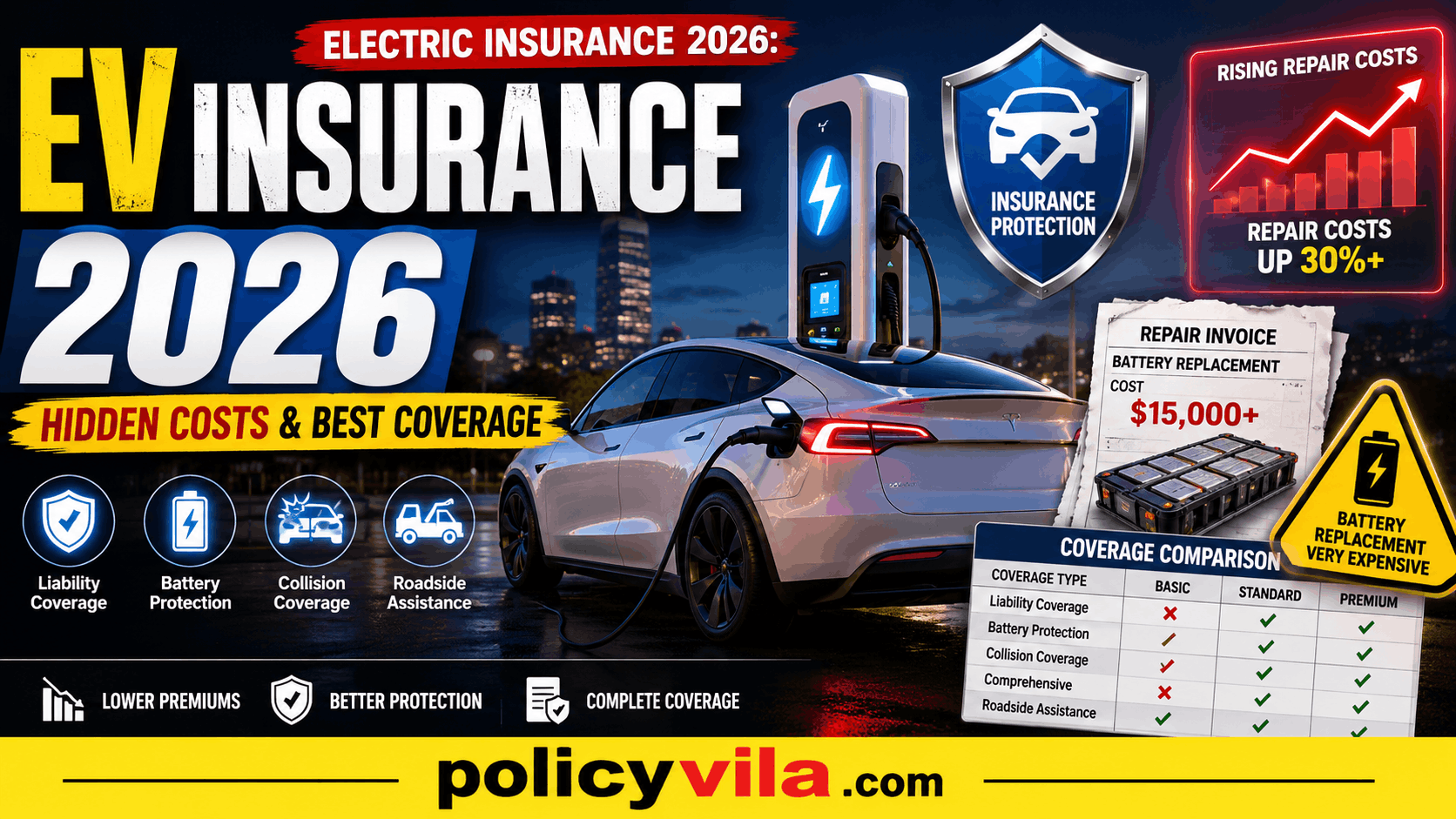
Electric vehicles genuinely do cost more to insure than comparable gas-powered cars, on average. That’s not a myth or an insurer overcharging EV drivers arbitrarily — it comes down to a few specific, well-documented cost drivers. Understanding what they are is what actually lets you do something about the premium, instead of just accepting whatever the first quote says.
Quick Answer: Is Electric Vehicle Insurance More Expensive?
Yes, on average. Industry rate data from sources including Insurify’s 2026 analysis puts full-coverage EV insurance at roughly $3,000 to $3,300 a year on average, compared to roughly $2,200 to $2,700 for gas-powered vehicles — commonly cited as somewhere in the range of 15% to 42% higher, depending on the dataset and how it’s measured. The gap is narrower for newer model years: several 2026 analyses put EVs built in 2024 or later at only about 18% more expensive to insure than comparable newer gas vehicles, as advanced safety technology becomes standard across both categories. Individual results vary enormously by specific model, location, and driver profile — a Chevrolet Silverado EV and a Tesla or luxury EV can differ by thousands of dollars a year.
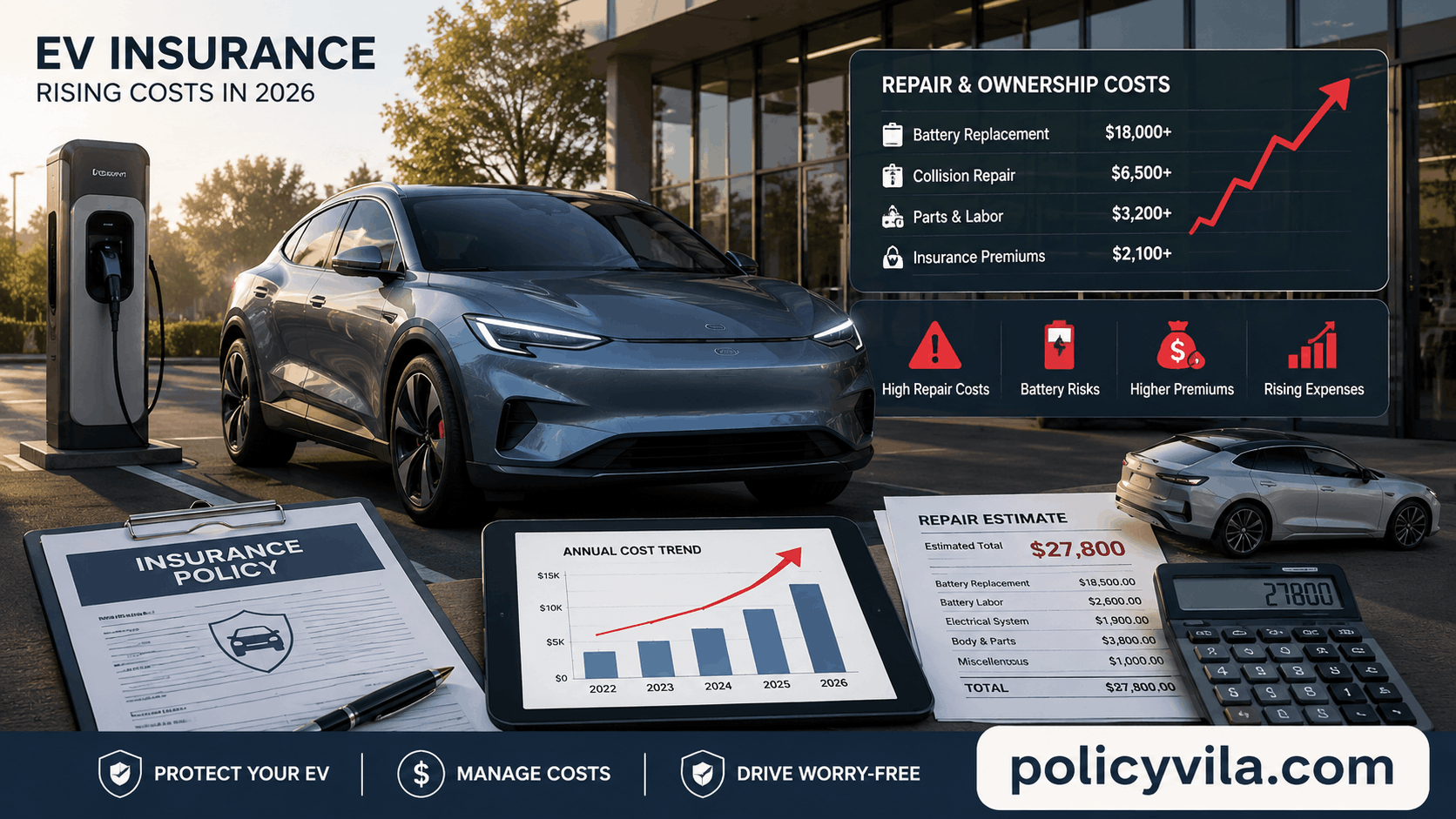
Table of Contents
- What Electric Vehicle Insurance Actually Is
- What EV Insurance Actually Costs (2026 Data)
- Why EVs Cost More to Insure
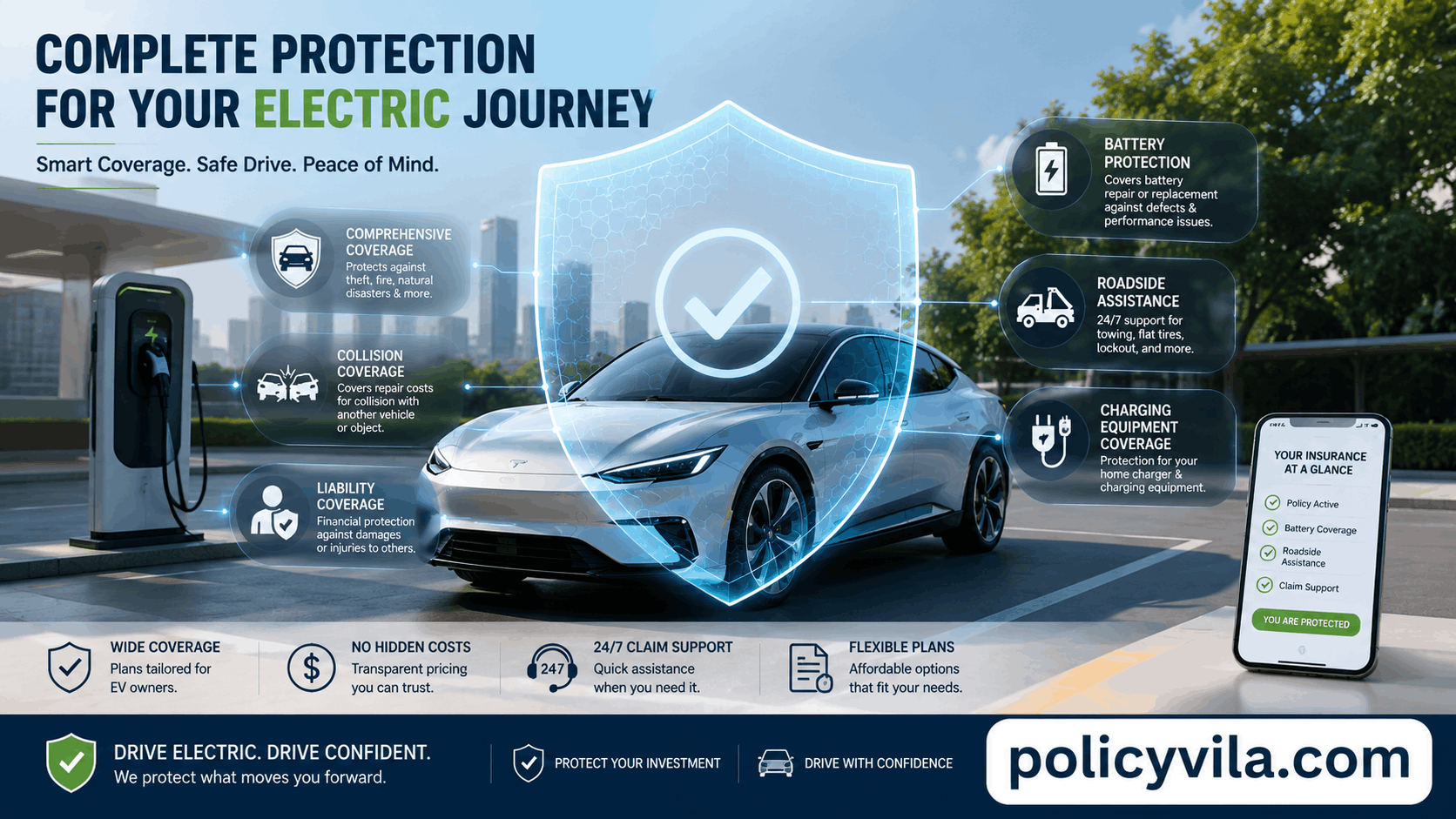
- Coverage Types That Matter Most for EVs
- What Affects Your Specific Rate
- How Insurance Costs Vary by Brand
- Home Charging Equipment and Insurance
- EV Insurance vs. Gas Vehicle Insurance
- Pros and Cons of EV Ownership Cost-Wise
- How to Actually Lower Your EV Premium
- How to Choose a Policy, Not Just a Price
- Common Mistakes EV Owners Make
- Checklist Before You Buy a Policy
- Frequently Asked Questions
What Electric Vehicle Insurance Actually Is
EV insurance isn’t a separate product category — it’s standard auto insurance applied to an electric vehicle. You don’t need a special “electric insurance” policy type; the same liability, collision, and comprehensive coverage structures that apply to gas vehicles apply to EVs. What changes is the underlying risk profile insurers are pricing: expensive high-voltage battery systems, specialized sensors and driver-assistance technology, software-dependent repairs, and a narrower network of certified repair shops in many regions.
What EV Insurance Actually Costs (2026 Data)
There’s no single “correct” average, since different data providers measure this differently — but multiple 2026 industry analyses converge on a similar general pattern.
| Source/Metric | EV Average (Full Coverage) | Gas Vehicle Average | Reported Gap |
|---|---|---|---|
| Insurify 2026 nationwide analysis | ~$3,159/year | ~$2,218/year | ~42% |
| Insurify, 2024+ model years only | Narrower gap | — | ~18% |
| MoneyGeek 2026 analysis | ~$3,281/year | ~$2,956/year (hybrid) | ~11% |
These figures are industry-wide averages pulled from rate-comparison data, not a personalized quote — treat them as a general planning range rather than an exact number for your specific vehicle. The spread across individual EV models is enormous: reporting cited a Chevrolet Silverado EV around $1,947 a year for full coverage — actually below the average gas vehicle — while premium EVs like the Audi e-tron lineup and various Tesla models were reported well above $2,800, with some luxury trims exceeding $10,000 annually. The vehicle you choose matters as much as the fact that it’s electric.
Why EVs Cost More to Insure
Several concrete, well-documented factors explain the gap rather than insurers simply charging more for anything labeled “electric.”
Expensive battery systems
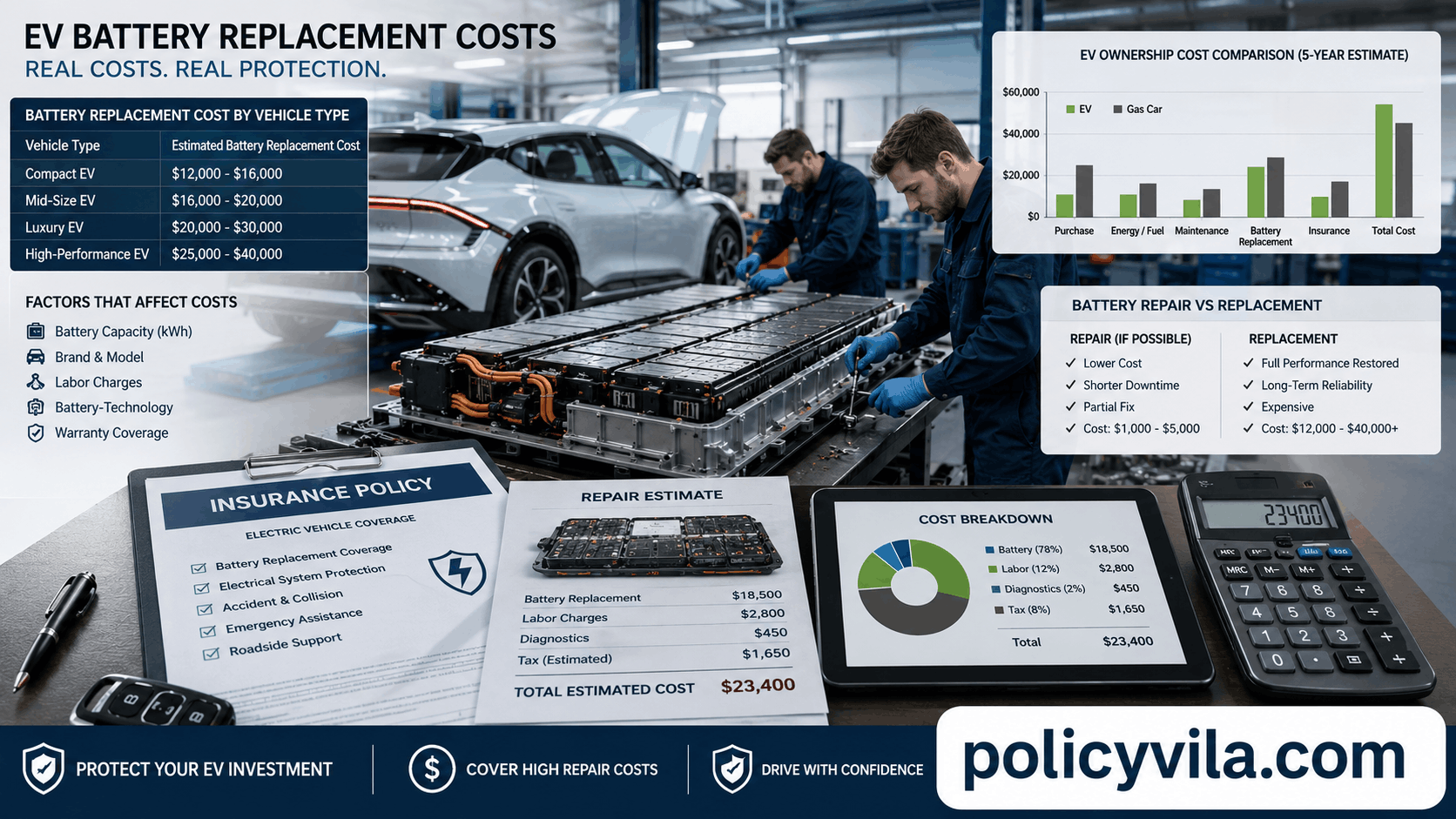
The high-voltage battery pack is typically the single most expensive component of an EV, and reported replacement costs for some models run into the tens of thousands of dollars. Because of this, insurers sometimes total a vehicle after battery-related damage rather than attempt a repair — even in cases where a comparable gas vehicle might be repairable, which raises the total-loss frequency insurers price around.
Specialized repairs and limited shop networks
Not every mechanic is certified to work on EVs. Many repairs require manufacturer-approved equipment, specialized training, and advanced diagnostics — and in many regions, the number of certified EV repair facilities remains limited relative to demand. Fewer shops competing for the work tends to mean higher labor costs and longer repair timelines, both of which factor into claim costs.
Advanced technology components
Cameras, radar, sensors, and driver-assistance systems improve safety, but they’re also expensive to replace and recalibrate — sometimes even after a relatively minor collision. A fender-bender that would be a simple bumper repair on an older gas vehicle can trigger sensor recalibration costs on an EV.
Higher replacement values
EVs generally carry higher purchase prices than comparable gas vehicles. Since comprehensive and collision coverage scale with a vehicle’s value, a higher sticker price directly translates to higher potential claim payouts — and higher premiums to match.
Notably, the gap between EV and gas insurance costs has been narrowing for newer vehicles specifically, since advanced driver-assistance features that once set EVs apart are now increasingly standard on new gas-powered cars too — meaning gas vehicles are catching up on repair complexity even as EVs remain somewhat pricier overall.
Coverage Types That Matter Most for EVs
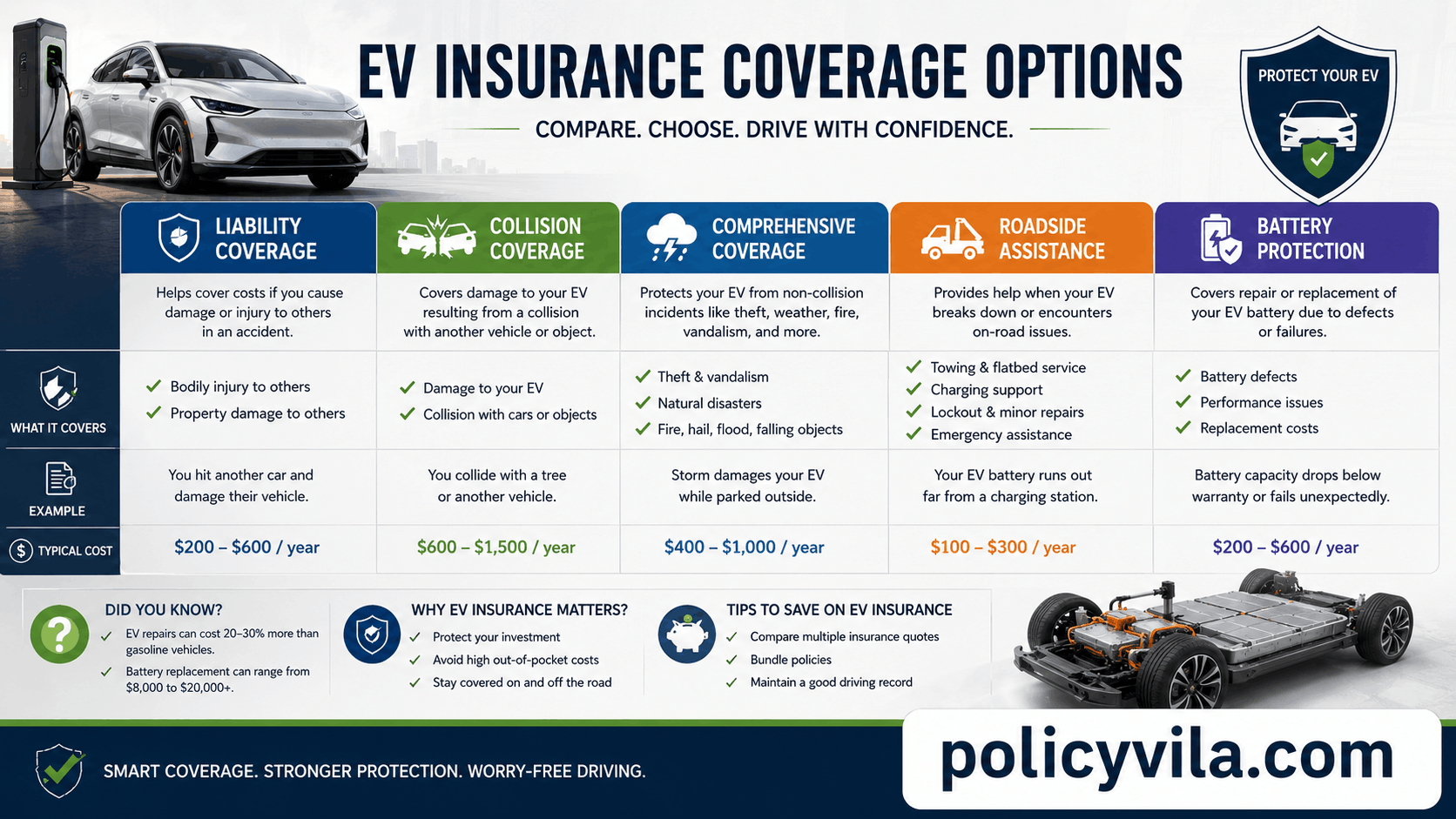
| Coverage | What It Generally Covers | EV-Specific Consideration |
|---|---|---|
| Liability | Injury or property damage you cause to others; required in most states | Standard requirement, same as gas vehicles |
| Collision | Damage to your vehicle from an accident | Battery and sensor damage can make claims more expensive |
| Comprehensive | Non-collision losses — theft, fire, vandalism, weather, falling objects | Relevant for battery-related non-collision damage, like flood exposure |
| Uninsured/underinsured motorist | Protection when another driver lacks adequate coverage | Especially relevant given higher EV replacement values |
| Medical payments | Healthcare costs after an accident, regardless of fault | No EV-specific difference |
| Roadside assistance | Towing, lockout help, and similar support | Some EV-specific plans include charging-related assistance |
| Rental reimbursement | Temporary transportation while your vehicle is repaired | Worth confirming given potentially longer EV repair timelines |
Ask specifically how your insurer handles battery damage, degradation claims, and whether charging equipment is covered under your auto policy, your homeowners policy, or neither — this varies by insurer and is one of the more commonly overlooked gaps.
[Relevant image: electric vehicle insurance coverage comparison showing liability, collision, comprehensive, and battery protection]
What Affects Your Specific Rate
- Vehicle make and model — luxury and high-performance EVs with expensive replacement parts cost meaningfully more to insure than budget-friendly models.
- Driving history — a clean record with no accidents or violations remains one of the strongest factors in any auto insurance quote, EV or otherwise.
- Location — traffic density, theft rates, weather risk, and local EV repair shop availability all factor into regional pricing differences.
- Annual mileage — lower mileage generally reduces accident exposure and can qualify for discounts.
- Credit-based insurance score — used by many insurers in states where it’s permitted; a stronger profile can support lower rates.
- Coverage limits and deductible — higher liability limits increase protection and premium; a higher deductible can lower the premium but increases out-of-pocket exposure per claim.
- Safety features — automatic emergency braking, lane-keeping assistance, and collision-avoidance systems may support discounts with some insurers.
How Insurance Costs Vary by Brand
Costs differ significantly across EV manufacturers, largely tracking the same underlying factors — repair network availability, parts cost, and vehicle value.
| Brand | General Cost Pattern | Why |
|---|---|---|
| Tesla | Often above average | Proprietary parts and technology, certified-repair requirements |
| Rivian | Can run higher, especially in newer markets | Relatively limited repair network given the brand’s newer entry into the market |
| Lucid | Generally on the higher end | Premium positioning and advanced technology |
| Ford EV models | Often more moderate | Larger, more established repair network and parts availability |
| Hyundai / Kia EV models | Often competitive | Strong value positioning relative to premium brands |
| Chevrolet (select models) | Can be below the EV average | Lower vehicle value and more mainstream parts availability |
This is a general pattern, not a guarantee for any specific policy — actual quotes depend heavily on your individual driver profile and location. Reported data shows some Tesla and luxury EV models running well above $2,800 to $10,000+ a year for full coverage, while more mainstream models from other brands land closer to, or even below, typical gas-vehicle premiums.
Home Charging Equipment and Insurance
Home charging is convenient, but it introduces a coverage question many EV owners never think to ask: is my charging equipment actually covered?
- Charging equipment damage — a home charging station can represent a meaningful investment, and coverage for damage to it varies considerably between insurers and policy types. It’s not automatically covered by either your auto or home policy — confirm which one, if either, actually applies.
- Electrical system considerations — installing a home charger may require electrical panel or wiring upgrades. Improper installation can create fire risk and, separately, insurance complications if damage is later traced to faulty work.
- Homeowners insurance interactions — don’t assume your home policy automatically extends to charging equipment; review both your auto and homeowners policies to see where the actual coverage lives, if anywhere.
- Liability considerations — if a visitor is injured using your charging equipment, liability coverage may become relevant depending on the circumstances.
Reducing these risks generally comes down to basics: hire a licensed electrician for installation, follow the manufacturer’s installation guidance, and have the setup inspected periodically rather than assuming it’s fine indefinitely.
EV Insurance vs. Gas Vehicle Insurance
| Factor | Electric Vehicles | Traditional Vehicles |
|---|---|---|
| Premium costs | Often higher | Often lower |
| Repair costs | Often higher | Often lower |
| Parts availability | More limited, improving over time | Widely available |
| Claim complexity | Often higher, especially battery-related | Typically more straightforward |
| Maintenance costs (outside insurance) | Generally lower | Generally higher |
EV ownership can still produce real savings overall through reduced fuel and maintenance costs — but insurance is one line item that tends to move in the opposite direction, and it’s worth factoring into a full cost-of-ownership comparison rather than assuming lower running costs automatically offset everything.
Pros and Cons of EV Ownership, Cost-Wise
| Pros | Cons / Limitations |
|---|---|
| Generally lower fuel and routine maintenance costs | Generally higher insurance premiums than a comparable gas vehicle |
| Advanced safety technology can reduce accident frequency | That same technology is expensive to repair or recalibrate after a claim |
| The insurance cost gap is narrowing for newer model years | Battery-related claims can be severe and sometimes result in a total loss |
| Some insurers offer EV-specific discounts or programs | Repair network limitations can mean longer claim timelines in some areas |
How to Actually Lower Your EV Premium
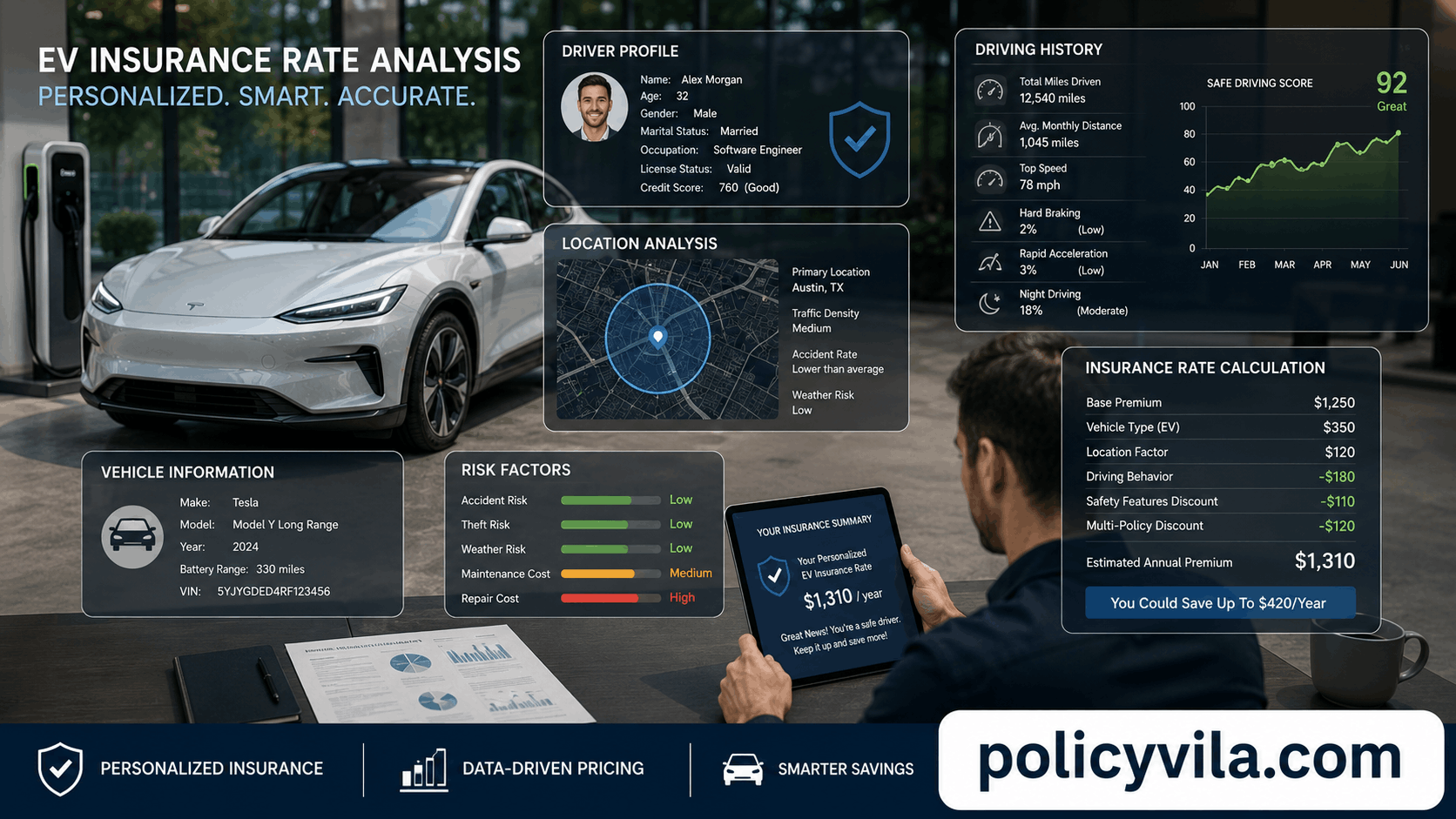
Compare multiple insurers directly
Because EV pricing varies more between insurers than gas-vehicle pricing typically does, shopping around tends to matter more, not less, for electric vehicles specifically.
Raise your deductible thoughtfully
A higher deductible can meaningfully lower your premium, but only make this trade if you could comfortably pay that deductible out of pocket after a real claim.
Bundle policies where it makes sense
Combining auto insurance with home, renters, or umbrella coverage through the same insurer often unlocks a multi-policy discount.
Ask about usage-based or telematics programs
Programs that track driving behavior can reward consistently safe driving with additional savings, though participation and privacy trade-offs are worth weighing individually.
Maintain a strong credit profile where applicable
In states that permit credit-based insurance scoring, a stronger credit profile can support a lower rate.
Ask specifically about EV-related discounts
Some insurers offer discounts tied to EV ownership or specific safety features — these aren’t always advertised prominently, so ask directly.
Review your coverage annually
Vehicle values, your driving patterns, and insurer pricing all shift over time — an annual review can catch savings opportunities that weren’t available when you first bought the policy.
How to Choose a Policy, Not Just a Price
- Know your EV’s current market value — higher-value vehicles generally warrant closer attention to coverage limits.
- Ask specifically how battery damage and degradation claims are handled — this is one of the most consequential coverage details for any EV owner.
- Get quotes from multiple insurers — the spread between companies tends to be wider for EVs than for gas vehicles.
- Read the exclusions — particularly around charging equipment, software-related issues, and specialized repair scenarios.
- Check the insurer’s EV repair network — a strong network can mean a smoother, faster claims experience.
- Look at total cost, not just the premium — deductibles, coverage limits, and realistic out-of-pocket exposure matter as much as the monthly number.
Common Mistakes EV Owners Make
Choosing coverage based only on price
Fix: The cheapest policy can leave meaningful coverage gaps for an expensive vehicle — compare protection alongside price.
Underinsuring an expensive vehicle
Fix: Minimum coverage requirements may not adequately protect a high-value EV; size your coverage to the vehicle’s actual worth.
Not understanding how battery claims are handled
Fix: Ask your insurer directly, in plain terms, how battery damage and degradation are treated before you need to file a claim.
Skipping available discounts
Fix: Ask specifically about safe-driving, multi-policy, safety-feature, and paperless billing discounts — many aren’t applied automatically.
Never reading the exclusions
Fix: Understanding what isn’t covered matters just as much as understanding what is.
Accepting the first quote
Fix: Given how much EV insurance pricing varies between insurers, skipping comparison shopping is one of the more expensive mistakes an EV owner can make.
Checklist Before You Buy a Policy
- Get quotes from at least three insurers
- Ask each insurer specifically how battery damage and degradation are handled
- Confirm whether charging equipment is covered, and by which policy
- Compare deductibles against your actual emergency savings
- Ask about EV-specific, safety-feature, and multi-policy discounts
- Check the insurer’s EV repair network in your area
- Read the policy’s exclusions in full before signing
- Revisit your coverage annually as your vehicle’s value and your circumstances change
Frequently Asked Questions
Do I need a special type of insurance for an electric vehicle?
No — EVs use the same auto insurance policy types as gas vehicles (liability, collision, comprehensive, and so on). What changes is the pricing, based on the vehicle’s specific risk profile, not the category of insurance itself.
How much more does EV insurance typically cost?
Industry data from 2026 generally puts EVs somewhere between roughly 15% and 42% more expensive to insure than comparable gas vehicles, depending on the dataset and vehicle age — with newer EV model years showing a narrower gap, closer to 18%, than older ones.
Does insurance cover EV battery replacement?
It can, if the damage results from a covered event like an accident, theft, or a covered weather event, subject to your policy’s terms. Normal battery degradation from age and use generally isn’t a covered loss — review your specific policy language rather than assuming either way.
Are Teslas more expensive to insure than other EVs?
Often, yes — reported data has consistently placed Tesla models above average for EV insurance, largely due to proprietary parts, specialized repair requirements, and vehicle value. Actual cost still depends heavily on the specific model, your location, and your driver profile.
Is the EV insurance cost gap closing over time?
There’s evidence it is, at least for newer vehicles. Multiple 2026 analyses show a narrower cost gap for 2024-and-newer model years compared to older EVs, largely because advanced safety technology is becoming standard on new gas vehicles too, not just EVs.
Does my home insurance automatically cover my EV charger?
Not automatically — coverage for home charging equipment varies by insurer and policy type. Confirm directly with both your auto and homeowners insurers which one, if either, covers your specific charging setup.
Is a used EV cheaper to insure than a new one?
Generally, yes, since insurance for collision and comprehensive coverage scales with a vehicle’s value, and used EVs typically carry a lower replacement value than new ones. Confirm with an actual quote rather than assuming, since repair-cost factors can still apply regardless of age.
Do all insurers offer EV-specific discounts?
No — availability varies significantly by insurer and isn’t always advertised prominently. Ask directly whether EV-specific programs, telematics discounts, or safety-feature credits are available before assuming a quote reflects every possible discount.
Final Thoughts
Higher insurance costs are a real part of EV ownership, not a myth or a pricing quirk — battery replacement costs, specialized repair requirements, and higher vehicle values all genuinely push premiums above what a comparable gas vehicle would cost. But “higher on average” isn’t the same as “high for every driver and every model” — the spread between the cheapest and most expensive EVs to insure is enormous, and the spread between insurers quoting the same vehicle can be just as wide.
The practical takeaway is straightforward: shop multiple insurers specifically for your vehicle, understand exactly how your policy treats battery damage, and factor the real insurance cost into your EV budget from the start rather than discovering it after the purchase is already made.
2 thoughts on “Electric Insurance in 2026: Hidden Costs, Coverage Secrets & How to Save Hundreds”