

Most people track their income closely — raises, bonuses, a good month in the business — but pay far less attention to what happens to that money afterward. That second half of the equation is usually the one that actually determines whether your finances are getting stronger or weaker.
Quick Answer: What Is Cash Flow?
Cash flow is the difference between the money coming into your household and the money going out over a set period. Positive cash flow means income exceeds expenses, leaving money for savings, debt repayment, or investing. Negative cash flow means expenses exceed income, which typically means relying on savings or credit to cover the gap. The Consumer Financial Protection Bureau’s Your Money, Your Goals toolkit devotes an entire module to building a cash flow budget specifically because tracking this — not just tracking income — is what reveals whether a household’s finances are actually stable.
Table of Contents
- Why Income Alone Is Misleading
- A Simple Comparison: Two Households
- Lifestyle Inflation: Where Raises Quietly Disappear
- How to Do Your Own Cash Flow Audit
- The 50/30/20 Framework
- Your Personal Cash Flow Worksheet
- Warning Signs Your Cash Flow Isn’t Healthy
- Positive vs. Negative Cash Flow
- Common Money Leaks
- Habits That Support Positive Cash Flow
- Why Positive Cash Flow Matters
- Common Cash Flow Myths
- Mistakes People Make When Managing Cash Flow
- Monthly Cash Flow Checklist
- Frequently Asked Questions
Why Income Alone Is Misleading
A high salary and financial stability aren’t the same thing. Plenty of people receive raises and promotions year after year and still live paycheck to paycheck, because their spending rises in step with their income. Meanwhile, someone earning considerably less can build real savings and investments simply by consistently spending less than they bring in.
Part of the reason is that income is easy to see — job titles, salaries, cars, homes — while the underlying numbers are invisible. Credit card balances, loan payments, and thin savings accounts don’t show up in casual conversation or on social media, which can make a financially stretched household look successful from the outside.
A Simple Comparison: Two Households
| Household A | Household B | |
|---|---|---|
| Monthly income | $9,000 | $4,800 |
| Monthly expenses | $9,400 | $3,900 |
| Monthly cash flow | –$400 | +$900 |
Household A earns nearly twice as much, but spends more than it takes in every month, which means relying on savings or credit to cover the gap. Household B earns much less but consistently keeps $900 for savings, debt repayment, or investing. On income alone, Household A looks stronger. On cash flow — which is the number that actually predicts financial trouble or stability — Household B is in a much better position.
Lifestyle Inflation: Where Raises Quietly Disappear
Lifestyle inflation happens when spending rises to match every increase in income — a bigger house after a promotion, a nicer car lease, more frequent takeout and travel. None of these decisions look reckless individually. Together, they can absorb every extra dollar a raise provided, leaving cash flow exactly where it started despite the higher salary.
The more useful question after a pay increase isn’t “what can I now afford?” but “how much of this can I direct toward savings, debt, or investing before my spending has a chance to catch up?” Automating that redirection — even a portion of a raise — is one of the more reliable ways to prevent lifestyle inflation from erasing the benefit of earning more.
How to Do Your Own Cash Flow Audit
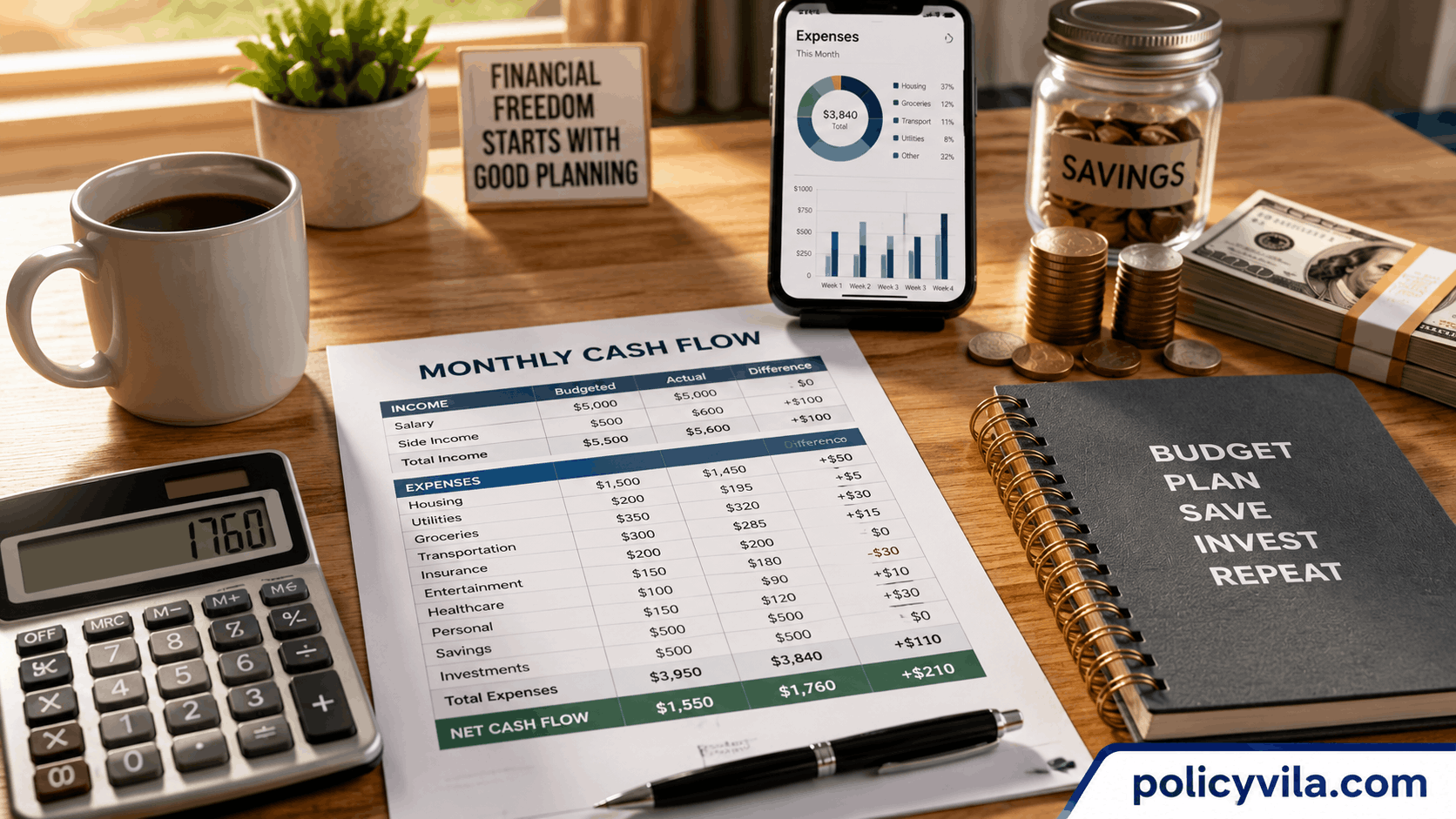
A cash flow audit doesn’t require accounting software or specialized knowledge — just an honest look at where money actually goes each month. The CFPB’s cash flow budgeting tool follows a similar structure: total up income, then account for every category of spending, rather than estimating a single “spending” number.
Step 1: Add up your monthly income
Include salary or wages, freelance income, business profit, rental income, side income, and any other regular inflow.
Step 2: List your fixed expenses
Rent or mortgage, insurance premiums, car payments, phone and internet bills, childcare, loan payments, and subscriptions — the costs that stay roughly the same each month.
Step 3: Track lifestyle spending
Groceries, dining out, entertainment, shopping, fuel, hobbies, and other spending that varies month to month. This category is usually where money quietly disappears without anyone noticing.
Step 4: Total your debt payments
Credit cards, personal loans, student loans, medical debt, and any buy-now-pay-later obligations.
Step 5: Record what you actually save
Not what’s left over — what you intentionally set aside for an emergency fund, a specific goal, or retirement.
Step 6: Record your investments
Retirement account contributions, index funds, or other money directed toward long-term growth.
The 50/30/20 Framework
If you want a starting structure rather than building categories from scratch, the CFPB suggests a flexible budgeting approach sometimes called the 50/30/20 rule: roughly 50% of income toward needs, 30% toward wants, and 20% toward savings and debt repayment. It’s a rough guideline, not a strict formula — the right split depends on your cost of living, obligations, and goals — but it’s a reasonable starting point if you’re not sure where to begin allocating your own numbers.
Your Personal Cash Flow Worksheet
| Category | Monthly Amount |
|---|---|
| Total income | |
| Fixed expenses | |
| Lifestyle expenses | |
| Debt payments | |
| Savings | |
| Investments | |
| Money remaining (cash flow) |
A positive number means you’re creating flexibility — room for emergencies, more aggressive saving, or investing. A number close to zero means you’re stable for now but have little room for the unexpected. A negative number is a signal worth addressing before it compounds into growing debt.

Warning Signs Your Cash Flow Isn’t Healthy
Financial trouble rarely appears overnight — it usually builds gradually through small, easy-to-overlook patterns.
| Warning Sign | Why It Matters |
|---|---|
| Savings balance keeps shrinking | Savings are being used for routine bills instead of emergencies or goals |
| Credit card balance keeps growing | Spending is regularly exceeding income, with interest making it worse over time |
| Living paycheck to paycheck | Little room to absorb a delayed paycheck or unexpected cost |
| Bonuses or refunds always go to catching up | Regular income may not actually be covering your regular lifestyle |
| No emergency fund | A single unexpected expense could force new debt |
| Spending rises after every raise | A classic sign of lifestyle inflation quietly erasing income gains |
| Only making minimum debt payments | Balances stay roughly flat while interest keeps accumulating |
Noticing one of these on its own isn’t necessarily a crisis — but two or three appearing together is a reasonable signal to sit down and actually run the numbers.
Positive vs. Negative Cash Flow
| Financial Area | Positive Cash Flow | Negative Cash Flow |
|---|---|---|
| Income vs. expenses | Income exceeds expenses | Expenses exceed income |
| Savings | Grow over time | Decline or stay depleted |
| Emergency readiness | Better prepared | More financially vulnerable |
| Investing | Possible on a regular basis | Often delayed indefinitely |
| Debt | Easier to pay down | Tends to increase |
| Flexibility | Higher — more options available | Lower — fewer choices in a crisis |
Common Money Leaks Worth Checking
Not every cash flow problem comes from one big expense. Small, recurring costs often do more damage over a year than a single large purchase:
- Frequent food delivery instead of cooking at home
- Unused subscriptions or gym memberships still being charged
- Paying only the minimum on high-interest debt
- Forgotten automatic renewals
- Bank fees or late-payment penalties
- Financing smaller purchases that could have been saved for instead
None of these need to be eliminated entirely — the goal is simply noticing which ones are happening on autopilot versus which ones you’d actually choose if you thought about it.
read also: Cheapest Cars to Insure for New Drivers: Lower-Risk Vehicles That Can Help Control Costs
Habits That Support Positive Cash Flow
- Pay yourself first — move savings out before spending has a chance to absorb it
- Automate savings and debt payments — removes the decision from every single month
- Review subscriptions periodically — quarterly is often enough to catch what’s no longer worth paying for
- Direct part of every raise to savings or debt — before your lifestyle has a chance to expand around it
- Compare recurring bills annually — insurance, phone, and internet plans often have cheaper options after the first year
- Track spending for at least a few weeks — most people underestimate small, frequent purchases until they actually add them up
- Review your numbers monthly — a short, regular check-in catches problems earlier than an annual deep dive
Why Positive Cash Flow Matters
Positive cash flow doesn’t automatically mean wealth — it means options. With consistent money left over each month, you’re in a position to build an emergency fund, invest regularly, pay down debt faster, and handle an unexpected expense without immediately reaching for a credit card. It also affects decisions that have nothing to do with spreadsheets: taking a career risk, negotiating from a position of stability, or simply sleeping better because a surprise bill wouldn’t derail everything else.
Negative cash flow works in the opposite direction. Instead of planning ahead, you’re managing today’s expenses reactively, savings erode, and even a modest emergency can escalate into new debt. The earlier this pattern is identified, the easier it is to correct before it compounds.
Common Cash Flow Myths
| Myth | Reality |
|---|---|
| “I earn enough, so I don’t need to track this.” | Income alone doesn’t guarantee stability — spending habits matter just as much |
| “I’ll start saving once I earn more.” | Without a plan, spending tends to rise with income, and the “later” habit rarely starts on its own |
| “A bonus or tax refund will fix things.” | One-time income doesn’t solve an ongoing pattern of spending more than you earn |
| “A little debt isn’t a big deal.” | Every debt payment reduces future cash flow through both principal and interest |
| “Investing can wait until things settle down.” | Time in the market is a real advantage that waiting quietly gives up |
Mistakes People Make When Managing Cash Flow
Tracking income but not spending
Fix: Run a full audit periodically — income tells only half the story.
Treating “what’s left over” as savings
Fix: Set a specific savings amount and move it out before spending, rather than hoping something remains at month’s end.
Letting every raise become new spending
Fix: Decide in advance what portion of any increase goes to savings, debt, or investing before it hits your account.
Ignoring small recurring charges
Fix: Review subscriptions and recurring bills every few months — they’re easy to forget and easy to cancel.
Only checking your bank balance, not your cash flow
Fix: A balance shows where you are today; cash flow shows the trend — both matter, but only one predicts the future.

Monthly Cash Flow Checklist
- Income stayed stable or grew this month
- Spent less than I earned
- Saved a specific, intentional amount
- Invested consistently, if applicable
- Made progress on debt, not just minimum payments
- Reviewed subscriptions and recurring charges
- Avoided unplanned or impulse purchases
- Emergency fund grew or stayed intact
[Relevant image: monthly budget worksheet with income, expenses, and savings categories filled in]
Frequently Asked Questions
Why is cash flow more important than salary?
Salary tells you what comes in; cash flow tells you what actually stays. A high income with spending that rises just as fast produces the same financial pressure as a modest income — cash flow is the number that reflects your actual trajectory.
How often should I review my cash flow?
Monthly is a practical baseline for most people — frequent enough to catch a developing pattern, infrequent enough that it doesn’t become a source of anxiety.
What typically causes negative cash flow?
Common causes include spending that’s grown alongside income, high-interest debt payments, inconsistent income without a buffer, and unplanned or emergency expenses without savings to absorb them.
Can someone with a modest income still have positive cash flow?
Yes — cash flow depends on the relationship between income and spending, not the size of the income alone. Consistently spending less than you earn matters more than the absolute number on your paycheck.
Should I focus on savings or debt repayment first?
Many people benefit from building a small starter emergency fund while also paying down high-interest debt, rather than choosing one exclusively. The right balance depends on your interest rates, income stability, and comfort with risk — a financial professional can help weigh this for your specific situation.
Does cash flow still matter after retirement?
Yes. In retirement, cash flow shifts from earned income to withdrawals, pensions, and Social Security versus ongoing expenses — managing that balance carefully affects how long savings actually last.
What’s the fastest way to improve cash flow?
Start by tracking actual spending for a few weeks to see where money is really going, then address the largest, most avoidable leaks first — recurring subscriptions, high-interest debt, and spending that’s crept up without a clear decision behind it.
Is the 50/30/20 rule the right budget for everyone?
It’s a reasonable starting framework, not a mandatory formula. Higher cost-of-living areas, irregular income, or significant debt can all justify a different split — treat it as a starting point to adjust from, not a rule to force your numbers into.

Final Thoughts
Cash flow isn’t an abstract financial term — it’s a direct reflection of daily habits, spending decisions, and priorities. The number that matters most isn’t how much you earn; it’s how much stays with you after everything else is paid, and what you do with it.
Improving cash flow doesn’t require a perfect income or an elaborate financial plan. Tracking where money actually goes, catching lifestyle inflation before it absorbs a raise, automating savings, and reviewing the numbers on a regular basis are ordinary habits that, practiced consistently, add up to real financial stability over time.